THE POTABLE CURMUDGEON: Hip Hops ... A look at two new New Albany breweries.
A weekly column by Roger A. Baylor.
I'm always an issue behind when it comes to reprinting my columns from Food & Dining Magazine. This one is from Spring 2016; Vol. 51 (February/March/April).
---
HIP HOPS: A LOOK AT TWO NEW NEW ALBANY BREWERIES
In 1906, thirsty residents of New Albany had the choice of three local breweries to visit when it came time to refill pails gone dry.
Paul Reising’s plant was the granddaddy of them all, taking up a whole West End city block, where Bavarian-style beers had been brewed on-site since just after the Civil War.
A half-mile away, Virt Nirmaier crafted a well-regarded “common” beer at his brewery on State Street, the western route out of New Albany, up Buffalo Trace and through the Knobs. Nirmaier’s Common sold to taverns for $1.25 a keg or $5.00 a barrel. His charge for smaller quantities is unknown.
Near the present-day high school on Vincennes Street, the Nadorffs brewed beer and cut ice in winter from a pond on their property. In 1907, the family stopped brewing and opened a wholesale beer distributorship, which survives to the present day.
Soon the scourge of Prohibition descended, ending the first great era of American brewing, but in truth, our failed national temperance experiment merely hastened the passage from independent local brewing to larger economies of scale regionally and nationally.
Pendulums have a fortunate way of swinging back, and brewing returned to New Albany in 2002, when the New Albanian Brewing Company first mashed in.
Then, in 2015, there was an abrupt tripling of numbers: Donum Dei Brewery and Floyd County Brewing Company (FCBC) both opened, and while it may seem novel for such a small city to have so many breweries, this pattern is being repeated all across the country.
Late last year, the Brewers Association reported the existence of 4,000 breweries in America — more than in 1906, and in fact, the most ever at any point in the nation’s history.
New Albany’s two newest breweries typify this upward arc. They’re independent, small and family owned. You can have a pint, grab a bite and take beer to go. Donum Dei is on the north side, down the road from Indiana University Southeast, and FCBC lies a short caber toss from the downtown YMCA.
Let’s take a look at these two local brewing start-ups.
A “Gift of God”
Rick Otey is a 50-something electronics engineer who didn’t like the taste of beer until work took him to Seattle during the 1990s. There Otey enjoyed a transformative encounter with Red Hook Extra Special Bitter (ESB), inspiring him to brew at home and seek craft beers on his own turf.
Facing a career juncture in 2014, Otey and wife Kimberly decided to redirect a portion of their retirement portfolio toward greater liquidity, and Donum Dei Brewery is the fruit of their investment.
By personal disposition and designer, the brewpub’s ethos is thoughtful and unhurried. “It’s not so much what we do, as what we don’t do,” Otey explains. “There’s no rush. Beer is a living thing, and we wait until it’s ready.”
This mantra extends to the compact, café-style food menu, with appetizers, soup and paninis: “It’s as simple and local as possible, at a decent price,” Otey says.
The décor and lighting are almost Scandinavian, with clean and modern wooden accents. There is neither television nor Wi-Fi. Otey would prefer your phone remain sheathed, because he seeks to encourage conversation and reflection.
Donum Dei is Latin for “gift of God,” and although Otey offers it in a broader metaphysical context, the history of beer and brewing is intertwined with the pursuit of higher truth, as with Trappist brewers fashioning their ales for sale, barter and communal consumption.
Otey’s delicious Enkel (single) Belgian Gold is the ideal example. As brewed at 4.4% abv in a classic Abbey mold, it is gently fruity, as befits a monastic table beer intended to accompany meals.
Donum Dei’s beer range reflects Otey’s principled eclecticism. There has been a Saison, Brown Porter, India Pale Ale and Red Ale. During the first quarter of 2016, expect to see a big, malty Wee Heavy in the Scottish stylistic vernacular.
He’ll serve it when it’s ready.
Quest for the Ale
Floyd County Brewing Company (FCBC) anchors a corner of Main and W. First St. in rapidly changing downtown New Albany. In addition to the bustling YMCA, neighbors include The Exchange Pub + Kitchen, Feast BBQ, and Seeds & Greens Natural Market and Deli.
The new brewpub bears owner Brian Hampton’s strategic imprint. “The beer names, graphics and décor all come from me,” he says. “I did most of the woodwork, too. Right now the kitchen learning curve is taking up most of my time.”
Like his counterpart Otey, Hampton is a home brewer and beer-seeking engineer, and he views the ideal pub as a place of refuge and escape, outfitted to provide a comfortable setting to get away from it all.
Hampton sought to refit an older building, creating modern comfort with Old World ambiance. The result looks something like a medieval banquet hall, but scaled down to a Yorkshire public house, then filtered through Monty Python outtakes from “The Holy Grail.” A hundred-year-old house was connected to a new annex built to house brewery and bar areas, and it feels far more venerable than it is.
All that’s missing is the mead bench, but give Hampton time. He’ll build one.
Brewer Jeff Coe is charged with alchem-izing Hampton’s ideas into fermented form. He is concentrating on a bedrock repertoire, including Braun Jovi (Brown Ale), Hefe’ns Gate Hefeweizen and Vlad’s India Pale Ale.
FCBC’s best-selling menu item is fish and chips, but oversized turkey legs often are spotted being gnawed. Both pair wonderfully with Arrow Smith Amber, marrying a malty ale of medium strength to orange peel and coriander flavorings otherwise expected in a Belgian-style Wit. It’s reminiscent of Blue Moon with caramel malt, only better, and it serves to remind us of the medieval tradition of “gruit,” an ale flavored and balanced with spices rather than hops.
For my best advice to Donum Dei and FCBC as they move forward, I propose these highly appropriate words from Richard Atkinson to Leonard, titular sixth Lord Dacre, in 1570, as quoted by Martyn Cornell:
“See that ye keep a noble house for beef and beer, that thereof may be praise given to God and to your honour.”
–––––––––––––––––––––––––––––––––
Donum Dei Brewery
3211 Grant Line Road,
New Albany, IN 47150
(502) 541-2950
www.donumdeibrewery.com
–––––––––––––––––––––––––––––––––
Floyd County Brewing Company
129 West Main Street,
New Albany, IN 47150
(470) 588-2337
www.floydcountybrewing.com
---
April 26: THE POTABLE CURMUDGEON: The mouse, the elephant, and a clash of nonpareils ... part two.
April 25: THE POTABLE CURMUDGEON: The mouse, the elephant, and a clash of nonpareils ... part one.
April 18: THE POTABLE CURMUDGEON: Euro ’85, Part 33 … All good things must come to a beginning.
April 11: THE POTABLE CURMUDGEON: Euro ’85, Part 32 … Leaving Leningrad.
April 4: THE POTABLE CURMUDGEON: Birracibo’s local/regional “craft” beer percentage rides the bench.
_
Showing posts with label local brewing history. Show all posts
Monday, May 09, 2016
Friday, April 01, 2016
Light beer? It’s from right here in New Albany.
The greatest New Albany story, seldom told, and one worth remembering.
---
LIGHT BEER? IT'S FROM RIGHT HERE ... by Roger A. Baylor.
In 1909, the German-language Louisville Anzeiger newspaper praised Augustus Tusch, a citizen of neighboring New Albany.
“Herr Tusch is a lager brewer of great repute whose cleanliness and quality is of the highest order, with barrels filled and delivered fresh within the astounding radius of ten blocks from his business address.”
It seems that Tusch was about to release a revolutionary new product. Who was this long forgotten New Albanian, and what was his plan to reorder the brewing universe?
Tusch was born in 1861 in Einenwitz, a Bavarian village internationally famous for the pureness of its drinking water. His itinerant father trained him to be a magician, but the young man changed careers in 1884, after a card trick went awry and injured a prelate’s eye. Fleeing town, he became a brewer’s apprentice in Lustigstadt, later eloping with his employer’s youngest daughter, Weitta, and relocating to Northern Germany.
The couple decided to immigrate to America. While working as a waiter in Hamburg to save money for the overseas journey, Tusch became acquainted with the city’s renowned Diät Pils, a low-strength, highly attenuated lager designered specifically for diabetics, consumptives and the chronically ill.
“Those poor, desperate drinkers are told that Diät Pils, which comes at a higher price, has less sugar and can be consumed in small amounts without detriment to their condition,” wrote Tusch, “but they still drink more of it because, they contend, it feels less full in their stomachs. Very interesting, this illusion.”
When the liner Teutonophilia left Hamburg for the United States, the Tusches had little to call their own. Their wooden chest contained earthenware beer mugs, a matrimonial pretzel mold, and – written in code – the secret technique for “triple hopping” that Tusch intended to use at his future brewery.
In 1902, Tusch’s dream finally came true, and a magnificent brewing plant was built in New Albany at the corner of West 8th and Water Streets. He immediately saw that while the older citizens preferred traditional styles, ensuing generations were stirring from ancient ways. Intrigued yet cautious, Tusch began ruminating.
There was German brewing, and then there was American marketing. He recalled his father’s magic tricks, and pondered:
“When the neighborhood men, these glassmakers and carpenters and blacksmiths, send their lovely rosy-cheeked children to me for growlers of beer, how might I convince them to pay for two buckets to hang from the handle bars of their bicycles, and not merely one?”
The answer finally came one late summer day, when Tusch accepted an acquaintance’s lunch invitation. Upon arrival, he was shocked – neither at the salad being prepared with vegetables from a patch by the street-side sewage ditch (in German, “Neuealbaneekanal”), nor the flank steak from the little butcher shop opposite Churchill Downs, but because the soup stock was none other than Tusch’s own Aecht Fett Tuscher Doppelbock.
“Scheisse!,” Tusch exclaimed. “My beer is so heavy that it makes barley soup!”
“The ancient monks were not speaking in riddles. Their beer really was liquid bread. Small wonder that my delivery wagons break down just a day after the thousand mile warranty is passed, and the children can convey only one bucket at a time to their toiling fathers. My Fett Tuscher weighs too much!”
Tusch’s conclusion was elegantly simple: “I must make light beer.”
He soon discovered that brewing light beer would require an entirely different technical approach. Previously, all beer had been dark in color, as stained by the inky residue of coal smoke in rusty kettles seldom cleaned. How to make this blackness into pale?
With the help of tanners at the nearby Moser firm, Tusch found that dark beer could be given a harsh lye bath, rendering it a bleached golden hue, and making it lighter in liquid weight by an impressive average of 25% per hundred barrels.
As for the “secret” triple hopping, Tusch discovered with considerable dismay that it actually was the norm in brewing circles worldwide, but anticipating the deceptive utility of the term for the purposes of salesmanship, he chose instead to keep the phrase and slash the hop presence in his new beer to almost nothing. Another 25% of weight duly vanished.
The result, dubbed Tuscher Leicht, clearly predates the modern light beer phenomenon by as many as fifty years. Ingeniously, Tusch had reduced the cost of production by half, and the beer itself, advertised as healthy in moderation, was so watery that drinkers could be counted on to consume even more of it at precisely the same price, without ever really thinking about the higher final toll on their wallets.
On April 1, 1910, the inaugural batch of Tusch’s new light beer emerged from the lagering cellar after ten days, was racked into massive wooden barrels, and loaded onto a brewery delivery wagon, much to the relief of a team of horses accustomed to far heavier beer. Numerous advance orders were waiting to be filled, and the forecast looked bright.
Alas, at this moment of triumph, the story of Augustus Tusch ends in tragedy.
When that very first wagon filled with Tuscher Leicht left the brewery yard, it struck Tusch, who had stepped outside to light his pipe, tripped when his boot caught a snag in the jagged, unrepaired sidewalk (the “Neuealbaneekranksteig”), and fell straight into the path of the unstoppable vehicle.
Tusch, the only man who knew the exact recipe for Tuscher Leicht, died later that day in St. Edward’s hospital, a doomed victim of the unbeerable erring of lightness.
_
Friday, February 20, 2015
The many faces of Faust.
![]() |
| Photo credit: Linked article in RFT |
Thanks to a Twitter exchange between Stan Hieronymus and Mitch Steele, I was made aware of this excellent article about Faust -- a St. Louis restaurateur and lager of olden times, and either of two Anheuser-Busch (now AB InBev) revivals of the beer -- not of the man, even if AB InBev is the Great Satan and the original Faust made a pact with the devil.
Here's the link, and permit me to say that the the rooftop beer garden of Faust's was badass.
Anheuser-Busch Resurrects Faust, the 130-Year-Old Beer Named for a St. Louis Legend, By Nancy Stiles (Riverfront Times)
... Apparently, even non-St. Louisans are instinctively drawn to the man on the postcard: Anthony (or Tony) Faust, Oyster King. Faust was a restaurateur, not a brewer, but he, the Anheuser-Busch family and the history of St. Louis itself became inextricably linked in the late nineteenth and early twentieth centuries. In 1884, Adolphus Busch himself brewed a beer named Faust Pale Lager after his favorite drinking buddy. For many years, it existed only in the documentation in A-B's massive archives.
Mitch Steele was at AB in 1998, when Faust was brought back the first time. I've always enjoyed telling this story (below), most recently last year prior to the beer writing symposium at the University of Kentucky. Mitch was to have been a speaker along with Stan and me, but couldn't make it. Maybe he'll be nearby next year, when Stone opens Gravity Head 2016.
I'm no fan of what AB has become, and yet 130 years might as well be the age of the pyramids. I'd try the latest revived Faust. Wouldn't pay for it, because I don't want my money being recycled to fight House Bill 168 in Kentucky.
But if you gave me one for free ...
Mitch Steele at Rich O’s in 1998 – Part One
... One of the American Originals series was Faust, the purported recreation of a 19th-century golden lager, named for a St. Louis restaurateur, and brewed as a house brand for him by pre-1900 AB. I ordered four kegs of Faust from the puzzled wholesaler, yanked the Budweiser, scattered P-O-S materials around the pizzeria, and instructed our employees to pitch the new beer as an AB product just like regular Budweiser, and better than regular Budweiser; furthermore, we were prepared to sell Faust at the very same price point as regular Budweiser even though the cost per keg was higher.
As it turned out, turkeys still couldn’t fly.
Sales of bottled Bud promptly skyrocketed. It took more than a month to sell the first two kegs of Faust, and by the time the third was ready for tapping, the “sell-by” dates already had expired. More confused than ever, the wholesaler bought back the unused kegs.
Brand-loyal Budweiser drinkers wouldn’t touch Faust, even at the same price point, precisely because it wasn’t their totemic Budweiser. Conversely, although it was a good product, and far more interesting a lager than the norm, those aficionados hanging out at Rich O’s wouldn’t drink it, either, because it was suspiciously inexpensive — and emanated from the hated multinational monolith.
(Part Two)
Friday, December 12, 2014
"History Brewing" in New Albany.
The newspaper of record for New Albany (NABC's home town) and Jeffersonville (where Red Yeti and Flat12 new taproom are located) is called the News and Tribune. It is a branch of the CNHI national tree.
Recently, the newspaper's weekly entertainment supplement considered the renovation of one of two buildings located just a couple blocks from my house, these being the last remnants of the 19th-century brewery (Market Street, sometimes called Buchheit) once working there. Ironically, I'd only recently written about the same topic at my other blog, and had been shown the interior of the featured house when the owners first began work in 2012 or thereabouts.
Revisiting the rise and fall of New Albany's 19th-century Market Street Brewery.
The SoIn article can be viewed here.
The N & T's reporter Daniel Suddeath also asked three questions of me, via e-mail. The questions and answers are reprinted below.
As for the house ... damn, I have to admit to WANTING it badly.
---
I will make a general comment and then answer the questions.
When I graduated from IU Southeast in 1982, there were fewer than one hundred breweries in the whole country. Beer as we know it came to America with European immigrants, but Prohibition killed small scale, local brewing, and the ensuing consolidation and commoditization of beer and brewing resulted in a vast shrinkage of stylistic choice.
In short, most of the remaining breweries produced German-style golden lager, differing primarily by the name printed on the label. By the 1970s, Americans who had traveled or been posted to the military overseas began asking why beers like they drank there couldn’t be gotten here.
First, imports addressed this need, but it was only a matter of time until someone revived small-scale “artisan” brewing. It really was artisanal then, because equipment had to be improvised, and homebrewers basically learned on the job. It started in places like California, the Pacific Northwest and Colorado (to an extent in New England) and moved around the country from those places. Nowadays the shorthand is “craft,” which can be misleading, because while in some respects it refers to ownership and production volume, the term has been adopted to refer to the type of beers being brewed.
1. There seems to be a renewed interest in brewing. What do you credit this to? Is it a good or bad thing for the industry?
The renewal probably owes to the good things about America as a melting pot – greater awareness of other places and other ways, more people traveling, better education, more discretionary income, greater interest in food and drink, and the like. Currently there is a tremendous boom in brewing, even given the previous rate of increase in breweries and volumes of production. It’s both a good and bad thing. In theory, with BudMillerCoors still controlling 85% to 90% of the market in a place like Indiana, the sky is the limit in terms of taking customers away from them. But the three tier system (having to go through middlemen) can be a pain, and a lot of breweries go into business with a debt service predicated on outside distribution, when this is becoming the hardest variable to control. The result probably will not be a bubble bursting, but there’s bound to be some dips and retrenching at some point. Now more than ever, a strong on-premise component is critical. Your own bricks and mortar is the only place you can control the variables.
2. You specialize in craft beers. What inspired you to go that route with your brewing operation?
Bizarrely, we’re the 13th oldest brewery in Indiana (started 2002). The other 87 or so have come into business since then. We’re all craft by the definitions of independent ownership and production size (largest are Three Floyds, Sun King and Upland, none yet above 40,000 barrels), and I’d guess we all brew what people think of as craft, which basically means NOT golden lagers of varying strengths – although some craft brewers dabble in those, too. Most craft brewers were inspired to go the non-golden lager route by the plain fact that those were readily available, anyway, and what we wanted to do was brew the styles that couldn’t be found, whether stouts or saisons or steam beers.
3. From what you've learned through your profession, what were breweries like 50, 75 and even 125 years ago? What was the beer like? Would it have been comparable to anything today? Stronger?
I’ve read that the breweries themselves often were family affairs, with the owner’s house on the grounds, and communal meals for employees, perhaps even rooms for them. Most of what they brewed didn’t go outside the city limits, but that changed as transportation got better. As for the beers, there is general agreement that from the end of Prohibition through WWII and until the craft movement began, American beer generally became weaker and more adulterated with adjuncts (corn and rice), which lighten the flavor and body, and are less expensive than barley malt. We brew a few throwback beers throughout the year, and people assume they’ll be stronger and heavier, but here’s the thing: In olden times, with fewer scientific controls, brewing was a hard discipline in which to exercise consistency. The more malt sugar, the higher the alcohol content, but not if the yeast is shaky and unable to do the job. So, the answer is contradictory. As now, there were beers designed to be strong, others brewed to be weaker (tax rates were a factor because they were based on the grain that went into the batch, not the alcohol content at the end), and others that would have been variable though not necessarily by design. Even recreating the older recipes, it’s hard to judge, because a century’s worth of genetic engineering has changed the malt, hops and yeast. To make this point clear, do any of us really know what chicken tastes like if everything tastes like chicken? A whole fryer 125 years ago probably tasted very different.
Monday, September 01, 2014
THE PC: Kevin, meet Tony. I’ll just take notes and drink beer.
A weekly web column by Roger A. Baylor.
Like so many other local beer people, I’ve been reading Kevin Gibson’s new book. It’s called Louisville Beer: Derby City History on Draft, and I picked it up just as I was finishing another, arguably weightier tome: Thinking the Twentieth Century, by the late Tony Judt, with Timothy Snyder.
One is a specific account of beer’s rise, fall and resurgence in Louisville, and the other a series of far-ranging conversations about 20th-century intellectual history. These may seem unrelated, and in many respects they are. However, there are points of convergence; more about that in a moment.
The last book to be written about Louisville beer was Louisville Breweries: A History of the Brewing Industry in Louisville, by Conrad Selle and Peter Guetig. It was published in 1997 and printed only once (I understand Peter is contemplating a revised edition). Obviously, much has changed since then, with breweries coming and going, and Kevin’s Louisville Beer provides ample coverage of our contemporary period.
I haven’t yet gotten to this second, more recent half of Kevin’s story. Rather, it is the first sections of his book that I find compelling, as he seeks to depict what beer really meant, day in and day out, in a place like Louisville prior to the era of Prohibition.
Broadly speaking to post-Colonial times and the early 1800s, beer arguably was of secondary consideration to cider and whisky – until substantial numbers of Germans began coming to this area following the disruptive revolutions of 1848.
Germans brought with them the technological underpinnings of lager brewing, which was about to explode into a worldwide phenomenon. More importantly to daily life in Louisville, they came equipped with cultural proclivities, which included beer as an integral part of social life. Because these immigrants enjoyed their tankards, it was a natural next step for “Know Nothing” nativists to conflate beer with immigration, and to incorporate xenophobia into what evolved as the temperance movement.
In short, there was Carrie Nation-building: God says drinking is bad, but forget that; just look at those non-English speaking, beer-drinking immigrants taking our jobs … and what’s more, we’d all work harder and be more efficient cogs of capitalism if we were sober. Hatchets fly, and nutrition becomes a crime. Rinse and repeat in the here and now.
---
And so we see that in the late 19th-century, some Louisville neighborhoods closely resembled the Fatherland, and these areas would have reminded me very much of those German milieus I was so eager to experience a century later during the 1980s.
It should suffice to note that beer was consumed voluminously at work and play, while bowling and playing baseball, during weddings and funerals, and in morning and nighttime. There were dozens of breweries, and rushing the growler meant dispatching one’s 10-year-old to the corner saloon, laden with a metal bucket. Some people succumbed to alcohol-induced diseases, while others sweated out the beer and lived to ripe old ages. Life went on, as it tends to do.
Prohibition came very close to wiping the slate clean. There were surviving breweries after Repeal, and some (Falls City, Oertel’s, Fehr’s) did quite well for a long time, but by the time of the Reagan administration, none remained in operation. Around 1990, David Pierce fortuitously brewed a batch at Charley’s Restaurant on Main Street in Louisville, and then he opened the Silo in 1992. Times began changing.
Since then, we’ve spent countless hours and brain cells debating whether this new “craft” beer era represents a restoration of the past, or a revolution. This consideration brings me back to Tony Judt, the historian.
---
During the course of his reflections, Judt asks a question: “What is the purpose or nature of history?” He follows it with another statement, “You cannot invent or exploit the past for present purposes.”
As I think about Kevin’s depiction of pre-1900 Louisville beer as an all-pervasive cultural norm, it seems to me that quite often I’ve done precisely as Judt admonishes. In fact, we all have. We’ve exploited the previous history of local beer to explain our present purposes, and to claim cultural (and mercantile) territory for ourselves. The problem is that by doing so, we consistently fail to account for how pervasively craft- and locally-driven 19th-century beer and beer culture really were.
Yes, beer came from elsewhere in America, floating down the river on boats and later in railway cars. Occasionally, beer came from very far away (see below). But the bulk of the beer produced in the neighborhood breweries of old were consumed nearby, within the neighborhood. Brewpubs of the current era generally have remained true to this model, production breweries of any size, less so.
In the end, it would be fascinating to know more about the business motivations of these 19th-century brewers. Were they content with being small and local, with limited range, or were they open to the idea of acquiring capital through hook or crook, and expanding to ship beer longer distances according to the capitalist export-driven ideal? We probably can’t know, although speculation’s worth a beer or three.
Judt also makes this observation:
“A history book – assuming its facts are correct – stands or falls by the conviction with which it tells its story. If it rings true to an intelligent, informed reader, then it is a good history book. If it rings false, then it is not good history, even if it’s well written by a great historian on the basis of sound scholarship.”
Louisville Beer passes this test. We can quibble over details, and yet it matters less what we know now about brewing methods and stylistic categorization, and more that in olden times, people were not aware of these details. Being a beer drinker in Louisville in the year 1890 was not about checking-in, chasing and hoarding. Rather, it likely involved a healthy dollop of German-ness; came accompanied with a good deal of child-like mystery as to the process; and resulted in prodigious intake in the relative absence of plasticized tap water, smoothies and teeth-corroding “soft” drinks.
In a future column, I’ll survey the “contemporary” section of Kevin’s book. Until then, we close with something posted to the Louisville Restaurants Forum many years ago. It’s a restaurant menu, with wine list and libations, from the Louisville Hotel, circa 1857.
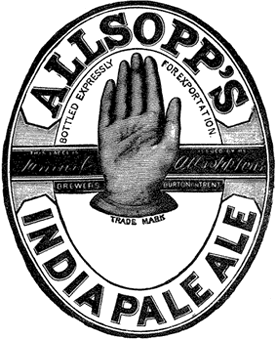
All the essentials are in place, with a purely French approach to cooking, ample quantities of meats, purely dispensable veggies, abundant wine from around the world, and the requisite “correct” imported beer list; none of that new-fangled German beer, and heaven forbid the inclusion of locally-made “Porter and Ale.” Instead, the beer stars are Guinness (then as now, imported from Dublin) and Allsop’s India Pale Ale from the United Kingdom.
Amazing. This still would have been the best beer list in Louisville in 1957, and as recently as the 1970s. We’ve come a long way, baby … and sometimes, not at all.
A weekly web column by Roger A. Baylor.
Like so many other local beer people, I’ve been reading Kevin Gibson’s new book. It’s called Louisville Beer: Derby City History on Draft, and I picked it up just as I was finishing another, arguably weightier tome: Thinking the Twentieth Century, by the late Tony Judt, with Timothy Snyder.
One is a specific account of beer’s rise, fall and resurgence in Louisville, and the other a series of far-ranging conversations about 20th-century intellectual history. These may seem unrelated, and in many respects they are. However, there are points of convergence; more about that in a moment.
The last book to be written about Louisville beer was Louisville Breweries: A History of the Brewing Industry in Louisville, by Conrad Selle and Peter Guetig. It was published in 1997 and printed only once (I understand Peter is contemplating a revised edition). Obviously, much has changed since then, with breweries coming and going, and Kevin’s Louisville Beer provides ample coverage of our contemporary period.
I haven’t yet gotten to this second, more recent half of Kevin’s story. Rather, it is the first sections of his book that I find compelling, as he seeks to depict what beer really meant, day in and day out, in a place like Louisville prior to the era of Prohibition.
Broadly speaking to post-Colonial times and the early 1800s, beer arguably was of secondary consideration to cider and whisky – until substantial numbers of Germans began coming to this area following the disruptive revolutions of 1848.
Germans brought with them the technological underpinnings of lager brewing, which was about to explode into a worldwide phenomenon. More importantly to daily life in Louisville, they came equipped with cultural proclivities, which included beer as an integral part of social life. Because these immigrants enjoyed their tankards, it was a natural next step for “Know Nothing” nativists to conflate beer with immigration, and to incorporate xenophobia into what evolved as the temperance movement.
In short, there was Carrie Nation-building: God says drinking is bad, but forget that; just look at those non-English speaking, beer-drinking immigrants taking our jobs … and what’s more, we’d all work harder and be more efficient cogs of capitalism if we were sober. Hatchets fly, and nutrition becomes a crime. Rinse and repeat in the here and now.
---
And so we see that in the late 19th-century, some Louisville neighborhoods closely resembled the Fatherland, and these areas would have reminded me very much of those German milieus I was so eager to experience a century later during the 1980s.
It should suffice to note that beer was consumed voluminously at work and play, while bowling and playing baseball, during weddings and funerals, and in morning and nighttime. There were dozens of breweries, and rushing the growler meant dispatching one’s 10-year-old to the corner saloon, laden with a metal bucket. Some people succumbed to alcohol-induced diseases, while others sweated out the beer and lived to ripe old ages. Life went on, as it tends to do.
Prohibition came very close to wiping the slate clean. There were surviving breweries after Repeal, and some (Falls City, Oertel’s, Fehr’s) did quite well for a long time, but by the time of the Reagan administration, none remained in operation. Around 1990, David Pierce fortuitously brewed a batch at Charley’s Restaurant on Main Street in Louisville, and then he opened the Silo in 1992. Times began changing.
Since then, we’ve spent countless hours and brain cells debating whether this new “craft” beer era represents a restoration of the past, or a revolution. This consideration brings me back to Tony Judt, the historian.
---
During the course of his reflections, Judt asks a question: “What is the purpose or nature of history?” He follows it with another statement, “You cannot invent or exploit the past for present purposes.”
As I think about Kevin’s depiction of pre-1900 Louisville beer as an all-pervasive cultural norm, it seems to me that quite often I’ve done precisely as Judt admonishes. In fact, we all have. We’ve exploited the previous history of local beer to explain our present purposes, and to claim cultural (and mercantile) territory for ourselves. The problem is that by doing so, we consistently fail to account for how pervasively craft- and locally-driven 19th-century beer and beer culture really were.
Yes, beer came from elsewhere in America, floating down the river on boats and later in railway cars. Occasionally, beer came from very far away (see below). But the bulk of the beer produced in the neighborhood breweries of old were consumed nearby, within the neighborhood. Brewpubs of the current era generally have remained true to this model, production breweries of any size, less so.
In the end, it would be fascinating to know more about the business motivations of these 19th-century brewers. Were they content with being small and local, with limited range, or were they open to the idea of acquiring capital through hook or crook, and expanding to ship beer longer distances according to the capitalist export-driven ideal? We probably can’t know, although speculation’s worth a beer or three.
Judt also makes this observation:
“A history book – assuming its facts are correct – stands or falls by the conviction with which it tells its story. If it rings true to an intelligent, informed reader, then it is a good history book. If it rings false, then it is not good history, even if it’s well written by a great historian on the basis of sound scholarship.”
Louisville Beer passes this test. We can quibble over details, and yet it matters less what we know now about brewing methods and stylistic categorization, and more that in olden times, people were not aware of these details. Being a beer drinker in Louisville in the year 1890 was not about checking-in, chasing and hoarding. Rather, it likely involved a healthy dollop of German-ness; came accompanied with a good deal of child-like mystery as to the process; and resulted in prodigious intake in the relative absence of plasticized tap water, smoothies and teeth-corroding “soft” drinks.
In a future column, I’ll survey the “contemporary” section of Kevin’s book. Until then, we close with something posted to the Louisville Restaurants Forum many years ago. It’s a restaurant menu, with wine list and libations, from the Louisville Hotel, circa 1857.
All the essentials are in place, with a purely French approach to cooking, ample quantities of meats, purely dispensable veggies, abundant wine from around the world, and the requisite “correct” imported beer list; none of that new-fangled German beer, and heaven forbid the inclusion of locally-made “Porter and Ale.” Instead, the beer stars are Guinness (then as now, imported from Dublin) and Allsop’s India Pale Ale from the United Kingdom.
Amazing. This still would have been the best beer list in Louisville in 1957, and as recently as the 1970s. We’ve come a long way, baby … and sometimes, not at all.
Photo
credits:
Sunday, June 02, 2013
Culbertson, Reising, Tricentennial and all that.
Bottles of Tricentennial will be along later in June. It will be pouring briefly at both NABC locations beginning on Tuesday, June 4.
Rocking the Culbertson's garden party with NABC Tricentennial.
Turns out a day's worth of weather anxiety was utterly misplaced. There wasn't a drop of rain on the Culbertson Mansion's garden party last evening, and yet it was appropriately wet insofar as an entire 15.5 gallon keg of NABC's Tricentennial Ale was concerned -- that is, before it became "dry" when the keg floated at last call.
During my lawn chat about the history of brewing in New Albany, I read this chestnut to the crowd. It's a longtime favorite, and "Drive on Old Bock" should be a Houndmouth song.
"Mr. Paul Reising, West End brewer, will issue his second edition of "Bock Beer" tomorrow. His customers will be supplied with the beverage in a prompt manner, as Mr. Reising is a prompt and reliable business man. Some people drink sassafras tea in the spring of the year; others use sage catnip and such, and others sarsaparilla. That is their privilege. Another class prefers Bock Beer and it is their privilege to do so. This is a free country. Drive on old Bock."
-- New Albany Ledger-Standard, April 29, 1881
Saturday, December 08, 2012
Scotch de Ainslie: Now on tap at both NABC locations. Here's what it means.
Hew Ainslie, New Albany's first commercial brewer, is the inspiration for NABC's Scotch de Ainslie, currently on tap at both locations.
But who was Ainslie?
The biographical sketch below was written by Louisville goldsmith, writer and homebrewer Conrad Selle, with editing by the author. Originally it was published in the FOSSILS newsletter circa 1994. Later it was a staple on the club's web site, and was republished at Potable Curmudgeon in 2005. Many thanks to Conrad, whose tireless research into Louisville area brewing can be experienced in Louisville Breweries, co-written with Peter Guetig. There was only one printing, but a few copies still may be floating around.
In 2012, NABC brewed four special "throwback" beers for our 25th anniversary. Three of them (Turbo Hog, Stumble Bus and Bourbondaddy) were revivals of pre-2006 recipes formulated by Michael Borchers. Scotch de Ainslie was the fourth, slated for release in December as a prelude to New Albany's Bicentennial celebration in 2013.
Scotch de Ainslie is a 7.4% Scottish-style ale in Wee Heavy territory, but with a twist, one having nothing whatever to do with Ainslie or the typical Scottish ale-making range: We used Belgian yeast, placing Scotch de Ainslie in the smaller, more esoteric category of Belgian Scotch Ales like Gordon's, Campbell's, and my consistent personal favorite, Scotch de Silly.
Make no mistake: Scotch de Ainslie is a malt bomb, but not without balance. The Belgian yeast accounts for fruity esters that provide a unique complexity to the flavor. The fact that we brewed it early in the year so as to have a bit for preview at the July anniversary party, then sat on the remainder for four months, makes the finished product quite mellow.
Get some before it goes; there isn't much. Here's the rest of the story.
---
Early New Albany brewer and Scottish-American poet Hew Ainslie ... by Conrad Selle.
Many early brewers worked their trade as a sideline or temporary trade before moving on to other occupations. Hew Ainslie is unique for having been principally a poet.
He was born at Bargany in Ayrshire, Scotland on April 5, 1792. Hew was the only son of George Ainslie, an employee on the estate of Sir Hew Dalrymple Hamilton. He was educated in the parish school at Ballantrae, and later at the academy at Ayr. In 1809 his family moved to Roslin, about six miles from Edinburgh. He married his cousin Janet Ainslie in 1812, whose brother Jock had married Hew's sister Eleanora.
Ainslie studied law in Glasgow, and worked as a clerk in the Register House in Edinburgh. In 1820 he revisited Ayrshire on foot with James Wellstood and John Gibson and in the next two years wrote A Pilgrimage to the Land of Burns, which was published in London in 1822. The book was an account of their travels and visits with some of Robert Burns's contemporaries, with songs and ballads by Ainslie that were much in the style of Burns, and illustrations by Wellstood.
In July, 1822, Ainslie sailed from Liverpool to New York with his friend Wellstood. Mrs. Ainslie and their three children joined him in the following year. Ainslie and Wellstood purchased Pilgrim's Repose, a farm at Hoosac Falls in Rensselaer County, New York. Ainslie and his family lived there for almost three years before joining Robert Owen's utopian socialist cooperative community at New Harmony, Indiana in 1825.
When Owen's community failed about a year later they moved first to Cincinnati, where Ainslie became a partner with Price and (Thomas) Wood in a brewery, then to Louisville. In Louisville, a town of 7,000, Ainslie opened a brewery in 1829 at 7th Street between Water and Main. Records show that B. Foster, Enoch Wenzell and Robert McKenzie worked there.
In February, 1832 there was a major flood of the Ohio River, with the river's waters rising to 46 feet above the low water level. A contemporary account of the "calamity" reads:
This was an unparalleled flood in the Ohio. It commenced on the 10th of February and continued until the 21st of that month, having risen to (an) extraordinary height ... above low-water mark. The destruction of property by this flood was immense. Nearly all the frame buildings near the river were either floated off or turned over and destroyed. An almost total cessation in business was the necessary consequence; even farmers from the neighborhood were unable to get to the markets, the flood having so affected the smaller streams as to render them impassable. The description of the sufferings by this flood is appalling ...
Ainslie's brewery was swept away with most of the neighborhood, but in the following years he remained in the beer business, working at the Nuttall brewery on the west side of 6th Street between Water and Main.
In 1840 he opened the first brewery in New Albany, the partnership of Bottomley & Ainslie. Soon that business was destroyed by fire. In the 1841 Louisville City Directory, Hew Ainslie is listed as a maltster; it was his last listing in the brewing trade. Discouraged by fire and flood, he gave up the brewing business altogether. Thereafter, his working life became somewhat intertwined with that of his children, particularly George and James Wellstood Ainslie.
Hew and Janet Ainslie had ten children, seven of them surviving to adulthood. George Ainslie, the eldest Ainslie son, had been apprenticed to Lachan McDougall around 1830 to learn the iron foundry and moulding trade, and he had acquired a solid business and technical education. He became a foreman at John Curry's foundry and married Mary Thirlwell, daughter of Charles Thirlwell, who was a brewer at the Nuttall Brewery (Hew Ainslie's one-time employer).
Thirlwell eventually acquired Nuttall and operated it until 1856. In 1842, George Ainslie became a partner in Gowan and McGhee's Boone Foundry. By 1845 Hew Ainslie -- still a poet throughout -- was employed as a finisher there as well as working as a contractor and in the building trades.
George and James Ainslie became highly successful in the foundry and machine business, enabling their father to devote more time to writing in later life. In 1853, Hew Ainslie made a long visit to New Jersey to visit members of the family of James Wellstood, undoubtedly providing the poet with a nostalgic link to the Scotland of his youth.
In 1855 a collection of Ainslie's verse, Scottish Songs, Ballads and Poetry, was published in New York. One latter-day commentator called Ainslie's songs of the sea "the best that Scotland has produced," and perhaps this assessment was borne out by the reception accorded Ainslie in Scottish literary circles in 1863, when he returned to Scotland for a final visit.
Janet Ainslie died in 1863 prior to Hew's last Scottish journey. In 1868 the elderly poet/brewer went to live with his son George in a new home on Chestnut Street (between 9th and 10th) in Louisville, where he spent the last decade of his life and was a familiar sight as he passed time tending the garden there. Ainslie died on March 6, 1878, and was eulogized in the Courier-Journal as "a poet of considerable merit to the people of his native land." Hew and Janet Ainslie are buried in Cave Hill Cemetery.
In addition to the many accomplishments noted previously, Ainslie is remembered for his height -- at 6 feet, 4 inches, he referred to himself in his works as "The Lang Linker" -- and for never losing his Scottish accent during almost six decades in America.
There is no specific information to be found as to the products of the breweries with which Hew Ainslie was involved in Louisville and New Albany, but we can surmise from the available evidence that they were typical small breweries of the time, with four or five employees, making ale, porter and stout. As a man who appreciated truth and beauty, it is likely that Hew Ainslie made good malt, and being conscientious with it, good beer as well.
The following poems by Hew Ainslie are copied from the Filson Historical Society's extremely rare copy of A Pilgrimage to the Land of Burns and Poetry, Ainslie's 1822 work combined with later efforts and reprinted in 1892, the centenary of his birth.
(Author's note: I have heard a scrap or two of Robert Burns, and expect these are much better read aloud in Scots dialect.)
THE DAFT DAYS.
The midnight hour is clinking, lads,
An' the douce an' the decent are winking, lads;
Sae I tell ye again,
Be't weel or ill ta'en,
It's time ye were quatting your drinking, lads.
Gae ben, 'an mind your gauntry, Kate,
Gi'es mair o' your beer, an' less bantry, Kate,
For we vow, whaur we sit,
That afore we shall flit,
We'se be better acquaint wi' your pantry, Kate.
The "daft days" are but beginning, Kate,
An we're sworn. Would you hae us a sinning, Kate?
By our faith an' our houp,
We will stick by the stoup
As lang as the barrel keeps rinning, Kate.
Thro' hay, an' thro' hairst, sair we toil it, Kate,
Thro' Simmer, an' Winter, we moil it, Kate;
Sae ye ken, whan the wheel
Is beginning to squeal,
It's time for to grease an' to oil it, Kate.
Sae draw us anither drappy, Kate,
An' gie us a cake to our cappy, Kate;
For, by spiggot an' pin!
It's waur than a sin
To flit when we're sitting sae happy, Kate.
LET'S DRINK TO OUR NEXT MEETING.
Let's drink to our next meeting, lads,
Nor think on what's atwixt;
They're fools wha spoil the present hour
By thinking on the next.
Then here's to Meg o' Morningside,
An Kate o' Kittlemark;
The taen she drank her hose and shoon,
The tither pawned her sark.
A load o' wealth, an' wardly pelf,
They say is sair to bear;
Sae he's a gowk would scrape an' howk
To make his burden mair
Then here's , &c.
Gif Care looks black the morn, lads,
As he's come doon the lum,
Let's ease our hearts by swearing, lads,
We never bade him come.
Then here's, &c.
Then here's to our next meeting, lads,
Ne'er think on what's atwixt;
They're fools who spoil the present hour
By thinking on the next.
Then here's, &c.
THE HOOSIER .
We lads that live up in the nobs,
Tho' our manners might yet bear a rubbing,
We're handy at neat little jobs
Such as chopping and hewing and grubbing.
Tho' we roost in a cabin of logs,
And clapboards lie 'twixt us and heaven,
Our mast makes us fine oily hogs,
And from hoop-poles we pick a good living.
Right quiet -- to a decent degree --
it's seldom we guzzle it deep, Sir,
Tho' we don't mind a bit of a spree,
Provided the liquor is cheap, Sir.
Our neighbours, that live 'cross the drink.
May laugh at our fondness for cider,
But so long as we pocket their clink
They may laugh till their mouths they grow wider.
Our gals make our trousers, you see,
From that beautiful stuff called tow linen,
and in coats of the linsey -- dang me,
If we don't look both handsome and winning.
Our wives are our weavers, to boot;
Ourselves are first rate on a shoe, Sir;
We can doctor a tub with a hoop --
And hark ! we're our own niggers too, Sir,
So here's to our Hoosier land,
The sons of its soil and its waters !
May the "nullies" ne'er get it in hand,
Nor demagogues tear it in tatters.
But still may it flourish and push,
Thro' vetos and all such tough cases,
Till railroads are common as brush,
And the nobs are as sleek as your faces.
To provide context to Ainslie's use of the "N" word, "The Hoosier" was intended as an anti-nullification poem -- a direct slap at the slave-owning caste south of the Ohio River, and a self-mocking espousal of the poor but free residents to the north. If any reader can shed further light on the history involved, please do.
But who was Ainslie?
The biographical sketch below was written by Louisville goldsmith, writer and homebrewer Conrad Selle, with editing by the author. Originally it was published in the FOSSILS newsletter circa 1994. Later it was a staple on the club's web site, and was republished at Potable Curmudgeon in 2005. Many thanks to Conrad, whose tireless research into Louisville area brewing can be experienced in Louisville Breweries, co-written with Peter Guetig. There was only one printing, but a few copies still may be floating around.
In 2012, NABC brewed four special "throwback" beers for our 25th anniversary. Three of them (Turbo Hog, Stumble Bus and Bourbondaddy) were revivals of pre-2006 recipes formulated by Michael Borchers. Scotch de Ainslie was the fourth, slated for release in December as a prelude to New Albany's Bicentennial celebration in 2013.
Scotch de Ainslie is a 7.4% Scottish-style ale in Wee Heavy territory, but with a twist, one having nothing whatever to do with Ainslie or the typical Scottish ale-making range: We used Belgian yeast, placing Scotch de Ainslie in the smaller, more esoteric category of Belgian Scotch Ales like Gordon's, Campbell's, and my consistent personal favorite, Scotch de Silly.
Make no mistake: Scotch de Ainslie is a malt bomb, but not without balance. The Belgian yeast accounts for fruity esters that provide a unique complexity to the flavor. The fact that we brewed it early in the year so as to have a bit for preview at the July anniversary party, then sat on the remainder for four months, makes the finished product quite mellow.
Get some before it goes; there isn't much. Here's the rest of the story.
---
Early New Albany brewer and Scottish-American poet Hew Ainslie ... by Conrad Selle.
Many early brewers worked their trade as a sideline or temporary trade before moving on to other occupations. Hew Ainslie is unique for having been principally a poet. He was born at Bargany in Ayrshire, Scotland on April 5, 1792. Hew was the only son of George Ainslie, an employee on the estate of Sir Hew Dalrymple Hamilton. He was educated in the parish school at Ballantrae, and later at the academy at Ayr. In 1809 his family moved to Roslin, about six miles from Edinburgh. He married his cousin Janet Ainslie in 1812, whose brother Jock had married Hew's sister Eleanora.
Ainslie studied law in Glasgow, and worked as a clerk in the Register House in Edinburgh. In 1820 he revisited Ayrshire on foot with James Wellstood and John Gibson and in the next two years wrote A Pilgrimage to the Land of Burns, which was published in London in 1822. The book was an account of their travels and visits with some of Robert Burns's contemporaries, with songs and ballads by Ainslie that were much in the style of Burns, and illustrations by Wellstood.
In July, 1822, Ainslie sailed from Liverpool to New York with his friend Wellstood. Mrs. Ainslie and their three children joined him in the following year. Ainslie and Wellstood purchased Pilgrim's Repose, a farm at Hoosac Falls in Rensselaer County, New York. Ainslie and his family lived there for almost three years before joining Robert Owen's utopian socialist cooperative community at New Harmony, Indiana in 1825.
When Owen's community failed about a year later they moved first to Cincinnati, where Ainslie became a partner with Price and (Thomas) Wood in a brewery, then to Louisville. In Louisville, a town of 7,000, Ainslie opened a brewery in 1829 at 7th Street between Water and Main. Records show that B. Foster, Enoch Wenzell and Robert McKenzie worked there.
In February, 1832 there was a major flood of the Ohio River, with the river's waters rising to 46 feet above the low water level. A contemporary account of the "calamity" reads:
This was an unparalleled flood in the Ohio. It commenced on the 10th of February and continued until the 21st of that month, having risen to (an) extraordinary height ... above low-water mark. The destruction of property by this flood was immense. Nearly all the frame buildings near the river were either floated off or turned over and destroyed. An almost total cessation in business was the necessary consequence; even farmers from the neighborhood were unable to get to the markets, the flood having so affected the smaller streams as to render them impassable. The description of the sufferings by this flood is appalling ...
Ainslie's brewery was swept away with most of the neighborhood, but in the following years he remained in the beer business, working at the Nuttall brewery on the west side of 6th Street between Water and Main.
In 1840 he opened the first brewery in New Albany, the partnership of Bottomley & Ainslie. Soon that business was destroyed by fire. In the 1841 Louisville City Directory, Hew Ainslie is listed as a maltster; it was his last listing in the brewing trade. Discouraged by fire and flood, he gave up the brewing business altogether. Thereafter, his working life became somewhat intertwined with that of his children, particularly George and James Wellstood Ainslie.
Hew and Janet Ainslie had ten children, seven of them surviving to adulthood. George Ainslie, the eldest Ainslie son, had been apprenticed to Lachan McDougall around 1830 to learn the iron foundry and moulding trade, and he had acquired a solid business and technical education. He became a foreman at John Curry's foundry and married Mary Thirlwell, daughter of Charles Thirlwell, who was a brewer at the Nuttall Brewery (Hew Ainslie's one-time employer).
Thirlwell eventually acquired Nuttall and operated it until 1856. In 1842, George Ainslie became a partner in Gowan and McGhee's Boone Foundry. By 1845 Hew Ainslie -- still a poet throughout -- was employed as a finisher there as well as working as a contractor and in the building trades.
George and James Ainslie became highly successful in the foundry and machine business, enabling their father to devote more time to writing in later life. In 1853, Hew Ainslie made a long visit to New Jersey to visit members of the family of James Wellstood, undoubtedly providing the poet with a nostalgic link to the Scotland of his youth.
In 1855 a collection of Ainslie's verse, Scottish Songs, Ballads and Poetry, was published in New York. One latter-day commentator called Ainslie's songs of the sea "the best that Scotland has produced," and perhaps this assessment was borne out by the reception accorded Ainslie in Scottish literary circles in 1863, when he returned to Scotland for a final visit.
Janet Ainslie died in 1863 prior to Hew's last Scottish journey. In 1868 the elderly poet/brewer went to live with his son George in a new home on Chestnut Street (between 9th and 10th) in Louisville, where he spent the last decade of his life and was a familiar sight as he passed time tending the garden there. Ainslie died on March 6, 1878, and was eulogized in the Courier-Journal as "a poet of considerable merit to the people of his native land." Hew and Janet Ainslie are buried in Cave Hill Cemetery.
In addition to the many accomplishments noted previously, Ainslie is remembered for his height -- at 6 feet, 4 inches, he referred to himself in his works as "The Lang Linker" -- and for never losing his Scottish accent during almost six decades in America.
There is no specific information to be found as to the products of the breweries with which Hew Ainslie was involved in Louisville and New Albany, but we can surmise from the available evidence that they were typical small breweries of the time, with four or five employees, making ale, porter and stout. As a man who appreciated truth and beauty, it is likely that Hew Ainslie made good malt, and being conscientious with it, good beer as well.
The following poems by Hew Ainslie are copied from the Filson Historical Society's extremely rare copy of A Pilgrimage to the Land of Burns and Poetry, Ainslie's 1822 work combined with later efforts and reprinted in 1892, the centenary of his birth.
(Author's note: I have heard a scrap or two of Robert Burns, and expect these are much better read aloud in Scots dialect.)
THE DAFT DAYS.
The midnight hour is clinking, lads,
An' the douce an' the decent are winking, lads;
Sae I tell ye again,
Be't weel or ill ta'en,
It's time ye were quatting your drinking, lads.
Gae ben, 'an mind your gauntry, Kate,
Gi'es mair o' your beer, an' less bantry, Kate,
For we vow, whaur we sit,
That afore we shall flit,
We'se be better acquaint wi' your pantry, Kate.
The "daft days" are but beginning, Kate,
An we're sworn. Would you hae us a sinning, Kate?
By our faith an' our houp,
We will stick by the stoup
As lang as the barrel keeps rinning, Kate.
Thro' hay, an' thro' hairst, sair we toil it, Kate,
Thro' Simmer, an' Winter, we moil it, Kate;
Sae ye ken, whan the wheel
Is beginning to squeal,
It's time for to grease an' to oil it, Kate.
Sae draw us anither drappy, Kate,
An' gie us a cake to our cappy, Kate;
For, by spiggot an' pin!
It's waur than a sin
To flit when we're sitting sae happy, Kate.
LET'S DRINK TO OUR NEXT MEETING.
Let's drink to our next meeting, lads,
Nor think on what's atwixt;
They're fools wha spoil the present hour
By thinking on the next.
Then here's to Meg o' Morningside,
An Kate o' Kittlemark;
The taen she drank her hose and shoon,
The tither pawned her sark.
A load o' wealth, an' wardly pelf,
They say is sair to bear;
Sae he's a gowk would scrape an' howk
To make his burden mair
Then here's , &c.
Gif Care looks black the morn, lads,
As he's come doon the lum,
Let's ease our hearts by swearing, lads,
We never bade him come.
Then here's, &c.
Then here's to our next meeting, lads,
Ne'er think on what's atwixt;
They're fools who spoil the present hour
By thinking on the next.
Then here's, &c.
THE HOOSIER .
We lads that live up in the nobs,
Tho' our manners might yet bear a rubbing,
We're handy at neat little jobs
Such as chopping and hewing and grubbing.
Tho' we roost in a cabin of logs,
And clapboards lie 'twixt us and heaven,
Our mast makes us fine oily hogs,
And from hoop-poles we pick a good living.
Right quiet -- to a decent degree --
it's seldom we guzzle it deep, Sir,
Tho' we don't mind a bit of a spree,
Provided the liquor is cheap, Sir.
Our neighbours, that live 'cross the drink.
May laugh at our fondness for cider,
But so long as we pocket their clink
They may laugh till their mouths they grow wider.
Our gals make our trousers, you see,
From that beautiful stuff called tow linen,
and in coats of the linsey -- dang me,
If we don't look both handsome and winning.
Our wives are our weavers, to boot;
Ourselves are first rate on a shoe, Sir;
We can doctor a tub with a hoop --
And hark ! we're our own niggers too, Sir,
So here's to our Hoosier land,
The sons of its soil and its waters !
May the "nullies" ne'er get it in hand,
Nor demagogues tear it in tatters.
But still may it flourish and push,
Thro' vetos and all such tough cases,
Till railroads are common as brush,
And the nobs are as sleek as your faces.
To provide context to Ainslie's use of the "N" word, "The Hoosier" was intended as an anti-nullification poem -- a direct slap at the slave-owning caste south of the Ohio River, and a self-mocking espousal of the poor but free residents to the north. If any reader can shed further light on the history involved, please do.
Monday, January 16, 2012
"Back Into the Future," at LouisvilleBeer.com
My latest column is up at LouisvilleBeer.com ... remember that these appear twice monthly, and thanks for reading.
Back Into the Future
Earlier in the week, I went for a refreshingly brisk walk in the cold winter’s rain. On the way back from downtown New Albany, I took the shortcut home via 10th Street, where it crosses Market next to the city’s war memorial traffic island. Mansion Row is only a block away to the south, and after 10th crosses Spring northward, the neighborhood is transitional.
Standing right there, between Market and Spring, is a nondescript yet dignified 19th-century red brick commercial building, two stories tall, with a sloping roof and a “fermentational” story to tell.
Saturday, January 08, 2011
Ackerman’s lives again: The 2011 BIG Winterfest ReplicAle is Imperial Double Stout ...
... an historic New Albany beer recipe reclaimed by the NABC brew team.
When Indiana’s craft brewers convene in Indianapolis for the annual Winterfest gala on Saturday, January 29, they’ll each bring a “ReplicAle.”
It’s a special one-time beer brewed by different Indiana brewing companies from the same basic recipe of malts and hops, but with their own local water and house yeasts.
The 2011 Winterfest recipe for ReplicAle, as researched and recreated by the New Albanian Brewing Company’s Jared Williamson and Jesse Williams, is Imperial Double Stout – an iconic product once brewed by New Albany’s long defunct Ackerman’s Brewery.
It has been three-quarters of a century since Imperial Double Stout was last seen hereabouts. Just after the repeal of Prohibition, it was formulated, brewed and distributed by the Southern Indiana Ice & Brewing Company, which was known locally as Ackerman’s Brewery.
Ackerman’s operated from 1933 to 1935 at the site of the former Paul Reising Brewing Company premises on the corner of West 5th and Spring Streets in New Albany. The brewery building was demolished in 1969 to make way for what is now the Holiday Inn Express.
In its brief heyday, Ackerman’s Imperial Double Stout was brewed only once each year, at Easter, as an early springtime treat for the brewery’s loyal customers.
Imperial Double Stout was meant as a substitute for Doppelbock, a German style traditionally served during Lenten fasts. It is rich, dark, strong and ideal for contemplative, cool-weather sipping.
As is customary, Winterfest attendees get the first chance to sample, contrast and compare Imperial Double Stout’s various reincarnations as brewed by breweries all across the state of Indiana.
Afterwards, limited amounts of NABC’s version of the elixir will be poured at NABC’s two New Albany locations, providing a tasty and educational glimpse into New Albany’s brewing past.
Jared’s and Jesse’s Imperial Double Stout recipe specifications:
Original Gravity: 20 degree Plato
Alcohol By Volume: Circa 8%
International Bittering Units: 35 – 40
Grist Bill:
80% Rahr 2-row Pale Malt
5% Briess Aromatic Malt
5% Briess Dark Chocolate Malt
5% Briess Roast Barley
2.5% Briess 80-degree Caramel Malt
2.5% Briess Cherry Smoked Malt
Hops:
Single addition at boil of your choice of hop, to achieve 35 - 40 IBU
Miscellany … Did you know:
Winterfest is an annual beer festival. In 2011, it takes place on Saturday, January 29, and offers the opportunity to sample over 150 beers from 50 different breweries – two ounces at a time. Winterfest is staged by the Brewers of Indiana Guild (BIG), whose members include all of Indiana's microbrewers and brewpubs. Other sponsors include World Class Beverages, Crown Liquors, NUVO, WTTS, Brewers Supply Group, and Briess. Winterfest is held at the Ag/Hort Building of the Indiana State Fairgrounds in Indianapolis. Proceeds from Winterfest benefit Joy's House, a charity that provides care for adults living with physical and mental challenges. Winterfest tickets are available online …
http://www.brewersofindianaguild.com/festival.html ... (with link to Etix)
… or at Crown Liquor stores in Indianapolis and environs.
NABC’s friends at Rick & Jeff Tours are offering motorcoach transportation to Winterfest 2011. The trip includes motorcoach transportation from Louisville to Indianapolis and back; Winterfest ticket; sample glass; program; and lunch & refreshments. The cost per person is $85. To reserve your spots, contact Rick at 502-314-6056 or rsouthward@insightbb.com.
The Brewers of Indiana Guild (BIG) is a non-profit 501(c) trade organization that focuses on promoting public awareness and appreciation for the quality and variety of beer produced in Indiana. With an all volunteer board, our members are dedicated to promoting responsible consumption of craft beer, while working to benefit a community larger than just our members.
Other brands brewed by New Albany’s iconic Ackerman’s brewery (1933-1935) included Amsterdamer Bock; Great Eagle; Gold Crest; India Pale Ale; Daniel Boone; Royal Munich; Vienna Select; and Old Rip.
When Indiana’s craft brewers convene in Indianapolis for the annual Winterfest gala on Saturday, January 29, they’ll each bring a “ReplicAle.”
It’s a special one-time beer brewed by different Indiana brewing companies from the same basic recipe of malts and hops, but with their own local water and house yeasts.
The 2011 Winterfest recipe for ReplicAle, as researched and recreated by the New Albanian Brewing Company’s Jared Williamson and Jesse Williams, is Imperial Double Stout – an iconic product once brewed by New Albany’s long defunct Ackerman’s Brewery.
It has been three-quarters of a century since Imperial Double Stout was last seen hereabouts. Just after the repeal of Prohibition, it was formulated, brewed and distributed by the Southern Indiana Ice & Brewing Company, which was known locally as Ackerman’s Brewery.
Ackerman’s operated from 1933 to 1935 at the site of the former Paul Reising Brewing Company premises on the corner of West 5th and Spring Streets in New Albany. The brewery building was demolished in 1969 to make way for what is now the Holiday Inn Express.
In its brief heyday, Ackerman’s Imperial Double Stout was brewed only once each year, at Easter, as an early springtime treat for the brewery’s loyal customers.
Imperial Double Stout was meant as a substitute for Doppelbock, a German style traditionally served during Lenten fasts. It is rich, dark, strong and ideal for contemplative, cool-weather sipping.
As is customary, Winterfest attendees get the first chance to sample, contrast and compare Imperial Double Stout’s various reincarnations as brewed by breweries all across the state of Indiana.
Afterwards, limited amounts of NABC’s version of the elixir will be poured at NABC’s two New Albany locations, providing a tasty and educational glimpse into New Albany’s brewing past.
Jared’s and Jesse’s Imperial Double Stout recipe specifications:
Original Gravity: 20 degree Plato
Alcohol By Volume: Circa 8%
International Bittering Units: 35 – 40
Grist Bill:
80% Rahr 2-row Pale Malt
5% Briess Aromatic Malt
5% Briess Dark Chocolate Malt
5% Briess Roast Barley
2.5% Briess 80-degree Caramel Malt
2.5% Briess Cherry Smoked Malt
Hops:
Single addition at boil of your choice of hop, to achieve 35 - 40 IBU
Miscellany … Did you know:
Winterfest is an annual beer festival. In 2011, it takes place on Saturday, January 29, and offers the opportunity to sample over 150 beers from 50 different breweries – two ounces at a time. Winterfest is staged by the Brewers of Indiana Guild (BIG), whose members include all of Indiana's microbrewers and brewpubs. Other sponsors include World Class Beverages, Crown Liquors, NUVO, WTTS, Brewers Supply Group, and Briess. Winterfest is held at the Ag/Hort Building of the Indiana State Fairgrounds in Indianapolis. Proceeds from Winterfest benefit Joy's House, a charity that provides care for adults living with physical and mental challenges. Winterfest tickets are available online …
http://www.brewersofindianaguild.com/festival.html ... (with link to Etix)
… or at Crown Liquor stores in Indianapolis and environs.
NABC’s friends at Rick & Jeff Tours are offering motorcoach transportation to Winterfest 2011. The trip includes motorcoach transportation from Louisville to Indianapolis and back; Winterfest ticket; sample glass; program; and lunch & refreshments. The cost per person is $85. To reserve your spots, contact Rick at 502-314-6056 or rsouthward@insightbb.com.
The Brewers of Indiana Guild (BIG) is a non-profit 501(c) trade organization that focuses on promoting public awareness and appreciation for the quality and variety of beer produced in Indiana. With an all volunteer board, our members are dedicated to promoting responsible consumption of craft beer, while working to benefit a community larger than just our members.
Other brands brewed by New Albany’s iconic Ackerman’s brewery (1933-1935) included Amsterdamer Bock; Great Eagle; Gold Crest; India Pale Ale; Daniel Boone; Royal Munich; Vienna Select; and Old Rip.
Tuesday, October 26, 2010
"A History of Breweries in New Albany," tonight at the Calumet Club.
Tonight at 7:00 p.m. I'm presenting a program entitled "A History of Breweries in New Albany." It is sponsored by the Floyd County Historical Society, and takes place at the Calumet Club (1614 E. Spring in NA).
It is free, the public is invited, and there'll be beer from NABC.
Wednesday, October 20, 2010
Wednesday Weekly: As they say, think globally and drink locally.
My tenure at Rich O’s Public House began in June of 1992, and in considering this simple chronological fact of our company’s development, it is important to remember that at the time, no local breweries were operating in the metropolitan Louisville.
However, the revolution was palpably imminent. It arrived shortly thereafter, and has wildly proliferated ever since. Almost two decades have passed, and with them an array of sensations and experiences.
What has been learned?
Apart from an abortive precursor at Charlie’s, a restaurant on Main Street in Louisville, the modern era of brewing in Kentuckiana began in the autumn of 1992, when the Silo Brewpub opened for business with David Pierce manning the brew house. Apart from the Silo, the closest functional brewery to metropolitan Louisville was Oldenberg, just this side of Cincinnati in Ft. Mitchell, Kentucky. Further afield, in Indianapolis, both Indianapolis Brewing Company (the Dusseldorfer brands) and Broad Ripple Brewpub (no distribution, then or now) were brewing beer.
That’s about it.
What’s more, almost no microbrewed beers (“craft” being a term to be coined much later) were available through normal wholesaling channels. The good beer game largely was played in terms of imports, most worthy examples being shipped from Europe.
We spent much time drinking beers like Guinness, Paulaner and Bass, fantasizing about the time to come, in what we could plainly see was a dawning age, when we’d be able to do it – to brew it – ourselves. Of course, the homebrewing contingents in LAGERS and FOSSILS already were brewing themselves, and so I’m restricting my field of vision to commercial brewing.
Even back then, we were not satisfied with Rich O’s being “just” a good beer bar, and we desperately wanted to brew our own. In 1994, the pre-existing Sportstime Pizza Inc. transitioned into the New Albanian Brewing Company, and we formulated a plan to acquire equipment and build a pub brewery at the original location on Grant Line Road.
Alas, neither the time nor the money was yet right, and the plans were shelved. We bided our time until 2002, by which time Tucker Brewing, Silver Creek Brewing, more than one Oldenberg branch, Pipkin, Hops!, Jack Daniels (no kidding), and perhaps other I’m forgetting already had come and gone, or were about to head out the door. We bought the remnants of Tucker via Silver Creek, and Michael Borchers fired up the NABC kettle for the first time.
By then, the go-to option for beer enthusiasts from the Louisville metropolitan area had long since been Bluegrass Brewing Company, which opened in 1993 in St. Matthews, having hired Dave away from the Silo.
For many of us, BBC was the one, crucial, necessary variable that truly mattered, as Dave pursued a quality program of mainstays and seasonals. BBC primarily was a brewpub with a small but growing degree of local distribution, and it was followed in later years by Cumberland Brews, Browning’s, and BBC’s own production facility at Clay & Main, which lie outside the scope of this essay.
Meanwhile, slowly and inexorably, as the years passed by, microbrews from elsewhere in America crept into the mix at the Public House. Some of them remain familiar today, like Sierra Nevada and Rogue. Others now are largely forgotten, like Baderbrau and Legacy.
To me, the analogy of a spigot gradually being rotated aptly illustrates these passing years. At some forgotten point, the trickle became a gushing torrent, with hundreds of beers from America’s hundreds of brewing companies, hundreds more from abroad, and the challenge of trying to decide which ones were worth stocking.
Verily, the American beer desert bloomed.
After visiting Delirium Tremens in Belgium in 2000, and watching as our beercycling group was toasted by the owner as representative of a burgeoning American market that was “saving” traditional brewing in his country, it began to occur to me how strange it was for drinkers in New Albany to rely on imports from afar, where local markets often were not sufficiently strong to support acknowledged world classic beers.
I didn’t realize it then, but this was the beginning of my grappling with the concept of local buying, local production and local creativity in beer. There would always be a place for the classics brewed throughout the world, but in the final analysis, shouldn’t the length and breadth of a local beer culture be measured by the strength of its local brewing?
By the mid-noughts, virtually every European brewery – big or small, good or bad – seemed to have found an American importer, and this was before the new generation of Mikkellers and Struises and Brew Dogs came on the scene. Concurrently, American craft brewing was growing at a rate far exceeding other beer business segments.
Taken together, the revolution of good beer became an unparalleled phenomenon mixing great taste with great business. If it were not, Anheuser-Busch would not be bragging about its own “craft” beers in a descriptive language utterly foreign to its corporate culture. Indeed, imitation remains the surest form of flattery.
Today, the Louisville metropolitan area boasts five brewing companies, including a total of eight brewhouses: BBC (2), Browning’s, Cumberland and NABC. Perhaps a thousand or more other brands come to the Louisville metropolitan area from macros and micros in America and the entire planet. I wouldn’t change a thing about this situation, because the founding generation fought for choice above all else.
At the same time, the next stage of the revolutionary struggle, at least on the part of those of us who are in the business of craft brewing, is to expand local brewing’s perimeter in its own marketplace. We must win back the hearts and minds of those living locally by making the case for genuinely local beer as distinctly indicative of what makes this region special, as worthy of a defined appellation of origin, as supportive of local brewing as adding inestimable value to a finished product, as recognizing that product as the freshest local daily option, as keeping more money in the local economy, and numerous other good reasons. If you have one, let me know and I’ll add it to a growing list.
My point is three-fold.
1. Some readers are not familiar with the back story, which I believe is crucial in understanding current times. Like any other individual, or any collective grouping such as the “good beer” business, accumulated experience shapes contemporary thinking.
2. There always has been a philosophical comparing-and-contrasting of beer from here, beer from there, and beer from all other places, a discussion that has changed as the times themselves have evolved.
3. Through it all, as reflects my personal experience, it has remained the case that even if one manages to create and maintain the very finest specialty beer bar (for which there’ll always be a need, and which I’ll always support), there is a glass ceiling that can be shattered only when beer is being brewed on site. Only then can artistic visions and expectations truly be attained, with a positive impact on local economies.
When it comes to Kentuckiana, our thriving local brewing industry represents an amazing revolutionary achievement. It exists alongside beer bars, restaurants, package outlets, homebrewing clubs, and every other manifestation of a vibrant beer culture, all of them worthy of equal recognition and celebration, all of them combining to provide a level of choice never before seen hereabouts. The Public House, formerly Rich O's, still offers the finest beers from anywhere and everywhere, even as we emphasize NABC more than before. We'll continue that marketing trajectory.
For me, after almost thirty years of effort, brewing locally is the pursuit that best unites the various stylistic, “create and buy local,” consciousness-expanding, educational-broadening strands of beer endeavor into an expression that is unique to Kentuckiana. No other place can be exactly like we are.
We must sell this fact – not just to the world, but even more importantly, to ourselves.
However, the revolution was palpably imminent. It arrived shortly thereafter, and has wildly proliferated ever since. Almost two decades have passed, and with them an array of sensations and experiences.
What has been learned?
Apart from an abortive precursor at Charlie’s, a restaurant on Main Street in Louisville, the modern era of brewing in Kentuckiana began in the autumn of 1992, when the Silo Brewpub opened for business with David Pierce manning the brew house. Apart from the Silo, the closest functional brewery to metropolitan Louisville was Oldenberg, just this side of Cincinnati in Ft. Mitchell, Kentucky. Further afield, in Indianapolis, both Indianapolis Brewing Company (the Dusseldorfer brands) and Broad Ripple Brewpub (no distribution, then or now) were brewing beer.
That’s about it.
What’s more, almost no microbrewed beers (“craft” being a term to be coined much later) were available through normal wholesaling channels. The good beer game largely was played in terms of imports, most worthy examples being shipped from Europe.
We spent much time drinking beers like Guinness, Paulaner and Bass, fantasizing about the time to come, in what we could plainly see was a dawning age, when we’d be able to do it – to brew it – ourselves. Of course, the homebrewing contingents in LAGERS and FOSSILS already were brewing themselves, and so I’m restricting my field of vision to commercial brewing.
Even back then, we were not satisfied with Rich O’s being “just” a good beer bar, and we desperately wanted to brew our own. In 1994, the pre-existing Sportstime Pizza Inc. transitioned into the New Albanian Brewing Company, and we formulated a plan to acquire equipment and build a pub brewery at the original location on Grant Line Road.
Alas, neither the time nor the money was yet right, and the plans were shelved. We bided our time until 2002, by which time Tucker Brewing, Silver Creek Brewing, more than one Oldenberg branch, Pipkin, Hops!, Jack Daniels (no kidding), and perhaps other I’m forgetting already had come and gone, or were about to head out the door. We bought the remnants of Tucker via Silver Creek, and Michael Borchers fired up the NABC kettle for the first time.
By then, the go-to option for beer enthusiasts from the Louisville metropolitan area had long since been Bluegrass Brewing Company, which opened in 1993 in St. Matthews, having hired Dave away from the Silo.
For many of us, BBC was the one, crucial, necessary variable that truly mattered, as Dave pursued a quality program of mainstays and seasonals. BBC primarily was a brewpub with a small but growing degree of local distribution, and it was followed in later years by Cumberland Brews, Browning’s, and BBC’s own production facility at Clay & Main, which lie outside the scope of this essay.
Meanwhile, slowly and inexorably, as the years passed by, microbrews from elsewhere in America crept into the mix at the Public House. Some of them remain familiar today, like Sierra Nevada and Rogue. Others now are largely forgotten, like Baderbrau and Legacy.
To me, the analogy of a spigot gradually being rotated aptly illustrates these passing years. At some forgotten point, the trickle became a gushing torrent, with hundreds of beers from America’s hundreds of brewing companies, hundreds more from abroad, and the challenge of trying to decide which ones were worth stocking.
Verily, the American beer desert bloomed.
After visiting Delirium Tremens in Belgium in 2000, and watching as our beercycling group was toasted by the owner as representative of a burgeoning American market that was “saving” traditional brewing in his country, it began to occur to me how strange it was for drinkers in New Albany to rely on imports from afar, where local markets often were not sufficiently strong to support acknowledged world classic beers.
I didn’t realize it then, but this was the beginning of my grappling with the concept of local buying, local production and local creativity in beer. There would always be a place for the classics brewed throughout the world, but in the final analysis, shouldn’t the length and breadth of a local beer culture be measured by the strength of its local brewing?
By the mid-noughts, virtually every European brewery – big or small, good or bad – seemed to have found an American importer, and this was before the new generation of Mikkellers and Struises and Brew Dogs came on the scene. Concurrently, American craft brewing was growing at a rate far exceeding other beer business segments.
Taken together, the revolution of good beer became an unparalleled phenomenon mixing great taste with great business. If it were not, Anheuser-Busch would not be bragging about its own “craft” beers in a descriptive language utterly foreign to its corporate culture. Indeed, imitation remains the surest form of flattery.
Today, the Louisville metropolitan area boasts five brewing companies, including a total of eight brewhouses: BBC (2), Browning’s, Cumberland and NABC. Perhaps a thousand or more other brands come to the Louisville metropolitan area from macros and micros in America and the entire planet. I wouldn’t change a thing about this situation, because the founding generation fought for choice above all else.
At the same time, the next stage of the revolutionary struggle, at least on the part of those of us who are in the business of craft brewing, is to expand local brewing’s perimeter in its own marketplace. We must win back the hearts and minds of those living locally by making the case for genuinely local beer as distinctly indicative of what makes this region special, as worthy of a defined appellation of origin, as supportive of local brewing as adding inestimable value to a finished product, as recognizing that product as the freshest local daily option, as keeping more money in the local economy, and numerous other good reasons. If you have one, let me know and I’ll add it to a growing list.
My point is three-fold.
1. Some readers are not familiar with the back story, which I believe is crucial in understanding current times. Like any other individual, or any collective grouping such as the “good beer” business, accumulated experience shapes contemporary thinking.
2. There always has been a philosophical comparing-and-contrasting of beer from here, beer from there, and beer from all other places, a discussion that has changed as the times themselves have evolved.
3. Through it all, as reflects my personal experience, it has remained the case that even if one manages to create and maintain the very finest specialty beer bar (for which there’ll always be a need, and which I’ll always support), there is a glass ceiling that can be shattered only when beer is being brewed on site. Only then can artistic visions and expectations truly be attained, with a positive impact on local economies.
When it comes to Kentuckiana, our thriving local brewing industry represents an amazing revolutionary achievement. It exists alongside beer bars, restaurants, package outlets, homebrewing clubs, and every other manifestation of a vibrant beer culture, all of them worthy of equal recognition and celebration, all of them combining to provide a level of choice never before seen hereabouts. The Public House, formerly Rich O's, still offers the finest beers from anywhere and everywhere, even as we emphasize NABC more than before. We'll continue that marketing trajectory.
For me, after almost thirty years of effort, brewing locally is the pursuit that best unites the various stylistic, “create and buy local,” consciousness-expanding, educational-broadening strands of beer endeavor into an expression that is unique to Kentuckiana. No other place can be exactly like we are.
We must sell this fact – not just to the world, but even more importantly, to ourselves.
Subscribe to:
Posts (Atom)