Showing posts with label Kevin Gibson. Show all posts

Thursday, January 21, 2016

NuLu Bock Fest and my theory for the origin of an idea.

Photo credit.

NuLu's having a Bock Fest.

It might help to know that in the Germanic milieu, Bock often is symbolized by a goat, which explains the notion of blessing goats and beer together.

Billy Goat, what? NuLu Bock Fest will feature goat races, beer and more, by Melissa Chipman (Insider Louisville)

On Saturday, March 26, the neighborhood is reviving that tradition during the new NuLu Bock Fest, a beer festival with music and goat races. Apparently bock beer festivals also were a tradition in Louisville that fell by the wayside during Prohibition. Organizers of the festival were able to trace the bock beer fest tradition back to 1858.

Bock beer is a low-hop style of lager originating in Germany.

NuLu being NuLu, media coverage has tended to be breathless, as though it is a solemn contractual obligation to trace all creativity and innovation back to a geographical construct that's barely existed for a decade.

I really hate being a squeaky wheel -- wait, no I don't, so kindly permit me to suggest that the germ of this Bock Fest idea can be attributed to local freelance writer Kevin Gibson's suggestions during Mayor Greg Fischer's local beer study group in the summer of 2014.

Here is a paragraph from the group's final draft in July, 2014.

Reconnect Louisville with its brewing heritage. Many in the city are unaware of the rich history of brewing in Louisville, and the rich heritage in beer culture in general. Louisville was once not just a thriving brewing hub, but also filled with lush, German beer gardens and beer celebrations that can and should be revisited today to help promote local brewing culture.

I attended the meetings. At the time, Kevin was pushing his book Louisville Beer: Derby City History on Draft, and I distinctly recall him mentioning "heritage," "German" and "Bock" multiple times. Oktoberfest was in the conversation, too.

Make no mistake: I'm a Bock kind of guy, and once a beer list for this fest is released, I'll pass it along in this forum. I'll almost surely attend.

However, in the short history of NuLu Bock Fest, I've not seen Kevin's name listed. Intellectual property rights matter tome, and perhaps this is just an oversight. Maybe at least they'll buy him a beer, or something.

Here's a review I wrote on Louisville Beer: Derby City History on Draft.


ON THE AVENUES: Louisville Beer, then and now ... and cheers to Rotary.


The strength of Kevin Gibson’s narrative lies in his ability to convey the way it felt to drink beer in Louisville at various times in the past. Details valued today mattered less back then. Being a beer drinker in Louisville in the year 1890 was not about checking-in, or chasing, trading and hoarding.

_

Wednesday, July 22, 2015

Kevin Gibson in LEO Weekly: "Homebrew: Craft beer before craft beer was cool."

FOSSILS meeting in 1997.

Kudos to Kevin Gibson for this well-researched and entertaining "recent" history of homebrewing in Louisville and Southern Indiana.

Kevin surveys LAGERS and FOSSILS, the latter of which celebrates its 25th birthday in September. I'll have more information on this, but in the meantime, if you were a member back in the day, keep the weekend of September 11, 12 and 13 open.

Homebrew: Craft beer before craft beer was cool, by Kevin Gibson (LEO Weekly)

The mustachioed 20-something sips away at his IPA of the week as he peers around the bar. All around him, people drink beers of all styles, colors and creeds. “Craft beer” is the buzz term of the 2010s thanks to a beer-drinking public that has increasingly demanded more and more from its beer than a 12-ounce, ice-cold bottle of “Corporate Light” can muster.

But good beer has been around for centuries. And it’s been around Louisville since the city was settled in the late 1700s and even after the fall of commercial brewing here in 1978. Home brewers kept the boilers burning in small batches during Prohibition, and they kept them burning even when light beers became the American fancy and the boilers at Falls City were turned off. At that point, the only beer Louisvillians — and most Americans — had available to drink was what many beer enthusiasts now call “corporate swill.”

Saturday, March 07, 2015

Gibson: With House Bill 168, "Kentucky finally rights a wrong."

I'll be the first to admit that last year, when AB-InBev first proposed buying the Owensboro wholesaler, it was a muddled story. Kevin Gibson and I spoke about it, and it was probably the least enlightened I've ever been on a topic this important.

It seemed inordinately complex at first, but in the end, it was very simple. After all, if the three-tier system in America is axiomatic, with exceptions in some states granted only to small producers, then playing fields need to be level. Once the legislature's powers-that-be indicated that small brewery self-distribution was off the table, then this was the next best outcome.

There may yet be lawsuits, and it's a bit ominous to me that Kentucky brewers were compelled to differ with Ohio's Rhinegeist (a fellow traveler by any measure) in order to pursue their own best interests.

So it goes. The legislative process is like that. Meanwhile, Kevin's analysis at Insider Louisville is straight to the point.

Opinion: In approval of ‘Beer Bill,’ Kentucky finally rights a wrong

... All the controversy and scuttlebutt the past few weeks over House Bill 168, aka the “Beer Bill,” bordered on ridiculous. I found myself confused over the entire issue, because, to me, it came down to one simple question: Do we have a three-tier system of alcohol distribution, or don’t we?

If we do, then the obvious action was to block A-B InBev (or any brewery) from being able to distribute its own products in Kentucky. That’s why there is a separation between supplier, distributor and retailer in the first place (thanks, Prohibition). If we don’t have a three-tier system, well, then it’s open season — all Kentucky breweries should be empowered to sell and distribute their products as they see fit. But a long-existing loophole enabled out-of-state brewers to distribute in Kentucky while in-state breweries could not.

Tuesday, December 23, 2014

Survey of coming breweries includes the latest news on New Albany's Donum Dei.

Donum Dei's new logo.

It's gratifying to have Kevin Gibson on the job as a free lancer, being remunerated (we hope) for the time and shoe leather required to assemble news and information about the local brewing scene. Notice how he manages to describe new businesses without resorting to boilerplate chamber of commerce-speak?

With the exception of Bannerman, I've been keeping up with these projects on a fairly consistent basis, especially Rick Stidham's Akasha. Because I'm based in Hoosierland, the extended excerpt from Kevin's piece details progress toward fruition at Donum Dei, which is located a few hundred yards (as the crow flies) from NABC's original location off Grant Line Road on the North Side of the West Bank.


Five new Louisville breweries to watch out for in 2015, by Kevin Gibson (Insider Louisville)

We’ll take a quick look at five new breweries that are either on track for or are working toward opening in 2015.

Akasha Brewing Company
Beer Engine

Donum Dei Brewery: Over in New Albany, at 3211 Grant Line Road, just a stone’s throw from the original New Albanian Brewing Company location, is another brewery in waiting. Richard Otey is brewing in his new space, which is nearly complete. However, he still is yet to offer a target opening date.

Originally, he told us he had planned to open sometime around Derby 2014; that prognostication later changed to summer, and then to Thanksgiving. Now, early 2015 looks most likely. But Donum Dei already has a batch of its pale ale brewed and ready to drink, as well as an enkle. Up next is wee heavy.

Kegs have been purchased, and the buildout seems mostly complete. Otey is doing most of the buildout himself, using reclaimed materials whenever possible, from rescued wood to 1940s-era mirrors to chairs from an old Wendy’s restaurant.

I stopped by recently, and the place looks within reach of opening. Still, Otey hesitates to throw out a deadline.

“Every time I try to make a deadline,” he told me, “it’s just that — it’s dead.”

He did tell me how he acquired his reclaimed brew kettle, which was purchased from a brewery in Vancouver Wash. — he found it on Craigslist.com on a Friday, left in his truck to pick it up on Saturday, and had it back at the brewery by Wednesday. He called it a five-day “turn and burn.”

Otey gave me a sample of the Donum Dei pale ale, his first test batch, that sure tasted better than a test batch — moderately hopped, it was well balanced and right on the money. He also gave me a sample of a roast beef panini that will be representative of the future food menu — another thumbs up. Expect sandwiches, soups, hummus and other such small eats once Donum Dei opens.

When will that be? Hard to say, although he admits February should be doable. Of course, as noted, last February he began construction hoping to open by Derby.

“I didn’t say which year,” he clarified with a smile.

Bannerman Brewing
Old Louisville Brewing Company

Sunday, November 09, 2014

My review of Kevin Gibson's Louisville Beer book, in the Winter edition of Food & Dining magazine.

My Hip Hops beer column still runs quarterly in Food & Dining magazine, the current issue of which is available throughout Louisville and Southern Indiana.

Via issuu Clip, you can read the full column here: Winter 2014 (Volume 46). It's a book review of Louisville Beer: Derby City History on Draft, by Kevin Gibson.

Here's a tease.

Louisville Beer Now and Then

... Louisville Beer is especially useful in providing descriptive attention to the two decades elapsing since brewing’s return. What’s more, this section of Gibson’s narrative offers context, and the inescapable conclusion is that the present-day craft constitutes a revolution all its own, rather than a restoration of past glories.

The late Tony Judt had this to say about the historian’s purpose: “You cannot invent or exploit the past for present purposes.” In this sense, although previous epochs of Louisville beer share similarities, they were very different from what craft beer has become.

Friday, September 05, 2014

Kevin Gibson will perform selections from his new book at these fine venues in September.

As noted previously, Kevin Gibson’s new book is wonderful, and you need to get one. It’s called Louisville Beer: Derby City History on Draft.

My review: THE PC: Kevin, meet Tony. I’ll just take notes and drink beer.

Kevin writes chronologically, beginning with Louisville’s earliest Anglo-Scottish ale traditions and concluding with today’s local craft beer boom. He detours briefly to consider the brewing process and beer styles, including our indigenous Kentucky Common and the Bock beers that once proliferated in springtime.

Wisely, he does not detour from the beer tale at hand to attempt a detailed examination of the alpha acid content of bittering hops used in pre-Prohibition Pilsner. Rather, he describes the experience of Louisville beer in everyday life, and documents how it has changed over time.

Kevin is mounting a considerable personal appearance campaign to promote the book. Here is a listing, with more information available at Facebook.

Events
Here is a list of events where you can purchase a book and/or meet the author:
Sept. 5 – Buffalo Wild Wings, Highlands, 6-9 p.m.
Sept. 6 – WAVE-3 Sunrise, 6:30 a.m.
Sept. 10 – Against the Grain, 401 E. Main St., 8 p.m.
Sept. 13 – Karen’s Book Barn, 127 E Main St, La Grange, Ky. , 2-4 p.m.
Sept. 13 – Apocalypse Brew Works, 1612 Mellwood Ave., 6-9 p.m.
Sept. 17 – BBC Taproom, 636 E. Main Street. 6:30 p.m.
Sept. 18 – WHAS Great Day Live, WHAS-11 TV, Time TBD
Sept. 18 – Salsarita’s, St. Matthews, 4-5:30 p.m.
Sept. 18 – Great Flood Brewing, 2120 Bardstown Rd, 6:30 p.m. (as part of Gus Bus Trivia)
Sept. 20 – Seven Sense Festival, 11-2 p.m.
Sept. 20 – Lock Stock and Smoking Barrels, Copper & Kings Distillery, 4-7 p.m.
Sept. 25 – New Albanian Brewing Company (Public House), 3312 Plaza Drive, 6-7:30 p.m.
Sept. 26 – Trolley Hop at A Reader’s Corner, 2044 Frankfort Ave., 7-9 p.m.
Sept. 27 – Nulu Fest, East Market Street (time TBD)
Oct. 9 – Beer Garden on Main (details TBA)
Oct. 11 – Costco, 12-2 (pending)

Oct. 17 – Louisville Brewfest, Slugger Field (time TBD)

Monday, September 01, 2014

THE PC: Kevin, meet Tony. I’ll just take notes and drink beer.

THE PC: Kevin, meet Tony. I’ll just take notes and drink beer.

A weekly web column by Roger A. Baylor.

Like so many other local beer people, I’ve been reading Kevin Gibson’s new book. It’s called Louisville Beer: Derby City History on Draft, and I picked it up just as I was finishing another, arguably weightier tome: Thinking the Twentieth Century, by the late Tony Judt, with Timothy Snyder.

One is a specific account of beer’s rise, fall and resurgence in Louisville, and the other a series of far-ranging conversations about 20th-century intellectual history. These may seem unrelated, and in many respects they are. However, there are points of convergence; more about that in a moment.

The last book to be written about Louisville beer was Louisville Breweries: A History of the Brewing Industry in Louisville, by Conrad Selle and Peter Guetig. It was published in 1997 and printed only once (I understand Peter is contemplating a revised edition). Obviously, much has changed since then, with breweries coming and going, and Kevin’s Louisville Beer provides ample coverage of our contemporary period.

I haven’t yet gotten to this second, more recent half of Kevin’s story. Rather, it is the first sections of his book that I find compelling, as he seeks to depict what beer really meant, day in and day out, in a place like Louisville prior to the era of Prohibition.

Broadly speaking to post-Colonial times and the early 1800s, beer arguably was of secondary consideration to cider and whisky – until substantial numbers of Germans began coming to this area following the disruptive revolutions of 1848.

Germans brought with them the technological underpinnings of lager brewing, which was about to explode into a worldwide phenomenon. More importantly to daily life in Louisville, they came equipped with cultural proclivities, which included beer as an integral part of social life. Because these immigrants enjoyed their tankards, it was a natural next step for “Know Nothing” nativists to conflate beer with immigration, and to incorporate xenophobia into what evolved as the temperance movement.

In short, there was Carrie Nation-building: God says drinking is bad, but forget that; just look at those non-English speaking, beer-drinking immigrants taking our jobs … and what’s more, we’d all work harder and be more efficient cogs of capitalism if we were sober. Hatchets fly, and nutrition becomes a crime. Rinse and repeat in the here and now.

---

And so we see that in the late 19th-century, some Louisville neighborhoods closely resembled the Fatherland, and these areas would have reminded me very much of those German milieus I was so eager to experience a century later during the 1980s.

It should suffice to note that beer was consumed voluminously at work and play, while bowling and playing baseball, during weddings and funerals, and in morning and nighttime. There were dozens of breweries, and rushing the growler meant dispatching one’s 10-year-old to the corner saloon, laden with a metal bucket. Some people succumbed to alcohol-induced diseases, while others sweated out the beer and lived to ripe old ages. Life went on, as it tends to do.

Prohibition came very close to wiping the slate clean. There were surviving breweries after Repeal, and some (Falls City, Oertel’s, Fehr’s) did quite well for a long time, but by the time of the Reagan administration, none remained in operation. Around 1990, David Pierce fortuitously brewed a batch at Charley’s Restaurant on Main Street in Louisville, and then he opened the Silo in 1992. Times began changing.

Since then, we’ve spent countless hours and brain cells debating whether this new “craft” beer era represents a restoration of the past, or a revolution. This consideration brings me back to Tony Judt, the historian.

---

During the course of his reflections, Judt asks a question: “What is the purpose or nature of history?” He follows it with another statement, “You cannot invent or exploit the past for present purposes.”

As I think about Kevin’s depiction of pre-1900 Louisville beer as an all-pervasive cultural norm, it seems to me that quite often I’ve done precisely as Judt admonishes. In fact, we all have. We’ve exploited the previous history of local beer to explain our present purposes, and to claim cultural (and mercantile) territory for ourselves. The problem is that by doing so, we consistently fail to account for how pervasively craft- and locally-driven 19th-century beer and beer culture really were.

Yes, beer came from elsewhere in America, floating down the river on boats and later in railway cars. Occasionally, beer came from very far away (see below). But the bulk of the beer produced in the neighborhood breweries of old were consumed nearby, within the neighborhood. Brewpubs of the current era generally have remained true to this model, production breweries of any size, less so.

In the end, it would be fascinating to know more about the business motivations of these 19th-century brewers. Were they content with being small and local, with limited range, or were they open to the idea of acquiring capital through hook or crook, and expanding to ship beer longer distances according to the capitalist export-driven ideal? We probably can’t know, although speculation’s worth a beer or three.

Judt also makes this observation:

“A history book – assuming its facts are correct – stands or falls by the conviction with which it tells its story. If it rings true to an intelligent, informed reader, then it is a good history book. If it rings false, then it is not good history, even if it’s well written by a great historian on the basis of sound scholarship.”

Louisville Beer passes this test. We can quibble over details, and yet it matters less what we know now about brewing methods and stylistic categorization, and more that in olden times, people were not aware of these details. Being a beer drinker in Louisville in the year 1890 was not about checking-in, chasing and hoarding. Rather, it likely involved a healthy dollop of German-ness; came accompanied with a good deal of child-like mystery as to the process; and resulted in prodigious intake in the relative absence of plasticized tap water, smoothies and teeth-corroding “soft” drinks.

In a future column, I’ll survey the “contemporary” section of Kevin’s book. Until then, we close with something posted to the Louisville Restaurants Forum many years ago. It’s a restaurant menu, with wine list and libations, from the Louisville Hotel, circa 1857.


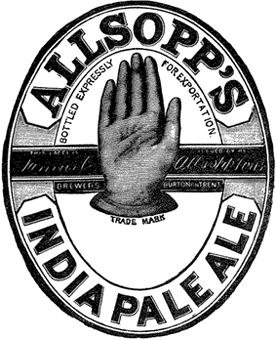
All the essentials are in place, with a purely French approach to cooking, ample quantities of meats, purely dispensable veggies, abundant wine from around the world, and the requisite “correct” imported beer list; none of that new-fangled German beer, and heaven forbid the inclusion of locally-made “Porter and Ale.” Instead, the beer stars are Guinness (then as now, imported from Dublin) and Allsop’s India Pale Ale from the United Kingdom.

Amazing. This still would have been the best beer list in Louisville in 1957, and as recently as the 1970s. We’ve come a long way, baby … and sometimes, not at all.

Photo credits:


Saturday, June 22, 2013

"NABC vs. Floyd County Health Department", at Louisville Beer Blog.


Kevin Gibson's Louisville Beer Blog delivers as promised: It's a locally-oriented, fun look at the Louisville beer scene. He's a longtime LEO columnist and free-lance writer.

Kevin offers a solid take on the current imbroglio afflicting my world here: wordpress.com/2013/06/21/nabc-vs-floyd-county-health-department/">NABC vs. Floyd County Health Department).

My thought about this strange and sudden clamp-down is “why?” Baylor called it a “power grab” in a press statement and filed an appeal, standing up for the fact that this abrupt mandate has no precedent. Meanwhile, Floyd County Health Officer Dr. Tom Harris is calling it a “state regulation,” and that vendors pouring beer at any public event must indeed pony up the $20 for a food permit. Yet, Baylor, who has been doing business in Floyd County and the surrounding areas for years, has never experienced it or even gotten a whiff of it until now.

Photo courtesy of Kate Caufield.

Wednesday, April 28, 2010

Falls City Beer? It's in today's LEO.

A month ago I ran into David Easterling at River City Distributing annual beer expo, and he gave me the lowdown on his "new" Fall City, which I turned into a formal interview and wrote as one of my Mug Shots columns for LEO. In turn, my editor Sara Havens informed me that Kevin Gibson had already written a Falls City piece for the newspaper's pre-Derby Bar Guide, released today.

Much to my delight, we didn't approach the return of Falls City from the same angle (with one fatherly exception), and so both of us are published back to back in today's issue.

The return of Falls City beer - my interview and a bit of the brand's history.

New Falls City Catching on with local beer drinkers - Kevin visited two Louisville taverns for feedback from the drinking public.