A weekly web column by Roger A. Baylor.
Like so many other local beer people, I’ve been reading Kevin Gibson’s new book. It’s called Louisville Beer: Derby City History on Draft, and I picked it up just as I was finishing another, arguably weightier tome: Thinking the Twentieth Century, by the late Tony Judt, with Timothy Snyder.
One is a specific account of beer’s rise, fall and resurgence in Louisville, and the other a series of far-ranging conversations about 20th-century intellectual history. These may seem unrelated, and in many respects they are. However, there are points of convergence; more about that in a moment.
The last book to be written about Louisville beer was Louisville Breweries: A History of the Brewing Industry in Louisville, by Conrad Selle and Peter Guetig. It was published in 1997 and printed only once (I understand Peter is contemplating a revised edition). Obviously, much has changed since then, with breweries coming and going, and Kevin’s Louisville Beer provides ample coverage of our contemporary period.
I haven’t yet gotten to this second, more recent half of Kevin’s story. Rather, it is the first sections of his book that I find compelling, as he seeks to depict what beer really meant, day in and day out, in a place like Louisville prior to the era of Prohibition.
Broadly speaking to post-Colonial times and the early 1800s, beer arguably was of secondary consideration to cider and whisky – until substantial numbers of Germans began coming to this area following the disruptive revolutions of 1848.
Germans brought with them the technological underpinnings of lager brewing, which was about to explode into a worldwide phenomenon. More importantly to daily life in Louisville, they came equipped with cultural proclivities, which included beer as an integral part of social life. Because these immigrants enjoyed their tankards, it was a natural next step for “Know Nothing” nativists to conflate beer with immigration, and to incorporate xenophobia into what evolved as the temperance movement.
In short, there was Carrie Nation-building: God says drinking is bad, but forget that; just look at those non-English speaking, beer-drinking immigrants taking our jobs … and what’s more, we’d all work harder and be more efficient cogs of capitalism if we were sober. Hatchets fly, and nutrition becomes a crime. Rinse and repeat in the here and now.
---
And so we see that in the late 19th-century, some Louisville neighborhoods closely resembled the Fatherland, and these areas would have reminded me very much of those German milieus I was so eager to experience a century later during the 1980s.
It should suffice to note that beer was consumed voluminously at work and play, while bowling and playing baseball, during weddings and funerals, and in morning and nighttime. There were dozens of breweries, and rushing the growler meant dispatching one’s 10-year-old to the corner saloon, laden with a metal bucket. Some people succumbed to alcohol-induced diseases, while others sweated out the beer and lived to ripe old ages. Life went on, as it tends to do.
Prohibition came very close to wiping the slate clean. There were surviving breweries after Repeal, and some (Falls City, Oertel’s, Fehr’s) did quite well for a long time, but by the time of the Reagan administration, none remained in operation. Around 1990, David Pierce fortuitously brewed a batch at Charley’s Restaurant on Main Street in Louisville, and then he opened the Silo in 1992. Times began changing.
Since then, we’ve spent countless hours and brain cells debating whether this new “craft” beer era represents a restoration of the past, or a revolution. This consideration brings me back to Tony Judt, the historian.
---
During the course of his reflections, Judt asks a question: “What is the purpose or nature of history?” He follows it with another statement, “You cannot invent or exploit the past for present purposes.”
As I think about Kevin’s depiction of pre-1900 Louisville beer as an all-pervasive cultural norm, it seems to me that quite often I’ve done precisely as Judt admonishes. In fact, we all have. We’ve exploited the previous history of local beer to explain our present purposes, and to claim cultural (and mercantile) territory for ourselves. The problem is that by doing so, we consistently fail to account for how pervasively craft- and locally-driven 19th-century beer and beer culture really were.
Yes, beer came from elsewhere in America, floating down the river on boats and later in railway cars. Occasionally, beer came from very far away (see below). But the bulk of the beer produced in the neighborhood breweries of old were consumed nearby, within the neighborhood. Brewpubs of the current era generally have remained true to this model, production breweries of any size, less so.
In the end, it would be fascinating to know more about the business motivations of these 19th-century brewers. Were they content with being small and local, with limited range, or were they open to the idea of acquiring capital through hook or crook, and expanding to ship beer longer distances according to the capitalist export-driven ideal? We probably can’t know, although speculation’s worth a beer or three.
Judt also makes this observation:
“A history book – assuming its facts are correct – stands or falls by the conviction with which it tells its story. If it rings true to an intelligent, informed reader, then it is a good history book. If it rings false, then it is not good history, even if it’s well written by a great historian on the basis of sound scholarship.”
Louisville Beer passes this test. We can quibble over details, and yet it matters less what we know now about brewing methods and stylistic categorization, and more that in olden times, people were not aware of these details. Being a beer drinker in Louisville in the year 1890 was not about checking-in, chasing and hoarding. Rather, it likely involved a healthy dollop of German-ness; came accompanied with a good deal of child-like mystery as to the process; and resulted in prodigious intake in the relative absence of plasticized tap water, smoothies and teeth-corroding “soft” drinks.
In a future column, I’ll survey the “contemporary” section of Kevin’s book. Until then, we close with something posted to the Louisville Restaurants Forum many years ago. It’s a restaurant menu, with wine list and libations, from the Louisville Hotel, circa 1857.

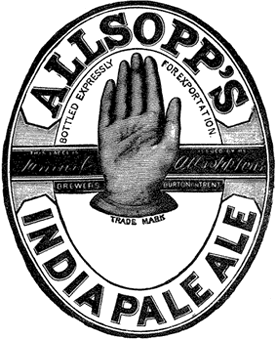
All the essentials are in place, with a purely French approach to cooking, ample quantities of meats, purely dispensable veggies, abundant wine from around the world, and the requisite “correct” imported beer list; none of that new-fangled German beer, and heaven forbid the inclusion of locally-made “Porter and Ale.” Instead, the beer stars are Guinness (then as now, imported from Dublin) and Allsop’s India Pale Ale from the United Kingdom.
Amazing. This still would have been the best beer list in Louisville in 1957, and as recently as the 1970s. We’ve come a long way, baby … and sometimes, not at all.
Photo
credits: