The following listing of new, "temp" bottled beers is from the most recent edition of Publicanista!, the official newsletter of the New Albanian Brewing Company, Rich O's Public House and Sportstime Pizza. I've tasted all but the Cassissona, and the excellence is uniform.
To begin with, who says there aren’t craft-brewed beers in Italy? Cassissona is a cassis-infused, bottom-fermented beer matured for six months in the bottle before release. 6.5% abv. Brewed near Como by Birrificio Italiano. A pretty 750 ml bottle of Cassissona goes for $16.00 on premise, and like all bottled beers, it is less for carry out.
Have I lost my mind? Two Italian beers that aren’t Peroni or Moretti? Maybe so, but I’m really excited about Panil Barriquee – dark, sour, Belgian-like, aged in Cognac barrels, and brewed in a suburb of Parma. 8% abv, $19.50. See also some really good comments about Panil Barriquee at RateBeer ratings and reviews.
At the recommendation of Emily, my always-helpful World Class Beverages representative, I’ve purchased a case of Rogue Chipotle Ale, which is said to be a refashioned version of the old Mexicali Rogue. Amber in color, with the typical house character of Rogue, the ale is lightly seasoned with smoky, peppery notes. 22 oz bombers, $6.75.
Uerige Doppel Sticke comes from Dusseldorf’s ranking Altbier brewery, and is a new creation that begins with the special recipe “Sticke,” but turns up the volume to beyond Doppelbock strength (8.5% abv). An 11.2 oz bottle sells for $6.00 (on premise).
Thursday, August 11, 2005


Monday, August 08, 2005
Brew at the Zoo tickets are now available.
Here's the press release -- tickets are available at NABC.
It’s that time of year again: Brew at the Zoo 2005! This year’s event, sponsored by BBC Beer Company, will again feature local beer, local wine, local food, and local music….all brought to you at the beautiful Louisville Zoo.
Brew at the Zoo takes place on Saturday, August 27, from 4 to 8 p.m. at the Oasis Field in the Louisville Zoo. Your ticket gets you admission to the Zoo along with the event.
In addition to last year’s participating breweries -- both Louisville BBCs, Cumberland Brews, Browning's Brewery and New Albanian, regional microbreweries like Oaken Barrel Brewing Company, Broad Ripple Brewing Company, Mad Anthony Brewing Company, Kalamazoo Brewing Company (Bell’s), and Hofbrauhaus Newport will be in attendance.
And while you’re there, be sure to check out the raffle prize baskets, containing gift certificates from participating restaurants and breweries, T-shirts, and a host of Zoo goodies.
Tickets can be purchased in advance at your local microbrewery for $25. Advance tickets purchased at the Zoo are $30, and tickets purchased the day of the event are $35.
It’s that time of year again: Brew at the Zoo 2005! This year’s event, sponsored by BBC Beer Company, will again feature local beer, local wine, local food, and local music….all brought to you at the beautiful Louisville Zoo.
Brew at the Zoo takes place on Saturday, August 27, from 4 to 8 p.m. at the Oasis Field in the Louisville Zoo. Your ticket gets you admission to the Zoo along with the event.
In addition to last year’s participating breweries -- both Louisville BBCs, Cumberland Brews, Browning's Brewery and New Albanian, regional microbreweries like Oaken Barrel Brewing Company, Broad Ripple Brewing Company, Mad Anthony Brewing Company, Kalamazoo Brewing Company (Bell’s), and Hofbrauhaus Newport will be in attendance.
And while you’re there, be sure to check out the raffle prize baskets, containing gift certificates from participating restaurants and breweries, T-shirts, and a host of Zoo goodies.
Tickets can be purchased in advance at your local microbrewery for $25. Advance tickets purchased at the Zoo are $30, and tickets purchased the day of the event are $35.
Thursday, August 04, 2005
Check out the L&N Wine Bar & Bistro's Local Microbrew Dinner on Monday Aug. 8 at 7:00 p.m.
I’ve copied the following post by Robin Garr from his Louisville Restaurants Forum, which quite simply is the only place to go while on-line for comprehensive discussions of dining out in this area.
The topic is a “local microbrew” beer dinner at L & N Wine Bar this coming Monday night. I’d have written something myself, but I was either too busy, too lazy, or would rather give Robin a plug, anyway.
---
I know we've been talking a lot about L&N Wine Bar's upcoming Beer Dinner on the forum, but it just occurred to me that I've neglected to post the specifics, including the course and beer lineup, time and reservation info. If you haven't already signed on (and it's going to be a great one), here are the particulars - thanks to Len for filling me in.
L&N Wine Bar & Bistro ... Local Microbrew dinner, Monday Aug. 8, 7 p.m.
This should be a great time for any beer lover and provides a unique opportunity to sample multiple beers from all four of our local microbreweries paired with a great meal, with representatives from all four breweries present. GM Tom Schreier will be present along with Scott Shreffler, L&N's assistant manager and resident beer guru. Here's the menu.
First course
Pan seared diver scallops, jumbo shrimp, and mussels in a light fennel/butter sauce spiced with a hint of chili's.
Beers: New Albanian Brewing Company Kaiser, BBC Golden Ale, Browning's IPA.
Second course
Baby spinach, arugula, and frisse, tossed in a warm applewood smoked bacon & Capriole Farm goat cheese and white balsamic vinaigrette, with candied walnuts.
Beers: NABCCone Smoker, BBC Pale Ale, Browning's ESB
Entrée
Grilled Beef Tenderloin filet w/ Point Reyes bleu cheese grits, grilled Field Day heirloom tomatoes, and a cracked black pepper demi-glace.
Beer: NABC Bob's Old 15-B Porter, BBC Nut Brown Ale, Browning's Porter
Dessert
Cumberland Brew Nitro Porter Ice Cream.
Cost is $45 per person, not including tax & gratuity, and the dinner begins at 7:00 p.m. on Aug. 8 (Monday). Reservations are required - call (502) 897-0070.
The topic is a “local microbrew” beer dinner at L & N Wine Bar this coming Monday night. I’d have written something myself, but I was either too busy, too lazy, or would rather give Robin a plug, anyway.
---
I know we've been talking a lot about L&N Wine Bar's upcoming Beer Dinner on the forum, but it just occurred to me that I've neglected to post the specifics, including the course and beer lineup, time and reservation info. If you haven't already signed on (and it's going to be a great one), here are the particulars - thanks to Len for filling me in.
L&N Wine Bar & Bistro ... Local Microbrew dinner, Monday Aug. 8, 7 p.m.
This should be a great time for any beer lover and provides a unique opportunity to sample multiple beers from all four of our local microbreweries paired with a great meal, with representatives from all four breweries present. GM Tom Schreier will be present along with Scott Shreffler, L&N's assistant manager and resident beer guru. Here's the menu.
First course
Pan seared diver scallops, jumbo shrimp, and mussels in a light fennel/butter sauce spiced with a hint of chili's.
Beers: New Albanian Brewing Company Kaiser, BBC Golden Ale, Browning's IPA.
Second course
Baby spinach, arugula, and frisse, tossed in a warm applewood smoked bacon & Capriole Farm goat cheese and white balsamic vinaigrette, with candied walnuts.
Beers: NABCCone Smoker, BBC Pale Ale, Browning's ESB
Entrée
Grilled Beef Tenderloin filet w/ Point Reyes bleu cheese grits, grilled Field Day heirloom tomatoes, and a cracked black pepper demi-glace.
Beer: NABC Bob's Old 15-B Porter, BBC Nut Brown Ale, Browning's Porter
Dessert
Cumberland Brew Nitro Porter Ice Cream.
Cost is $45 per person, not including tax & gratuity, and the dinner begins at 7:00 p.m. on Aug. 8 (Monday). Reservations are required - call (502) 897-0070.
Wednesday, August 03, 2005
Jim Koch of Sam Adams scores points with the Curmudgeon by "insisting glass is best."
Thanks to loyal reader Dave for this self-explanatory link:
Head-to-head war: bottles vs. cans -- founder of Sam Adams sparks industry brouhaha by insisting glass is best.
I've had my differences with Jim Koch, but will go with him on this one. Here's the crucial excerpt:
Koch, considered a microbrewing industry pioneer, maintains that canned beer runs the risk of imparting a metallic taste. Although plastic protects the inside of the can, Koch says the tab and lip of the aluminum can -- where people sip their beer -- is exposed.
The undiagnosed problem is that people DRINK BEER FROM CANS. Insofar as the nation's mass-market swillmeisters condone such behavior, it hardly matters given the lack of flavor inherent in their products, but for a craft beer brewer to do so?
Hate to say it, but Koch's right.
Head-to-head war: bottles vs. cans -- founder of Sam Adams sparks industry brouhaha by insisting glass is best.
I've had my differences with Jim Koch, but will go with him on this one. Here's the crucial excerpt:
Koch, considered a microbrewing industry pioneer, maintains that canned beer runs the risk of imparting a metallic taste. Although plastic protects the inside of the can, Koch says the tab and lip of the aluminum can -- where people sip their beer -- is exposed.
The undiagnosed problem is that people DRINK BEER FROM CANS. Insofar as the nation's mass-market swillmeisters condone such behavior, it hardly matters given the lack of flavor inherent in their products, but for a craft beer brewer to do so?
Hate to say it, but Koch's right.
Monday, August 01, 2005
PC in GA: Beers in Savannah.
Savannah, Georgia is a very old city that was freshly immortalized a decade ago in a book I didn’t read and a subsequent movie I failed to watch, which means that among the multitudes of tourists visiting the city during a typical week in July, my mind may have been the only one uncluttered by preconceived notions of dark mysteries and sepulchral sculptures – not to mention Forrest-you-know-who, munching chocolates on a park bench and making you have bad dreams about LBJ whether you choose to or not.
Blessed with a thriving and diversified economy, and afflicted with an exurb as sprawling as any, Savannah’s downtown historical preservation district is justly celebrated. Small and symmetrical for ridiculously easy navigation, and yet sufficiently large to allow getting a bit lost if the mood strikes, the district’s streets are tailor-made for wandering from pub to espresso bar to tidy oak-canopied square oozing genteel charm and Spanish moss.
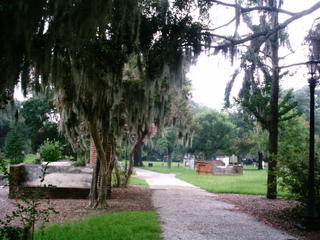
Arriving in town at midday on Sunday, we reported immediately to the Planter’s Inn facing Reynolds Square, checked in, and parked the car in the adjacent garage, where it remained until departure on Tuesday morning.
The desk clerk’s recommendation for a quick midday bite was to walk three blocks to the City Market, an ongoing urban renewal effort undoubtedly intended to disperse the crowds that descend upon the waterfront River Street. There we found Vinnie Van Go Go’s, an above-average pizza joint, and dined sumptuously on various combos of sun-dried tomatoes, pineapple, anchovies and jalapeno peppers.
Savannah Fest from the Moon River brewpub was listed as being on tap at the pizzeria, but upon inquiring, I learned that the same outfit’s summer special Wheezy Heifer had been substituted for the lager. Given my mixed feelings about wheat ales, I opted for water to smooth the way down to the bottom for my beloved little fishies.
It makes me tingle just thinking about it.
Later that evening, Moon River Brewing Company was selected as the venue for an evening meal and sampling. Savannah’s only brewpub is located on Bay Street, just a short stroll and a twenty-foot drop (by stairs) from River Street and nightly party festivities roughly comparable to the arena license ambience of Louisville’s Fourth Street Live. Moon River is just far enough away from the young River Street crowd to be relaxed, but it, too, can issue you a plastic cup for taking beer out into the street, which is legal in the city.
Moon River occupies the ground floor of a former hotel that dates to the early 1800’s, and has been remodeled several times since. Décor is predominantly wood, with some pastel wall tints and pleasant artwork on display. Mercifully unlike Hilton Head Brewing Company, point-of-sale materials for mass-market swill are not in garish, overbearing evidence, and although two famous brands of alcoholic soda pop are sold, they’re neither promoted heavily nor priced competitively.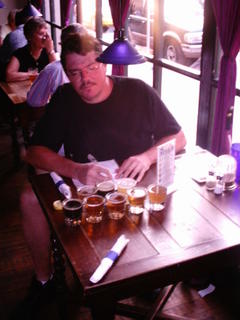
My house-brewed sampler tray included:
Wild Wacky Wit
A Belgian-style wheat ale in the Hoegaarden tradition, with a good balance of coriander and citrus, but less than optimal head retention. A good effort, though admittedly not my favorite style unless I’m riding a bicycle in Belgium.
Moon Light
A reduced-character version of the Fest, pale and inoffensive, with hints of fruity esters that transcend the style, but the central point is this: Moon River has a light beer, so there’s no sense in accepting less than full mark-up on bottles mass-market swill. Kudos for that attitude.
Savannah Fest Bier
Not overly hoppy, and hinting broadly at a Dortmunder style, it tasted even better with Viet-Thai cuisine the following night at the Saigon restaurant on Broughton Street.
Swamp Fox India Pale Ale
Clocking in at 7% is the pick of the Moon River litter, namesake of the legendary Revolutionary War guerilla fighter that the hip-hop generation has never heard of, and not at all ironically, hip-hoppiest beer in Savannah.
The Captain Porter
Restrained English character, drinking lighter than its 6% strength, with plenty of chocolate notes, and overall, good Anglo-Porter flavor.
Wheezy Heifer
A veritable unfiltered American-style wheat textbook on the many problems associated with such an abominable style. Certainly there is wheat character in abundance, but no balancing esters or phenols as in the Belgian or German varieties, and with a very blunt, harsh finish. Fruit slices would have to be added to save this beer … please, don’t get me started.
Gallery Espresso Stout
Thin-bodied stout with assertive, pronounced espresso flavor owing to “cold infusion” of beans from the Gallery Espresso café on Bull Street (across from Six Pence Pub). “Okay,” said the Missus, “but I’d need sugar and cream.”
Mai-Rye Bock
Warming pale bock, albeit a medium-bodied one at best, with the clean lager character suitably nailed, but the requisite malt richness lacking. Still, quite enjoyable at 7.6%.
Swamp Fox IPA won the coin-flip competition to stand alongside a steak and baked potato, beating out Mai-Rye by a handful of delicious hop cones.
All things considered, Moon River was an excellent experience for us, and I recommend it, but do be forewarned that the brewpub’s menu refers to the American Civil War as the “war of northern aggression,” and speaking for myself alone, I find this sort of sentiment patently unamusing.
Amid numerous walks and rest stops in recognition of the steadily escalating heat index, Monday afforded time for lunch at Kevin Barry’s Pub on River Street.
It is claimed by one or another authority that Savannah hosts the second or third largest St. Patrick’s Day festival in the United States, and perhaps that or another on-line poll has confirmed Kevin Barry’s to be one of the Top Ten Irish pubs in America, and be all this as it may, it’s a fine establishment, anyway, though perhaps touched by a smidgen of the blarney when it comes to ratings and rankings.
The pub’s home in a 200-year-old cotton warehouse is exemplary, with then-ancient virgin timbers supporting the ceiling and ballast stones from ships used in the walls. The paper placeholder menus tell the story of Irish literary figures like Brendan Behan, George Bernard Shaw and James Joyce, though not of the ranking Irish bard, Bono.
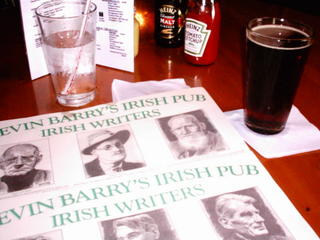
It’s the usual lineup of Irish ales at Kevin Barry’s, and in this there’s no disgrace at all, because Guinness is a refreshing quaffer of unmatched thirst-quenching character on a sultry day (or night, or morning), and at $4.00 for an Imperial pint, relatively inexpensive. Oddly, contract-brewed Charleston Brown Ale is the same price for a 16-oz mixer. The Reuben is good, and there’s live Hibernian tunes every night for a nominal $2.00 cover charge.
Our final pub stop on Monday night was the Six Pence Pub on Bull Street, which is spotted quite easily by using the red phone booth outside as a point of reference. A branch of the Mellow Mushroom pizza chain lies just around the corner, and Gallery Espresso is a short stumble away. Six Pence features reasonably priced English pub grub, i.e., Shepherd’s Pie and the like, has a short draft list that’s good, and generally speaking, boasts a comfortable, chatty, neighborhood feel.
A final nocturnal glance at a stately handful of Savannah’s squares, fountains and statuary, sans plastic go-cups, brought the Georgia portion of the trip to a close.
Next time: Charleston, South Carolina.
Sunday, July 31, 2005
PC in SC: Hilton Head Brewing Company.
It isn’t so bad joining a snail’s pace queue at the departure gate to await an explanation as to why airplanes don’t carry spare tires in the trunk like cars do, and it’s even tolerable in such an emergency to depend on a corporate entity like Starbucks to provide caffeine sufficient to ride out the bureaucratic process, but to be forced to endure mid-1970’s musical dreck like Tony Orlando & Dawn, the Starland Vocal Band and Bread goes beyond the pale of acceptable stress in a civilized society, proving yet again that torture is not the best way to solicit compliance.
In the end, the tire wasn’t even bad, although US Airways didn’t make the call until after painstakingly rerouting most of the steaming passengers in front of us, and our flight from Louisville to Charlotte was only minutes late. After the connection there, touchdown in Savannah, and a visit to Budget, we hit the highway in search of the fabled recreational paradise of Hilton Head and my family reunion headquarters for 2005.
Had the reunion not been held at Hilton Head, it is doubtful we’d have visited any time soon, but in the end, it was a good experience.
In short order, we learned that Hilton Head is a 42-square-mile island off the South Carolina coast that was the home of a dozen antebellum cotton plantations (overseers and slaves only, owing to the pestilential conditions), and as recently as 1950 was without electricity and still strictly agrarian.
There are now 30,000 year-round residents, two million annual visitors, bicycles galore and whole families atop them, 300 eateries, 25 gold courses, more gated cul de sacs than Arlington National (cemetery, not golf course – Jesus, put the clubs away, will you) has tombstones, and one museum devoted to the only truly unique and interesting sociological phenomenon on the island, African-American “Gullah” culture.
Hilton Head itself is an open-air museum not so much of the wealthy, who indeed are different than us, so much so that like certain species of wildlife, they’re only seen at dawn before retiring for the night behind the very poshest of the velour gates, but of the upwardly mobile nouveau riche, the Bush-voting, golf bag-toting, chardonnay-sipping former occupant of the middle class for whom Hilton Head and places like it have been specifically constructed in the fashion of a Disney-like homage to serve the interests of the culturally clueless.
But there’s a brewpub on Hilton Head, so we went to check it out.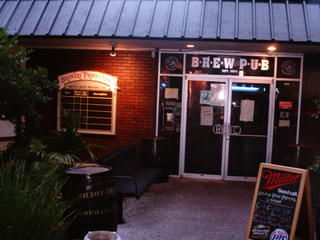
Hilton Head Brewing Company is located just off the traffic circle that leads into the Sea Pines area of the island, where we had the questionable fortune to be booked into a room in the South Beach/Salty Dog complex of tourist establishments. That being said, at least we had beach access a few hundred yards away, and immediate proximity to the Land’s End Tavern, where Palmetto Pale Ale (Charleston), as good a Sierra Nevada Pale Ale clone as you’ll find in the Low Country, is available on tap.
Thumbs up to that, and back to the brewpub. It’s hard to find, being one of several pubs and restaurants comprising a freestanding food court of sorts just off Greenwood Drive.
Like many brewpubs, perhaps even the majority, Hilton Head Brewing Company sends out numerous mixed signals, touting mass-market swill by means of typically obnoxious point-of-sale materials alongside an attractive, exposed brew house, and having not one but two “kid’s nights” weekly while selling all the foo-foo mixed umbrella drinks their parents can throw back … and so on.
Ultimately, one must judge the beer, and I was pleasantly surprised. The four styles sampled were Pub Light, South Atlantic Pale, Calibogue Amber and Raspberry Wheat, and only the latter was perfumed and forgettable.
The light is golden and bears hints of Kolsch-like fruitiness, and the pale ale is mild and Cascade-driven. The Calibogue is chunky for the style, with an a.b.v. in the 6% range, and malty sweet. I was tempted to mix the amber and the pale ale to take a bit of the sweet edge off the stronger ale, but in the end went with a full pint of South Atlantic to accompany moderately spicy chicken wings and my yearly hamburger with mushrooms and blue cheese.
That’s right, yearly. My previous burger was consumed in St. Louis at a Cardinals-A’s game in June, 2004 … but of course, White Castles and other hangover medicines don’t count.
We purchased a 2-liter signature growler with a swing-cap stopper for $20, and called it an evening. The Calibogue stood up nicely to a catered reunion barbecue feast on Saturday that boasted a mustard-laced, vinegary sauce atop finely pulled, almost grated pork, with collard greens and sweet potatoes on the side.
The grocery stores and supermarkets on Hilton Head island are reasonably well stocked with craft beers (Palmetto, Sierra) and the usual mainstream imports like Guinness and some of the German pilsners, a few of which are to be sighted on tap at various establishments.
Combined with the ales available at the brewpub, the situation is by no means desperate – and certainly helped with navigating the family festivities, which sometimes resemble the ambience of the airport musical selection.
Next time: Savannah, Georgia.
Saturday, July 30, 2005
If you missed today's Microbrewers Festival in Indy, you missed an incredible array of craft brews, with nary a can of mass-market swill in sight.
Indiana’s tenth Microbrewers Festival, which is staged annually by the Brewers of Indiana Guild and associated sponsors, and benefits the Northside Optimist Club, was held earlier today at Opti-Park in Broad Ripple in Indianapolis.
Having just returned from South Carolina on Thursday and been forced to work much of the day Friday, I limited my stay at the festival to the three hours immediately preceding the opening of the gates and the arrival of the paying customers.
And, to a dozen or so small samples. Really.
Pre-fest always is the best time to jaw with brewery friends and reps, because everyone’s working to keep their heads above water once the crowd storms the gates, and today was no exception.
While making the rounds, I enjoyed some excellent sips, including the supple, spiced Grand Cru from Indy’s newest brewpub, Brugge Brasserie; an excellent barrel-aged barley wine from Lafayette Brewing Company; and some of the elusive, fuller-than-full, multigrain Breakfast Stout from Founders in Grand Rapids, Michigan.
Veronica Sanders was there to boast about Bell’s Two Hearted Ale, winner of the best of show in the 2005 commercial category in the Indiana State Fair judging and inheritor of the title held by New Albanian since 2004. As regional microbrewing haven, Michigan was well represented this year, with New Holland, Dark Horse, Stoney Creek and Arcadia present in addition to Kalamazoo and Founders.
Marvin McKay says that he’s slowly but surely assembling the pieces of his intended follow-up to the late, lamented Chalkie’s, and may be up and running in a yet-to-be-disclosed location early in 2006. Best of luck to him; Marvin’s one of the classiest fellows in the business.
Both Cavalier and World Class distributors brought a boatload of good beers from across the United States – too many to mention here..
Just before leaving to meet Diana and search out a place to celebrate my forthcoming birthday (you’ll just have to guess how old), I had the good sense to say hello to Ken Price, brewer at Oaken Barrel Brewing Company in Greenwood, and Ken informed me that his Saison was on tap at the pub. What’s more, he recommended today’s Oaken Barrel kitchen special, a smokehouse combo of ribs, pulled pork, baked beans and corn on the cob.
Half an hour later, we were at Oaken Barrel’s doorstep. Ken’s Belgian-style Saison is clean and subtly fruity and finishes dry, with the requisite peppery notes. While neither overly complex nor Baroque, there’s still much to tease and tempt the palate, and a better complement to garlic-laced barbecue with a thick, sweet and tangy sauce is difficult for me to imagine … unless, of course, the meal were served in Belgium, not Greenwood. Nothing against the latter, mind you, but I’m funny about geography.
The fruits of today’s festival networking won’t be immediately apparent to Rich O’s patrons, but remember: It’s only nine or so weeks until Lupulin Land Harvest Hop festival.
Having just returned from South Carolina on Thursday and been forced to work much of the day Friday, I limited my stay at the festival to the three hours immediately preceding the opening of the gates and the arrival of the paying customers.
And, to a dozen or so small samples. Really.
Pre-fest always is the best time to jaw with brewery friends and reps, because everyone’s working to keep their heads above water once the crowd storms the gates, and today was no exception.
While making the rounds, I enjoyed some excellent sips, including the supple, spiced Grand Cru from Indy’s newest brewpub, Brugge Brasserie; an excellent barrel-aged barley wine from Lafayette Brewing Company; and some of the elusive, fuller-than-full, multigrain Breakfast Stout from Founders in Grand Rapids, Michigan.
Veronica Sanders was there to boast about Bell’s Two Hearted Ale, winner of the best of show in the 2005 commercial category in the Indiana State Fair judging and inheritor of the title held by New Albanian since 2004. As regional microbrewing haven, Michigan was well represented this year, with New Holland, Dark Horse, Stoney Creek and Arcadia present in addition to Kalamazoo and Founders.
Marvin McKay says that he’s slowly but surely assembling the pieces of his intended follow-up to the late, lamented Chalkie’s, and may be up and running in a yet-to-be-disclosed location early in 2006. Best of luck to him; Marvin’s one of the classiest fellows in the business.
Both Cavalier and World Class distributors brought a boatload of good beers from across the United States – too many to mention here..
Just before leaving to meet Diana and search out a place to celebrate my forthcoming birthday (you’ll just have to guess how old), I had the good sense to say hello to Ken Price, brewer at Oaken Barrel Brewing Company in Greenwood, and Ken informed me that his Saison was on tap at the pub. What’s more, he recommended today’s Oaken Barrel kitchen special, a smokehouse combo of ribs, pulled pork, baked beans and corn on the cob.
Half an hour later, we were at Oaken Barrel’s doorstep. Ken’s Belgian-style Saison is clean and subtly fruity and finishes dry, with the requisite peppery notes. While neither overly complex nor Baroque, there’s still much to tease and tempt the palate, and a better complement to garlic-laced barbecue with a thick, sweet and tangy sauce is difficult for me to imagine … unless, of course, the meal were served in Belgium, not Greenwood. Nothing against the latter, mind you, but I’m funny about geography.
The fruits of today’s festival networking won’t be immediately apparent to Rich O’s patrons, but remember: It’s only nine or so weeks until Lupulin Land Harvest Hop festival.
Thursday, July 28, 2005
Back from the Palmetto State, with more beer to come.
It’s difficult to maintain that you’ve returned from a brief vacation feeling “refreshed” when temperatures were in the high 90’s throughout.
However, on two of the days a morning dip in the ocean provided a respite from the heat and humidity, and of course, the tourist infrastructure is air-conditioned.
Importantly, there were more decent local beers than I’d been led to believe existed in the South Carolina and Georgia coastal “lowcountry”.
Perhaps they weren’t always spectacular beers, but they were drinkable, nonetheless, and occasionally quite good.
Specifically, I’d have killed for Palmetto Pale Ale on Friday night, when my cousins catered a lovely “lowcountry boil” on the grounds of a top-dollar and thoroughly Dickensian modern housing development near Beaufort (that’s pronounced BYOO-ferd, blue staters).
The concept of the boil is grand, indeed. Fresh shrimp, crawdads and any additional available seafood, ears of corn, kielbasa and new potatoes are cooked with a propane torch in a gigantic pot, unceremoniously dumped atop the table in trays and greedily devoured.
My family being, well, my family, a pony keg of Miller Lite was thoughtfully iced and tapped.
I drank Coke, itself a southern innovation.
Owing to Allen family demographics, these once-a-year family reunion trips almost always will almost always take place in the deepest, red-state South in late July. Last year’s was held near Atlanta, and in 2006, Orlando will be the venue. The exceptions will be hosted by my cousins in Madison, Indiana, and me (in 2010).
When it's my turn, I'm aiming to have fabricated evidence pointing to a long-lost German branch of the family tree, and organizing a Bamberg idyll.
Given the realities of my situation, one must be prepared to execute the famed lemonade conversion, and so time was devoted to surveys of historic Savannah and Charleston following the family festivities on Hilton Head. In all three locales, good beer was to be found ... and it saved my life.
There’ll be more here on these beers, breweries and pubs, although a working day on Friday and the 10th Annual Indiana Microbrewers Festival in Indianapolis on Saturday must come first.
It’s always good to be back.
However, on two of the days a morning dip in the ocean provided a respite from the heat and humidity, and of course, the tourist infrastructure is air-conditioned.
Importantly, there were more decent local beers than I’d been led to believe existed in the South Carolina and Georgia coastal “lowcountry”.
Perhaps they weren’t always spectacular beers, but they were drinkable, nonetheless, and occasionally quite good.
Specifically, I’d have killed for Palmetto Pale Ale on Friday night, when my cousins catered a lovely “lowcountry boil” on the grounds of a top-dollar and thoroughly Dickensian modern housing development near Beaufort (that’s pronounced BYOO-ferd, blue staters).
The concept of the boil is grand, indeed. Fresh shrimp, crawdads and any additional available seafood, ears of corn, kielbasa and new potatoes are cooked with a propane torch in a gigantic pot, unceremoniously dumped atop the table in trays and greedily devoured.
My family being, well, my family, a pony keg of Miller Lite was thoughtfully iced and tapped.
I drank Coke, itself a southern innovation.
Owing to Allen family demographics, these once-a-year family reunion trips almost always will almost always take place in the deepest, red-state South in late July. Last year’s was held near Atlanta, and in 2006, Orlando will be the venue. The exceptions will be hosted by my cousins in Madison, Indiana, and me (in 2010).
When it's my turn, I'm aiming to have fabricated evidence pointing to a long-lost German branch of the family tree, and organizing a Bamberg idyll.
Given the realities of my situation, one must be prepared to execute the famed lemonade conversion, and so time was devoted to surveys of historic Savannah and Charleston following the family festivities on Hilton Head. In all three locales, good beer was to be found ... and it saved my life.
There’ll be more here on these beers, breweries and pubs, although a working day on Friday and the 10th Annual Indiana Microbrewers Festival in Indianapolis on Saturday must come first.
It’s always good to be back.
Monday, July 18, 2005
Here’s one we missed: North Korean official visits Chinese brewery.
Sunday, July 17, 2005
New Albanian Brewing's porter to become "old," but not as a result of aging.
Every other week, and sometimes more often if there’s time, I write Publicanista!, the official newsletter of Rich O’s Public House, the New Albanian Brewing Company and Sportstime Pizza.
You can subscribe to this on-line newsletter by going to www.newalbanian.com and following the directions in the box to the bottom right of the page.
Here’s an excerpt from last week.
NABC brewer Jesse Williams has a batch of Bob’s 15 B porter on the way, and therein a problem has arisen. Evidently, the official numbering scheme for style and sub-style definitions has changed, and according to the Beer Judge Certification Program, 15 B now refers to German Dunkel Weizen.
I’m inclined to leave the name unchanged for the sake of tradition, and to observe the vital dictates of remaining contrarian at all times with respect to style, but your thoughts are appreciated. Next Friday (July 22) we’ll have a cask-conditioned firkin of Bob’s 15 B pouring from the beer engine.
Both my business partner Amy and longtime FOSSILS club stalwart Ed Tash wrote to suggest that we change the name of the beer to Old 15 B, and Ed included this rationale:
I've been giving some thought to your dilemma, caused by the BJCP changing robust porter from 15 B to 12 B. I suggest you call your Porter "Bob's Old 15 B.”
Here's why. There is book about Jack Daniels whisky published about a year ago that attempts to explain the origin of Jack Daniels Old Number 7.
According to the author, the number 7 was the license number of the Jack Daniels distillery. The borders of the county the distillery was located in changed, and the distillery changed counties (without moving), which caused the distillery to be given a new license number. Jack Daniels had established “7” as a brand name and didn't want to start over with a new name, so he put "Old Number 7" on the barrels, bottles, etc.
I have not read the book, but I heard the author interviewed on WFPL-FM 89.3 when the book came out.
Now you know more about Jack Daniels than you ever wanted to know, but bottom line is that I think you should keep 15 B in the name; your customers already know the name and what to expect from the beer.
Besides, only a handful of geeks know that Robust Porter is now 12 B.
Ed makes a strong case, and Amy agrees -- so it will be.
The forthcoming batch of Bob’s Old 15 B will be the first to bear the qualifier … but not the last.
Cheers.
You can subscribe to this on-line newsletter by going to www.newalbanian.com and following the directions in the box to the bottom right of the page.
Here’s an excerpt from last week.
NABC brewer Jesse Williams has a batch of Bob’s 15 B porter on the way, and therein a problem has arisen. Evidently, the official numbering scheme for style and sub-style definitions has changed, and according to the Beer Judge Certification Program, 15 B now refers to German Dunkel Weizen.
I’m inclined to leave the name unchanged for the sake of tradition, and to observe the vital dictates of remaining contrarian at all times with respect to style, but your thoughts are appreciated. Next Friday (July 22) we’ll have a cask-conditioned firkin of Bob’s 15 B pouring from the beer engine.
Both my business partner Amy and longtime FOSSILS club stalwart Ed Tash wrote to suggest that we change the name of the beer to Old 15 B, and Ed included this rationale:
I've been giving some thought to your dilemma, caused by the BJCP changing robust porter from 15 B to 12 B. I suggest you call your Porter "Bob's Old 15 B.”
Here's why. There is book about Jack Daniels whisky published about a year ago that attempts to explain the origin of Jack Daniels Old Number 7.
According to the author, the number 7 was the license number of the Jack Daniels distillery. The borders of the county the distillery was located in changed, and the distillery changed counties (without moving), which caused the distillery to be given a new license number. Jack Daniels had established “7” as a brand name and didn't want to start over with a new name, so he put "Old Number 7" on the barrels, bottles, etc.
I have not read the book, but I heard the author interviewed on WFPL-FM 89.3 when the book came out.
Now you know more about Jack Daniels than you ever wanted to know, but bottom line is that I think you should keep 15 B in the name; your customers already know the name and what to expect from the beer.
Besides, only a handful of geeks know that Robust Porter is now 12 B.
Ed makes a strong case, and Amy agrees -- so it will be.
The forthcoming batch of Bob’s Old 15 B will be the first to bear the qualifier … but not the last.
Cheers.
Wednesday, July 13, 2005
At least it wasn't served with a tomato wedge.
There was an auction yesterday to settle accounts at Kelly’s Lounge, once a fixture on wide, wide Dixie Highway in Shively.
The auctioneer’s circular didn’t explain the reasons for the bar’s demise, and it can’t be said to matter much to me either way, since I hadn’t been there in almost a quarter century, but the one time I did drop into Kelly’s to have a beer while waiting for a friend, something happened that I’ll always remember.
A man slid onto the barstool next to mine and ordered “the usual,” which was a pitcher of Miller Lite, a frosted glass … and a quart of tomato juice.
He proceeded to mix the light beer and tomato juice half and half until the can was empty and the pitcher was dry, except for the small portion he poured into my glass when I expressed amazement at something I’d never seen done before.
A Miller Lite with flavor, or carbonated tomato juice?
What did the tomato juice ever do to deserve such a fate?
For a list of this and other beer cocktails that you’ll never see me sanction, go here.
The auctioneer’s circular didn’t explain the reasons for the bar’s demise, and it can’t be said to matter much to me either way, since I hadn’t been there in almost a quarter century, but the one time I did drop into Kelly’s to have a beer while waiting for a friend, something happened that I’ll always remember.
A man slid onto the barstool next to mine and ordered “the usual,” which was a pitcher of Miller Lite, a frosted glass … and a quart of tomato juice.
He proceeded to mix the light beer and tomato juice half and half until the can was empty and the pitcher was dry, except for the small portion he poured into my glass when I expressed amazement at something I’d never seen done before.
A Miller Lite with flavor, or carbonated tomato juice?
What did the tomato juice ever do to deserve such a fate?
For a list of this and other beer cocktails that you’ll never see me sanction, go here.
Sunday, July 10, 2005
Dogfish Head's handcrafted Liquor de Malt is good beer, bad marketing.
Our scant allocation of Dogfish Head Liquor de Malt, billed as a bottle-condition, handcrafted malt liquor brewed with three types of corn (7% abv), was one case of twelve 40-ounce bottles, plastic-capped, and each coming with its own paper sack adorned with printed logo.
We quickly sold eleven of the bottles. The twelfth came home with me, and I’ve opted to ignore the explicit directions for proper use and instead pour the beer, sans paper bag, into my preferred tasting vessel, a 15-year-old Slovak pub mug.
Other than NABC’s Turbo Hog, I’ve not sampled an American malt liquor since my last visit to the Great American Beer Festival, when the temptation to relive memories of the early 1980’s compelled me to quaff a taster of Mickey’s Malt Liquor. It just wasn’t the same without tasting it directly from the wide-mouthed green bottle, but the flavor was as I remembered it.
Dogfish Head’s typically quirky version of what, in the American sense, should be an alcoholically enhanced, adjunct-choked lager marketed to those concerned with “bang for the buck” (the mainstream beer world’s equivalent of “raincoater” in porno parlance) is actually fairly good, with a creamy, lingering head and a deep golden hue.
The presence of corn is unmistakable in the palate, with Liquor de Malt exhibiting the sweetness left behind when the cob is tossed into the garbage, but there’s enough malt character for balance, and a hint of the trademark Dogfish hopping for good measure.
The beer itself? It’s fine, and illustrates the redemptive possibilities inherent in a microbrewery’s decision to personalize a mainstream style.
However, I must note that the marketing for Liquor de Malt is in questionable taste; we all know the stereotypes associated with malt liquor – all in good fun, I suppose they’d say, but the symbolism attached to drinking from a paper sack verges on tacky just the same.
We quickly sold eleven of the bottles. The twelfth came home with me, and I’ve opted to ignore the explicit directions for proper use and instead pour the beer, sans paper bag, into my preferred tasting vessel, a 15-year-old Slovak pub mug.
Other than NABC’s Turbo Hog, I’ve not sampled an American malt liquor since my last visit to the Great American Beer Festival, when the temptation to relive memories of the early 1980’s compelled me to quaff a taster of Mickey’s Malt Liquor. It just wasn’t the same without tasting it directly from the wide-mouthed green bottle, but the flavor was as I remembered it.
Dogfish Head’s typically quirky version of what, in the American sense, should be an alcoholically enhanced, adjunct-choked lager marketed to those concerned with “bang for the buck” (the mainstream beer world’s equivalent of “raincoater” in porno parlance) is actually fairly good, with a creamy, lingering head and a deep golden hue.
The presence of corn is unmistakable in the palate, with Liquor de Malt exhibiting the sweetness left behind when the cob is tossed into the garbage, but there’s enough malt character for balance, and a hint of the trademark Dogfish hopping for good measure.
The beer itself? It’s fine, and illustrates the redemptive possibilities inherent in a microbrewery’s decision to personalize a mainstream style.
However, I must note that the marketing for Liquor de Malt is in questionable taste; we all know the stereotypes associated with malt liquor – all in good fun, I suppose they’d say, but the symbolism attached to drinking from a paper sack verges on tacky just the same.
Monday, July 04, 2005
The surreal absurdity of Pabst Blue Ribbon as alt-retro-chic.
“Just as young consumers might wear '70s-look sneakers or sip '50s cocktails, many are bellying up to the bar for the beers Grandpa drank — maybe a Rheingold, a Leinenkugel's or a Utica Club.
“They're sometimes called ’retro beers,’ brands that might bring to mind old men in ribbed undershirts but are finding new life with the young. It worked for Pabst Blue Ribbon, and now others are trying.”
From Marketers use word of mouth to pop the top on retro beer, by an unidentified USA Today staff writer.
Readers will be shocked to discover that I’ve had my share of Pabst Blue Ribbon, beginning in the 1970’s and continuing sporadically into the Reagan years, then screeching to a complete and well deserved halt for more than a decade until a mercifully brief refresher course was experienced during an evening or two in 2003.
One thing kept coming back to me as I read USA Today’s throwaway fluff piece about the latest marketing trend that has nothing whatsoever with the essence of the product being vended.
That’s the way Pabst tasted back when Grandpa actually drank it, long before the Internet and cell phones. It was a distinctly flavored product, and one that has very little to do with the inoffensive beer as it is currently manufactured.
Back in the day, you may or may not have liked Pabst, but you couldn’t accuse it of being watered down. In those days, you could pour it in a glass, and if you cared to risk your flatware, insert a spoon and see it stand straight up.
Now Pabst in a glass probably would be mistaken for Evian.
Today’s PBR, known primarily as Dennis Hopper’s beer of choice in “Blue Velvet,” and currently the darling of yet another blithely unaware target consumer group that drinks beer because of what they see and not what they taste, reminds me of the dastardly 70-calorie Pabst Extra Light of the early 1980’s.
The Pabst signature flavor is still somehow in evidence, but it is so compromised that it bears almost no resemblance to the rough-edged, grainy golden olfactory monster I remember seldom being able to get through without choking.
Oh, well. Sometimes I wish I could follow trends instead of always creating my own. It’s a curse, but at least the beer that passes between my lips does so because of its flavor -- and not because of an accrued image of Americana accepted as gospel by those who never experienced the genuine article.
“They're sometimes called ’retro beers,’ brands that might bring to mind old men in ribbed undershirts but are finding new life with the young. It worked for Pabst Blue Ribbon, and now others are trying.”
From Marketers use word of mouth to pop the top on retro beer, by an unidentified USA Today staff writer.
Readers will be shocked to discover that I’ve had my share of Pabst Blue Ribbon, beginning in the 1970’s and continuing sporadically into the Reagan years, then screeching to a complete and well deserved halt for more than a decade until a mercifully brief refresher course was experienced during an evening or two in 2003.
One thing kept coming back to me as I read USA Today’s throwaway fluff piece about the latest marketing trend that has nothing whatsoever with the essence of the product being vended.
That’s the way Pabst tasted back when Grandpa actually drank it, long before the Internet and cell phones. It was a distinctly flavored product, and one that has very little to do with the inoffensive beer as it is currently manufactured.
Back in the day, you may or may not have liked Pabst, but you couldn’t accuse it of being watered down. In those days, you could pour it in a glass, and if you cared to risk your flatware, insert a spoon and see it stand straight up.
Now Pabst in a glass probably would be mistaken for Evian.
Today’s PBR, known primarily as Dennis Hopper’s beer of choice in “Blue Velvet,” and currently the darling of yet another blithely unaware target consumer group that drinks beer because of what they see and not what they taste, reminds me of the dastardly 70-calorie Pabst Extra Light of the early 1980’s.
The Pabst signature flavor is still somehow in evidence, but it is so compromised that it bears almost no resemblance to the rough-edged, grainy golden olfactory monster I remember seldom being able to get through without choking.
Oh, well. Sometimes I wish I could follow trends instead of always creating my own. It’s a curse, but at least the beer that passes between my lips does so because of its flavor -- and not because of an accrued image of Americana accepted as gospel by those who never experienced the genuine article.
Friday, July 01, 2005
Jeffersonville condemns Glenn Muncy's building, while the Curmudgeon condemns him.
Updating an earlier report in Potable Curmudgeon, and giggling uncontrollably while doing so, we hear the sounds of pompous bluster emanating from the neighboring city of Jeffersonville.
Muncy threatens lawsuit over building condemnation, by Larry Thomas, Jeffersonville Evening News city editor.
Here’s an excerpt:
The owner of the site of a once-thriving Jeffersonville business is livid that his property has been targeted for condemnation so it can be turned over to another developer.
"I'll sue them," Glenn Muncy said on Thursday, after learning that the Jeffersonville Redevelopment Commission voted 4-0 to exercise imminent domain* over property he owns at 228 Spring St., once home to Tubby's.
At various junctures in Thomas’s commendably straight-faced report, Muncy claims to have convinced the state of Indiana that “$500,000 in liens and judgments” against his property is a case of mistaken identity, insists he has investors waiting to form a corporation, vows that he’s just turned away a buyer for the building, and yes, “confirmed” plans to open a microbrewery at the site.
Perhaps the Jeffersonville police force still remains on Muncy’s back alley payroll, as the congenital fact fabricator and former last-place mayoral candidate belched back at me in 1993 while threatening to have them harass me after I politely declined to become involved with an early plan to establish a brewery, one just as spurious as the current non-starter.
Too bad, really. It’d be much funnier to taste his beer.
See Tubby, the sequel: As much a "master brewer" as the Curmudgeon is a neuro-surgeon.
---
* "imminent domain" as in Thomas's original article; it should be "eminent domain."
Muncy threatens lawsuit over building condemnation, by Larry Thomas, Jeffersonville Evening News city editor.
Here’s an excerpt:
The owner of the site of a once-thriving Jeffersonville business is livid that his property has been targeted for condemnation so it can be turned over to another developer.
"I'll sue them," Glenn Muncy said on Thursday, after learning that the Jeffersonville Redevelopment Commission voted 4-0 to exercise imminent domain* over property he owns at 228 Spring St., once home to Tubby's.
At various junctures in Thomas’s commendably straight-faced report, Muncy claims to have convinced the state of Indiana that “$500,000 in liens and judgments” against his property is a case of mistaken identity, insists he has investors waiting to form a corporation, vows that he’s just turned away a buyer for the building, and yes, “confirmed” plans to open a microbrewery at the site.
Perhaps the Jeffersonville police force still remains on Muncy’s back alley payroll, as the congenital fact fabricator and former last-place mayoral candidate belched back at me in 1993 while threatening to have them harass me after I politely declined to become involved with an early plan to establish a brewery, one just as spurious as the current non-starter.
Too bad, really. It’d be much funnier to taste his beer.
See Tubby, the sequel: As much a "master brewer" as the Curmudgeon is a neuro-surgeon.
---
* "imminent domain" as in Thomas's original article; it should be "eminent domain."
Monday, June 27, 2005
Maido's updated beer list is impressive.
Thanks to those who've sent me updates in response to the request to keep us posted on where to find good beer in Kentuckiana.
Over the weekend, Jim Huie wrote with this list of his current beers at Maido Essential Japanese (1758 Frankfort Ave., 894-8775).
Draft
Bell's Two-Hearted
Stone Arrogant Bastard
BBC APA
BBC Dark Star Porter
Kronenbourg 1664
Woodchuck Pear Cider
Regular Bottles
Ephemere
Dogfish Head Aprihop
McEwan's Scotch Ale
Bell's Sparkling (almost gone)
Bell's Oberon
Bell's Amber
Rogue Oregon Golden (under a case left)
Rogue Honey Cream
Sierra Nevada Pale Ale
Left Hand Milk Stout
Samuel Adam's Cherry Wheat
Bitburger
22+ Beers
Rogue Morimoto Imperial Pilsner
Rogue Morimoto Soba
Rogue Morimoto Black Obi
Stone Ruination IPA
Talon Barley Wine
Kirin Ichiban
Asahi Super Dry
Jim adds: "I have a goal to someday have Ruination on tap."
Good luck on that one. My pub, Rich O's Public House, was allocated two kegs of Ruination IPA for June (they're gone as of last week) with the stipulation that they be sold only during June and not at any other time.
I obeyed Stone's "rules" and sold both kegs, one delicious pint at a time, and it wasn't until the nectar was depleted that I questioned following a rule set down by a brewing company that prides itself on breaking rules.
Jim has put together a truly great and diverse short beer list, including one of my summertime favorites, Rogue Honey Cream. That's right -- I'm a big fan of golden ales when they're built like that.
Over the weekend, Jim Huie wrote with this list of his current beers at Maido Essential Japanese (1758 Frankfort Ave., 894-8775).
Draft
Bell's Two-Hearted
Stone Arrogant Bastard
BBC APA
BBC Dark Star Porter
Kronenbourg 1664
Woodchuck Pear Cider
Regular Bottles
Ephemere
Dogfish Head Aprihop
McEwan's Scotch Ale
Bell's Sparkling (almost gone)
Bell's Oberon
Bell's Amber
Rogue Oregon Golden (under a case left)
Rogue Honey Cream
Sierra Nevada Pale Ale
Left Hand Milk Stout
Samuel Adam's Cherry Wheat
Bitburger
22+ Beers
Rogue Morimoto Imperial Pilsner
Rogue Morimoto Soba
Rogue Morimoto Black Obi
Stone Ruination IPA
Talon Barley Wine
Kirin Ichiban
Asahi Super Dry
Jim adds: "I have a goal to someday have Ruination on tap."
Good luck on that one. My pub, Rich O's Public House, was allocated two kegs of Ruination IPA for June (they're gone as of last week) with the stipulation that they be sold only during June and not at any other time.
I obeyed Stone's "rules" and sold both kegs, one delicious pint at a time, and it wasn't until the nectar was depleted that I questioned following a rule set down by a brewing company that prides itself on breaking rules.
Jim has put together a truly great and diverse short beer list, including one of my summertime favorites, Rogue Honey Cream. That's right -- I'm a big fan of golden ales when they're built like that.
Saturday, June 25, 2005
Gannett's sham rag Velocity omits us, but that's fine with me.
The past Wednesday was the occasion for Velocity's special dinng issue, purported to be a comprehensive listing of Louisville area eateries.
Last night I was asked why neither Rich O's Public House nor Sportstime Pizza appeared in this dining issue.
The answer is simple: I didn't return the survey because I was annoyed at the phone call from Velocity soliciting advertising for the special issue. It took five minutes to sift through the bluster to the point where it was acknowledged that we could be listed without buying an ad so long as we filled out a form, which was promptly received and immediately relegated to the waste paper basket.
Oh, well.
Last night I was asked why neither Rich O's Public House nor Sportstime Pizza appeared in this dining issue.
The answer is simple: I didn't return the survey because I was annoyed at the phone call from Velocity soliciting advertising for the special issue. It took five minutes to sift through the bluster to the point where it was acknowledged that we could be listed without buying an ad so long as we filled out a form, which was promptly received and immediately relegated to the waste paper basket.
Oh, well.
Wednesday, June 22, 2005
Irish Rover Too in today's LEO.
In today’s LEO, restaurant and food writer Marty Rosen reviews Irish Rover Too, the La Grange, Kentucky, branch of the long-established original Irish Rover on Frankfort Avenue.
No fears the second time around for Irish Rover Too
A strong case can be made that Marty, who in civilian life is the chief librarian at Indiana University Southeast, is the best pure writer among those ink-stained Louisvillians who tackle food and drink on a regular basis. He brings erudition to the table along with the meal and libations, and his prose is a joy to read.
Live a bit and you’ll come to realize that Irish pubs are akin to comfort food, but just because everyone’s grandmother could prepare meatloaf, it doesn’t mean that some recipes weren’t better than others.
Chain Irish pubs have begun to sprout across the landscape, and these are both reprehensible and generally populated by people who mistake Killian’s for beer. My advice in this instance, as with most other analogous situations in the pursuit of the perfect pint, is to avoid them.
The chains, and the people.
Outside of Ireland itself, I’ve been to Irish pubs throughout Europe, most of them operated by Irish expatriates, and all of them having at least Guinness in common, or else having no right to lay claim to comprehensible “Irishness.”
Last summer, while in the boondocks north of Atlanta for a family reunion, we discovered M'vorneen's in the unlikely locale of Cartersville, Georgia – and as with a previous experience long ago in Bucharest’s Dubliner, I learned yet again that a pint of stout goes a long way toward relieving a melancholy sense of unfamiliarity.
It is this unparalleled ability to relate to the inner desires of Anglophones that is the singular marketable commodity of Ireland. The Reidys always have done it well in Louisville, and I’m happy to see their La Grange experiment working out.
No fears the second time around for Irish Rover Too
A strong case can be made that Marty, who in civilian life is the chief librarian at Indiana University Southeast, is the best pure writer among those ink-stained Louisvillians who tackle food and drink on a regular basis. He brings erudition to the table along with the meal and libations, and his prose is a joy to read.
Live a bit and you’ll come to realize that Irish pubs are akin to comfort food, but just because everyone’s grandmother could prepare meatloaf, it doesn’t mean that some recipes weren’t better than others.
Chain Irish pubs have begun to sprout across the landscape, and these are both reprehensible and generally populated by people who mistake Killian’s for beer. My advice in this instance, as with most other analogous situations in the pursuit of the perfect pint, is to avoid them.
The chains, and the people.
Outside of Ireland itself, I’ve been to Irish pubs throughout Europe, most of them operated by Irish expatriates, and all of them having at least Guinness in common, or else having no right to lay claim to comprehensible “Irishness.”
Last summer, while in the boondocks north of Atlanta for a family reunion, we discovered M'vorneen's in the unlikely locale of Cartersville, Georgia – and as with a previous experience long ago in Bucharest’s Dubliner, I learned yet again that a pint of stout goes a long way toward relieving a melancholy sense of unfamiliarity.
It is this unparalleled ability to relate to the inner desires of Anglophones that is the singular marketable commodity of Ireland. The Reidys always have done it well in Louisville, and I’m happy to see their La Grange experiment working out.
Saturday, June 18, 2005
One road trip, three Indiana breweries: Brugge Brasserie, Broad Ripple and Oaken Barrel.
Recently my friend Greg and I motored to Indianapolis to have lunch and beers at Brugge Brasserie, the city’s newest brewpub. Afternooncaps were taken just up the Monon Trail at the venerable Broad River Brewing Company, then on the Southside at Oaken Barrel Brewing Company in Greenwood.
Coincidentally, the city’s NUVO newspaper chose the same week as our road trip to publish a feature on breweries and craft beer in Central Indiana:
Down to Drinking, by Rita Kohn
Head to Head: The Individuality of Taste, also by Rita Kohn
We began at Indiana's newest brewery.
Brugge Brasserie
Brugge Brasserie opened just a few weeks ago. It is an ambitious effort to duplicate the food menu at a typical Belgian restaurant – mussels, crepes, stews and café snacks – and accompany these culinary highlights with house-brewed Belgian styles.
So far, the results are promising. Décor is clean and modernistic, befitting a sit-down Belgian restaurant more so than a traditional café, and the server was knowledgeable and attentive.
We began with a herring appetizer. Perhaps unsurprisingly, it was composed of pickled herring chunks, something more in keeping with the Baltic shoreline than Belgium’s North Sea frontage, although in fairness, it would be almost impossible to replicate the marvelous “new” herring filets with fresh chopped onion favored in Flanders and the Netherlands.
For the main course, Greg chose Carbonade Flamande (traditional Belgian beer and beef stew), while I opted for two pounds of mussels from Prince Edward Island, Canada, with a choice (typical in Belgium) of a half-dozen broths.
The meaty mussels were served heaping over the edges of the requisite black pot, and required a careful stacking of spent shells to avoid an avalanche. I’m compelled to quibble with the presentation of the side of fries – which, as most people know by now, is Belgian national obsession.
Brugge Brasserie serves what to my experience is an inauthentic variety of seasoned fries, something rarely if ever seen in Belgium, and brings them to the table in a paper cone (seen at Belgian street stands and never at restaurants) intended for sticking into holes cut in the tabletops.
Gimmicky. The fries should be parboiled, deep-fried and brought on a plate.
The Carbonade was suitably rich and tasty stew. The version served at Brugge Brasserie comes in an oversized bowl; like goulash in Central Europe and chili in America, there as many ways to prepare and serve the dish as there are cooks.
To be a spanking new brewpub is to frequently run through house beers until supply and demand are adjusted, so only three beers were available on draft on the day of our visit, along with Lindemans Framboise. We didn’t look to see if bottled Belgians are available.
Wit
Traditional Belgian-style cloudy wheat, yellowish-orange, heavier on the coriander than the orange spicing common to the style.
Pilsner
After all, pilsner derivatives (Stella, Maes, Jupiler) account for more than 70% of the beer consumed in Belgium. Really. Pale golden, noble hops; fresh-tasting Germanic derivative, as intended.
Abbey Dubbel
Dark and yeasty, with typical Belgian fruity esters coming out as the ale warmed. Excellent with the mussels and the beef stew.
For such a young establishment, all the elements are in place at Brugge Brasserie for it to be a showplace of a decidedly underserved genre, although certainly there’ll be ample tweaking along the way.
To top off a fine visit, we had an interesting conversation with owner/brewer Ted Miller, who recently was interviewed at Indiana Beer.
Ted attended high school with Kevin Matalucci, longtime brewer at Broad Ripple Brewing Company, then was followed by Kevin as Broad Ripple’s brewer, so it seemed perfectly reasonable to stroll the Monon Trail two scenic blocks, dodging roller blades, bikes and noontime strollers, and visit Kevin and his beers, always great favorites of the Curmudgeon’s.
Broad Ripple Brewing Company
Founded by Yorkshire native John Hill long before microbrewing and Broad Ripple were fashionable, Broad Ripple Brewing’s English-style ambience and flavorful ales remain a benchmark of the Indy beer scene.
Kevin’s ESB and IPA are bona fide Indiana-brewed classics, maybe heavier in body than generally experienced in England, but fiendishly drinkable and tickling the palate with bountiful hops.
Kevin is a gregarious and funny man, and I always look forward to hearing his updates during my infrequent visits to Broad Ripple.
Greg had never been to the Broad Ripple brewpub, so I enjoyed telling him the story about how the quintessentially British pub interior – wood, tin ceilings, upholstered wall seating, stained glass -- actually has not been in place for a hundred years. When John Hill arrived on the scene in the late 1980’s, the building housed an auto parts store.
Oaken Barrel Brewing Company
For a pint shy of two years, Ken Price has manned the helm at Oaken Barrel’s brewhouse. He says that business is good at the restaurant and brewpub, which is strategically placed along I-65 in Greenwood, permitting southerners a final chance at good beer before traversing the painful distance back to Louisville.
Oaken Barrel is installing a larger mash tun and brew kettle, and Ken looks forward to using the increased capacity to fill more fermenters, more quickly. After a period just prior to Ken’s arrival at Oaken Barrel, when Oaken Barrel aspired to be a regional store shelf player in the Upland Brewing mold, the company has sidestepped and opted for being a brewpub that does some distribution.
A good American-style IPA and a seasonal Maibock both stood up quite nicely with a plate of well-spiced chicken wings.
Greg may or may not have eaten … count the beers, and you’ll understand why I’m glad he volunteered to drive.
Coincidentally, the city’s NUVO newspaper chose the same week as our road trip to publish a feature on breweries and craft beer in Central Indiana:
Down to Drinking, by Rita Kohn
Head to Head: The Individuality of Taste, also by Rita Kohn
We began at Indiana's newest brewery.
Brugge Brasserie
Brugge Brasserie opened just a few weeks ago. It is an ambitious effort to duplicate the food menu at a typical Belgian restaurant – mussels, crepes, stews and café snacks – and accompany these culinary highlights with house-brewed Belgian styles.
So far, the results are promising. Décor is clean and modernistic, befitting a sit-down Belgian restaurant more so than a traditional café, and the server was knowledgeable and attentive.
We began with a herring appetizer. Perhaps unsurprisingly, it was composed of pickled herring chunks, something more in keeping with the Baltic shoreline than Belgium’s North Sea frontage, although in fairness, it would be almost impossible to replicate the marvelous “new” herring filets with fresh chopped onion favored in Flanders and the Netherlands.
For the main course, Greg chose Carbonade Flamande (traditional Belgian beer and beef stew), while I opted for two pounds of mussels from Prince Edward Island, Canada, with a choice (typical in Belgium) of a half-dozen broths.
The meaty mussels were served heaping over the edges of the requisite black pot, and required a careful stacking of spent shells to avoid an avalanche. I’m compelled to quibble with the presentation of the side of fries – which, as most people know by now, is Belgian national obsession.
Brugge Brasserie serves what to my experience is an inauthentic variety of seasoned fries, something rarely if ever seen in Belgium, and brings them to the table in a paper cone (seen at Belgian street stands and never at restaurants) intended for sticking into holes cut in the tabletops.
Gimmicky. The fries should be parboiled, deep-fried and brought on a plate.
The Carbonade was suitably rich and tasty stew. The version served at Brugge Brasserie comes in an oversized bowl; like goulash in Central Europe and chili in America, there as many ways to prepare and serve the dish as there are cooks.
To be a spanking new brewpub is to frequently run through house beers until supply and demand are adjusted, so only three beers were available on draft on the day of our visit, along with Lindemans Framboise. We didn’t look to see if bottled Belgians are available.
Wit
Traditional Belgian-style cloudy wheat, yellowish-orange, heavier on the coriander than the orange spicing common to the style.
Pilsner
After all, pilsner derivatives (Stella, Maes, Jupiler) account for more than 70% of the beer consumed in Belgium. Really. Pale golden, noble hops; fresh-tasting Germanic derivative, as intended.
Abbey Dubbel
Dark and yeasty, with typical Belgian fruity esters coming out as the ale warmed. Excellent with the mussels and the beef stew.
For such a young establishment, all the elements are in place at Brugge Brasserie for it to be a showplace of a decidedly underserved genre, although certainly there’ll be ample tweaking along the way.
To top off a fine visit, we had an interesting conversation with owner/brewer Ted Miller, who recently was interviewed at Indiana Beer.
Ted attended high school with Kevin Matalucci, longtime brewer at Broad Ripple Brewing Company, then was followed by Kevin as Broad Ripple’s brewer, so it seemed perfectly reasonable to stroll the Monon Trail two scenic blocks, dodging roller blades, bikes and noontime strollers, and visit Kevin and his beers, always great favorites of the Curmudgeon’s.
Broad Ripple Brewing Company
Founded by Yorkshire native John Hill long before microbrewing and Broad Ripple were fashionable, Broad Ripple Brewing’s English-style ambience and flavorful ales remain a benchmark of the Indy beer scene.
Kevin’s ESB and IPA are bona fide Indiana-brewed classics, maybe heavier in body than generally experienced in England, but fiendishly drinkable and tickling the palate with bountiful hops.
Kevin is a gregarious and funny man, and I always look forward to hearing his updates during my infrequent visits to Broad Ripple.
Greg had never been to the Broad Ripple brewpub, so I enjoyed telling him the story about how the quintessentially British pub interior – wood, tin ceilings, upholstered wall seating, stained glass -- actually has not been in place for a hundred years. When John Hill arrived on the scene in the late 1980’s, the building housed an auto parts store.
Oaken Barrel Brewing Company
For a pint shy of two years, Ken Price has manned the helm at Oaken Barrel’s brewhouse. He says that business is good at the restaurant and brewpub, which is strategically placed along I-65 in Greenwood, permitting southerners a final chance at good beer before traversing the painful distance back to Louisville.
Oaken Barrel is installing a larger mash tun and brew kettle, and Ken looks forward to using the increased capacity to fill more fermenters, more quickly. After a period just prior to Ken’s arrival at Oaken Barrel, when Oaken Barrel aspired to be a regional store shelf player in the Upland Brewing mold, the company has sidestepped and opted for being a brewpub that does some distribution.
A good American-style IPA and a seasonal Maibock both stood up quite nicely with a plate of well-spiced chicken wings.
Greg may or may not have eaten … count the beers, and you’ll understand why I’m glad he volunteered to drive.
Tuesday, June 14, 2005
Excerpt from DUI Gulag.
Here's a pot stirrer.
DUI Gulag: MADD's Political Agenda
Here's an excerpt:
Instead of focusing on ways to remove the chronic/alcoholic drunk driver from our highways, MADD’s primary focus is upon "drivers who have had something to drink." MADD is undeterred by the fact that government accident and fatality data clearly show that low BAC "drivers who have had something to drink" do not pose a legitimate threat to public safety. The fact that a sleepy person or a person talking on a cell-phone while driving may be inherently more dangerous than someone who has had two or three beers to drink appears to be of no concern to MADD.
I think I wrote this once upon a time ...
DUI Gulag: MADD's Political Agenda
Here's an excerpt:
Instead of focusing on ways to remove the chronic/alcoholic drunk driver from our highways, MADD’s primary focus is upon "drivers who have had something to drink." MADD is undeterred by the fact that government accident and fatality data clearly show that low BAC "drivers who have had something to drink" do not pose a legitimate threat to public safety. The fact that a sleepy person or a person talking on a cell-phone while driving may be inherently more dangerous than someone who has had two or three beers to drink appears to be of no concern to MADD.
I think I wrote this once upon a time ...
Sunday, June 12, 2005
Tim Webb returns with a fully updated "Good Beer Guide to Belgium."
British beer writer Tim Webb’s essential “Good Beer Guide to Belgium” guidebook has been updated, and the new version is being published this summer.
Webb's Belgian beer guide is a classic, but not just because it is essential for any beer lover contemplating a trip to Belgium who seeks the most accurate information on where to find the best beers and what to drink once there.
In terms of style, Webb writes with acerbic wit, refusing to suffer fools, international brewing conglomerates and bad beers alike. To read his guidebook is to receive a primer on what it means to be a beer aficionado in a world that unthinkingly accepts the mediocre.
In conjunction with Destinations Booksellers in New Albany, I’ll try to put together a bulk order for Webb's book if enough people are interested in owning a copy. Please let me know.
Webb's Belgian beer guide is a classic, but not just because it is essential for any beer lover contemplating a trip to Belgium who seeks the most accurate information on where to find the best beers and what to drink once there.
In terms of style, Webb writes with acerbic wit, refusing to suffer fools, international brewing conglomerates and bad beers alike. To read his guidebook is to receive a primer on what it means to be a beer aficionado in a world that unthinkingly accepts the mediocre.
In conjunction with Destinations Booksellers in New Albany, I’ll try to put together a bulk order for Webb's book if enough people are interested in owning a copy. Please let me know.
Friday, June 03, 2005
Frankfort Avenue Corridor/Clifton: Please help edit and augment the Curmudgeon's area good beer selections.
Readers, this is the sixth of several posts that provide sections of my forthcoming Good Beer Guide to Kentuckiana, which will be posted at the Potable Curmudgeon web site.Your help is badly needed. What have I gotten wrong, forgotten, omitted?
---------------------
FRANKFORT AVENUE CORRIDOR/CLIFTON
Beginning in the early 1990’s, the stretch of Frankfort Avenue from Story Avenue to the intersection with Lexington Road became home to numerous restaurants, shops and pubs, with particular concentration in the Clifton neighborhood.
Bourbons Bistro
2255 Frankfort Ave.
894-8838
By most accounts, this newly opened establishment (spring, 2005) has the most extensive list of bourbons in the city. No word yet on beer.
Café Lou Lou
1800 Frankfort Ave.
893-7776
It may boast the bizarrely trendy Pabst Blue Ribbon on its web site, but owner/chef Clay Wallace tells us that there is good beer to be found within.
Caffè Classico Espresso Café
2144 Frankfort Ave.
894-0199
If you’re a fan of European coffee and espresso and prefer the gentler, more refined continental approach to caffeine absorption, you’ll love Tommie Mudd’s Caffe Classico.
A Europhile by way of Buenos Aires (his wife’s birthplace), Tommie’s Italian espresso roast is sleeker, smoother and less oily than the Seattle-style that most of us grew up enjoying, and which in fairness, continue to drink at other Frankfort Avenue coffee houses (Heine Brothers, Java Brewing) – of course, depending on the mood.
Caffe Classico goes beyond excellent coffee, and also has sandwiches, light meals and a short beer list, mostly lagers, but also featuring Duvel, still one of the must-stock Belgians.
Irish Rover
2319 Frankfort Avenue
899-3544
The original Irish Rover on Frankfort Ave. (recently joined by the Irish Rover, Too in Lagrange) has been the yardstick for Irish pubs in Louisville since 1994.
Michael and Siobhan Reidy offer the standard Hibernian lineup of well-kept draft ales and lagers, along with a kitchen that integrates classic Irish recipes with new trends in the island’s cookery. Highly atmospheric, and much recommended.
Maido Essential Japanese
1758 Frankfort Ave.
894-8775
A critically praised Osaka-style “pub, sake bar and eatery,” with a very good beer list assembled by co-owner Jim Huie, formerly a bartender at BBC St. Matthews, described in this Potable Curmudgeon blog entry.
North End Cafe
1722 Frankfort Ave.
896-8770
We’re awaiting word on the beer list at this recently expanded restaurant.
---------------------
FRANKFORT AVENUE CORRIDOR/CLIFTON
Beginning in the early 1990’s, the stretch of Frankfort Avenue from Story Avenue to the intersection with Lexington Road became home to numerous restaurants, shops and pubs, with particular concentration in the Clifton neighborhood.
Bourbons Bistro
2255 Frankfort Ave.
894-8838
By most accounts, this newly opened establishment (spring, 2005) has the most extensive list of bourbons in the city. No word yet on beer.
Café Lou Lou
1800 Frankfort Ave.
893-7776
It may boast the bizarrely trendy Pabst Blue Ribbon on its web site, but owner/chef Clay Wallace tells us that there is good beer to be found within.
Caffè Classico Espresso Café
2144 Frankfort Ave.
894-0199
If you’re a fan of European coffee and espresso and prefer the gentler, more refined continental approach to caffeine absorption, you’ll love Tommie Mudd’s Caffe Classico.
A Europhile by way of Buenos Aires (his wife’s birthplace), Tommie’s Italian espresso roast is sleeker, smoother and less oily than the Seattle-style that most of us grew up enjoying, and which in fairness, continue to drink at other Frankfort Avenue coffee houses (Heine Brothers, Java Brewing) – of course, depending on the mood.
Caffe Classico goes beyond excellent coffee, and also has sandwiches, light meals and a short beer list, mostly lagers, but also featuring Duvel, still one of the must-stock Belgians.
Irish Rover
2319 Frankfort Avenue
899-3544
The original Irish Rover on Frankfort Ave. (recently joined by the Irish Rover, Too in Lagrange) has been the yardstick for Irish pubs in Louisville since 1994.
Michael and Siobhan Reidy offer the standard Hibernian lineup of well-kept draft ales and lagers, along with a kitchen that integrates classic Irish recipes with new trends in the island’s cookery. Highly atmospheric, and much recommended.
Maido Essential Japanese
1758 Frankfort Ave.
894-8775
A critically praised Osaka-style “pub, sake bar and eatery,” with a very good beer list assembled by co-owner Jim Huie, formerly a bartender at BBC St. Matthews, described in this Potable Curmudgeon blog entry.
North End Cafe
1722 Frankfort Ave.
896-8770
We’re awaiting word on the beer list at this recently expanded restaurant.
Baxter Avenue Strip: Please help edit and augment the Curmudgeon's area good beer selections.
Readers, this is the fifth of several posts that provide sections of my forthcoming Good Beer Guide to Kentuckiana, which will be posted at the Potable Curmudgeon web site.Your help is badly needed. What have I gotten wrong, forgotten, omitted?
---------------------
BAXTER AVENUE STRIP
Probably Louisville’s heaviest concentration of bars, restaurants and clubs, and in recent years the object of much scrutiny on the part of neighborhood activists, this area is in flux with the advent of 4th Street Live.
Flanagan’s Ale House
934 Baxter Ave
585-3700
Owned by the same family as O’Shea’s, and with an import-accented bottled beer list tending to be more stylistically challenging than the area norm.
Molly Malone’s Irish Pub and Restaurant
933 Baxter Avenue
473-1222
In the beginning, Molly Malone’s was long on expensive imported décor and short on charm, but this has changed, and the pub seems to have settled into its niche with good grace. A younger, perhaps rowdier crowd testifies to its location along the Baxter Avenue strip. Fine outdoor seating in front.
O’Shea’s Traditional
956 Baxter Avenue
589-7373
Steadily evolving during the first decade of its operation, O’Shea’s has become a dependable venue with solid pub grub, frequent musical entertainment and yet another above average outdoor seating area.
Irish standbys Guinness, Harp and Smithwick’s are joined by Rogue and Goose Island seasonals on a mid-range draft list, while the bottled list leans heavier toward the British Isles, but includes a few more esoteric styles, represented notably by Celebrator Doppelbock and Duvel.
Outlook Inn
916 Baxter Ave.
583-4661
This fabled late-night meeting place has less to do with good beers, although they’re served right alongside the more popular swill, than with thirty years of experience catering to Highlands drinkers.
Wick’s Pizza Parlor
975 Baxter Avenue
458-1828
Wick’s now operates at multiple locations, though it is known primarily for the original Baxter Avenue shop. Perhaps a good beer or two (Bass?) is available on tap, but the pie’s decent, and the other nearby choices place it squarely on the Baxter pub crawl circuit.
Willy’s
942 Baxter Ave.
583-2969
Originally “Wet Willy’s,” an idea that strangely coincided with a Florida bar chain of the same name, and famously ran afoul of local animal rights activists concerned with a proposal to have live alligators (or something equally absurd) roaming beneath a glass dance floor … conceived and operated by local “club concept” masters … catering to a very young crowd … none of which bodes well for quality of the 68 beers said to be on tap (including swill and cider) … but to each his or her own.
---------------------
BAXTER AVENUE STRIP
Probably Louisville’s heaviest concentration of bars, restaurants and clubs, and in recent years the object of much scrutiny on the part of neighborhood activists, this area is in flux with the advent of 4th Street Live.
Flanagan’s Ale House
934 Baxter Ave
585-3700
Owned by the same family as O’Shea’s, and with an import-accented bottled beer list tending to be more stylistically challenging than the area norm.
Molly Malone’s Irish Pub and Restaurant
933 Baxter Avenue
473-1222
In the beginning, Molly Malone’s was long on expensive imported décor and short on charm, but this has changed, and the pub seems to have settled into its niche with good grace. A younger, perhaps rowdier crowd testifies to its location along the Baxter Avenue strip. Fine outdoor seating in front.
O’Shea’s Traditional
956 Baxter Avenue
589-7373
Steadily evolving during the first decade of its operation, O’Shea’s has become a dependable venue with solid pub grub, frequent musical entertainment and yet another above average outdoor seating area.
Irish standbys Guinness, Harp and Smithwick’s are joined by Rogue and Goose Island seasonals on a mid-range draft list, while the bottled list leans heavier toward the British Isles, but includes a few more esoteric styles, represented notably by Celebrator Doppelbock and Duvel.
Outlook Inn
916 Baxter Ave.
583-4661
This fabled late-night meeting place has less to do with good beers, although they’re served right alongside the more popular swill, than with thirty years of experience catering to Highlands drinkers.
Wick’s Pizza Parlor
975 Baxter Avenue
458-1828
Wick’s now operates at multiple locations, though it is known primarily for the original Baxter Avenue shop. Perhaps a good beer or two (Bass?) is available on tap, but the pie’s decent, and the other nearby choices place it squarely on the Baxter pub crawl circuit.
Willy’s
942 Baxter Ave.
583-2969
Originally “Wet Willy’s,” an idea that strangely coincided with a Florida bar chain of the same name, and famously ran afoul of local animal rights activists concerned with a proposal to have live alligators (or something equally absurd) roaming beneath a glass dance floor … conceived and operated by local “club concept” masters … catering to a very young crowd … none of which bodes well for quality of the 68 beers said to be on tap (including swill and cider) … but to each his or her own.
4th Street Live/Near 4th Street Live: Please help edit and augment the Curmudgeon's area good beer selections.
Readers, this is the fourth of several posts that provide sections of my forthcoming Good Beer Guide to Kentuckiana, which will be posted at the Potable Curmudgeon web site.Your help is badly needed. What have I gotten wrong, forgotten, omitted?
---------------------
4th STREET LIVE
4TH Street Live, which opened in 2004, is Louisville’s latest effort to remake its moribund downtown, this time in the image of the many Cordish real estate company’s developments throughout the United States.
As such, considering the company’s long track record, bountiful incentives provided by local and state governments, and an influx of people actually living downtown for the first time in recent memory, the effort stands a very good chance of succeeding.
The less said about Hard Rock Cafe and TGI Friday’s, the better.
Early results suggest that a demographic shift in entertainment habits is under way, with food and drink businesses in the Highlands and Frankfort Avenue and Bardstown Road corridors reinventing themselves by moving away from the younger party crowd that flocks to 4th Street Live’s posh, neon-encased clubs.
When 4th Street is closed off for special concerts, a special “area” alcohol license enables people to walk the street freely between establishments.
The Pub Louisville
569-7782
Nicholson’s Scottish pub in Cincinnati is part of the same tavern chain as The Pub, and the two share many traits.
Drafts are heavily English/Scots/Irish, with a representative list of bottled beers, wines and spirits. There is a stated intent to offer cask ales, but as yet, no information on their frequency. If Nicholson’s can be taken as a guide, then we may expect cask offerings from B. United International and Shelton Brothers, served with a cask breather, and very high priced.
Sully’s Saloon & Restaurant
585-4100
Boasting just enough Celtic imagery to be classified as “faux” Irish, and meriting further research.
Maker’s Mark Bourbon House & Lounge
568-9009
Obviously mentioned here not for the beer, and also not just for the Maker’s Mark, as the management expresses a commitment to showcasing bourbons from all Kentucky distillers.
NEAR 4TH STREET LIVE
Crowds drawn to the Cordish entertainment enclave are starting to see more locally owned options just outside the boundaries, including coffee shops, delis, and at least one beer-friendly establishment.
BBC 4th Street
2 Theatre Square (north of Broadway)
568-2224
As if the BBC saga weren’t already confusing, another outpost has popped up just south of 4th Street Live, on Theatre Square (itself the remnant of a 1980’s revitalization effort), roughly opposite downtown’s most atmospheric musical venue, the Louisville Palace.
BBC 4th Street serves beers brewed in St. Matthews by Jerry Gnagy, and food prepared by the owners of Third Avenue Café, who are the primary operators of this newest BBC.
Since brewster Eileen Martin, late of Browning’s, is managing BBC 4th Street, there is some talk of brewing on site at some point in the future.
---------------------
4th STREET LIVE
4TH Street Live, which opened in 2004, is Louisville’s latest effort to remake its moribund downtown, this time in the image of the many Cordish real estate company’s developments throughout the United States.
As such, considering the company’s long track record, bountiful incentives provided by local and state governments, and an influx of people actually living downtown for the first time in recent memory, the effort stands a very good chance of succeeding.
The less said about Hard Rock Cafe and TGI Friday’s, the better.
Early results suggest that a demographic shift in entertainment habits is under way, with food and drink businesses in the Highlands and Frankfort Avenue and Bardstown Road corridors reinventing themselves by moving away from the younger party crowd that flocks to 4th Street Live’s posh, neon-encased clubs.
When 4th Street is closed off for special concerts, a special “area” alcohol license enables people to walk the street freely between establishments.
The Pub Louisville
569-7782
Nicholson’s Scottish pub in Cincinnati is part of the same tavern chain as The Pub, and the two share many traits.
Drafts are heavily English/Scots/Irish, with a representative list of bottled beers, wines and spirits. There is a stated intent to offer cask ales, but as yet, no information on their frequency. If Nicholson’s can be taken as a guide, then we may expect cask offerings from B. United International and Shelton Brothers, served with a cask breather, and very high priced.
Sully’s Saloon & Restaurant
585-4100
Boasting just enough Celtic imagery to be classified as “faux” Irish, and meriting further research.
Maker’s Mark Bourbon House & Lounge
568-9009
Obviously mentioned here not for the beer, and also not just for the Maker’s Mark, as the management expresses a commitment to showcasing bourbons from all Kentucky distillers.
NEAR 4TH STREET LIVE
Crowds drawn to the Cordish entertainment enclave are starting to see more locally owned options just outside the boundaries, including coffee shops, delis, and at least one beer-friendly establishment.
BBC 4th Street
2 Theatre Square (north of Broadway)
568-2224
As if the BBC saga weren’t already confusing, another outpost has popped up just south of 4th Street Live, on Theatre Square (itself the remnant of a 1980’s revitalization effort), roughly opposite downtown’s most atmospheric musical venue, the Louisville Palace.
BBC 4th Street serves beers brewed in St. Matthews by Jerry Gnagy, and food prepared by the owners of Third Avenue Café, who are the primary operators of this newest BBC.
Since brewster Eileen Martin, late of Browning’s, is managing BBC 4th Street, there is some talk of brewing on site at some point in the future.
Irish Pubs: Please help edit and augment the Curmudgeon's area good beer selections.
Readers, this is the third of several posts that provide sections of my forthcoming Good Beer Guide to Kentuckiana, which will be posted at the Potable Curmudgeon web site.Your help is badly needed. What have I gotten wrong, forgotten, omitted?
---------------------
IRISH PUBS
The Irish Rover paved the Anglo-Irish pub path more than ten years ago, and numerous competitors have followed in the Reidys’ footsteps. Kitty O’Kirwan’s (Irish) and Sir Churchill’s (English) are two that didn’t make the cut.
Irish Rover
2319 Frankfort Avenue
899-3544
The original Irish Rover on Frankfort Ave. (recently joined by the Irish Rover, Too in Lagrange) has been the yardstick for Irish pubs in Louisville since 1994.
Michael and Siobhan Reidy offer the standard Hibernian lineup of well-kept draft ales and lagers, along with a kitchen that integrates classic Irish recipes with new trends in the island’s cookery. Highly atmospheric, and much recommended.
Molly Malone’s Irish Pub and Restaurant
933 Baxter Avenue
473-1222
In the beginning, Molly Malone’s was long on expensive imported décor and short on charm, but this has changed, and the pub seems to have settled into its niche with good grace. A younger, perhaps rowdier crowd testifies to its location along the Baxter Avenue strip. Fine outdoor seating in front.
O’Shea’s Traditional
956 Baxter Avenue
589-7373
Steadily evolving during the first decade of its operation, O’Shea’s has become a dependable venue with solid pub grub, frequent musical entertainment and yet another above average outdoor seating area.
Irish standbys Guinness, Harp and Smithwick’s are joined by Rogue and Goose Island seasonals on a mid-range draft list, while the bottled list leans heavier toward the British Isles, but includes a few more esoteric styles, represented notably by Celebrator Doppelbock and Duvel.
---------------------
IRISH PUBS
The Irish Rover paved the Anglo-Irish pub path more than ten years ago, and numerous competitors have followed in the Reidys’ footsteps. Kitty O’Kirwan’s (Irish) and Sir Churchill’s (English) are two that didn’t make the cut.
Irish Rover
2319 Frankfort Avenue
899-3544
The original Irish Rover on Frankfort Ave. (recently joined by the Irish Rover, Too in Lagrange) has been the yardstick for Irish pubs in Louisville since 1994.
Michael and Siobhan Reidy offer the standard Hibernian lineup of well-kept draft ales and lagers, along with a kitchen that integrates classic Irish recipes with new trends in the island’s cookery. Highly atmospheric, and much recommended.
Molly Malone’s Irish Pub and Restaurant
933 Baxter Avenue
473-1222
In the beginning, Molly Malone’s was long on expensive imported décor and short on charm, but this has changed, and the pub seems to have settled into its niche with good grace. A younger, perhaps rowdier crowd testifies to its location along the Baxter Avenue strip. Fine outdoor seating in front.
O’Shea’s Traditional
956 Baxter Avenue
589-7373
Steadily evolving during the first decade of its operation, O’Shea’s has become a dependable venue with solid pub grub, frequent musical entertainment and yet another above average outdoor seating area.
Irish standbys Guinness, Harp and Smithwick’s are joined by Rogue and Goose Island seasonals on a mid-range draft list, while the bottled list leans heavier toward the British Isles, but includes a few more esoteric styles, represented notably by Celebrator Doppelbock and Duvel.
Breweries in Metro Louisville: Please help edit and augment the Curmudgeon's area good beer selections.
Readers, this is the second of several posts that provide sections of my forthcoming Good Beer Guide to Kentuckiana, which will be posted at the Potable Curmudgeon web site.Your help is badly needed. What have I gotten wrong, forgotten, omitted?
----------------------------------
BREWERIES IN METRO LOUISVILLE
Swill may yet reign as Louisville’s beer of choice, but the city still manages to sustain five separate brewing entities.
BBC Brewing Company
636 East Main Street
584-2739
Located on the downtown Louisville site of the now defunct Pipkin Brewing Company, BBC Brewing is a production brewery wholly separate from the original brewpub from which it was spawned. This split came about as a result of what can only be called an “uncivil war” between brewpub and brewery investors, circa 2002.
Eventually a settlement was reached, and now BBC Brewing Company produces kegs and bottles for off-premise sales, with original BBC brewmaster David Pierce crafting versions of his classic styles (Alt, Dark Star Porter) similar to, and in the case of the APA, markedly superior, to those still brewed in St. Matthews.
No food service is offered at the Taproom, but visitors are invited to bring their own snacks and meals or consult a handy guide to local eateries that will deliver.
Bluegrass Brewing Company
3939 Shelbyville Road
899-7070
The original BBC brewpub (1993) is located on Shelbyville Road in the St. Matthews neighborhood on Louisville’s east side. The brewer is Jerry Gnagy, and the beer lineup includes classic BBC styles (American Pale Ale, Dark Star Porter, et al) as formulated by original brewmaster David Pierce, as well as Jerry’s own rotating seasonals (an excellent California Common, for one, and also the headsplitting Ultra) and even a few holdovers (Mephistopheles Metamorphosis) from Tim Rastetter, who served as a consultant for a brief period circa 2002-2003.
Food is served seven days a week, televised sports and live music are constants, and there is an attractive outdoor seating area.
Browning’s Restaurant & Brewery
401 East Main Street (at Louisville Slugger Field)
515-0174
Fine dining (Park Place on Main) and a brewpub (Browning’s Restaurant & Brewery), both under the same management, lie side by side within Louisville Slugger Field, home of the city’s Triple-A Bats. The showpiece tower brewing system that serves as the central design feature of Browning’s has often been mistaken for a spittoon by a series of “no speak beer” owners and decision makers, but the brewpub remains the only hope for a decent pint of beer within the confines of the notoriously beer-unfriendly Slugger Field.
Cumberland Brews
1576 Bardstown Road
458-8727
Matt Gould, the hardest-working brewer in Louisville, squeezes every last drop of quality out of an impossibly tiny 2-barrel system in the very heart of the Highlands, with personal favorites including Nitro Porter and Pale Ale.
Opened by the Allgeier family in 2000, Cumberland Brews has garnered consistently good reviews for the quality of its kitchen and the intimate conviviality of the atmosphere.
New Albanian Brewing Company
3312 Plaza Drive, New Albany
812-949-2804
Established in 2002, NABC is the microbrewing arm of New Albany’s Rich O’s Public House (the area’s finest specialty beer bar since 1992) and Sportstime Pizza, which began operations in 1987.
In April, 2005, the brewing baton was passed from Michael Borchers to Jesse Williams, and it is hoped that an increase in brewing capacity will be achieved later in the year.
----------------------------------
BREWERIES IN METRO LOUISVILLE
Swill may yet reign as Louisville’s beer of choice, but the city still manages to sustain five separate brewing entities.
BBC Brewing Company
636 East Main Street
584-2739
Located on the downtown Louisville site of the now defunct Pipkin Brewing Company, BBC Brewing is a production brewery wholly separate from the original brewpub from which it was spawned. This split came about as a result of what can only be called an “uncivil war” between brewpub and brewery investors, circa 2002.
Eventually a settlement was reached, and now BBC Brewing Company produces kegs and bottles for off-premise sales, with original BBC brewmaster David Pierce crafting versions of his classic styles (Alt, Dark Star Porter) similar to, and in the case of the APA, markedly superior, to those still brewed in St. Matthews.
No food service is offered at the Taproom, but visitors are invited to bring their own snacks and meals or consult a handy guide to local eateries that will deliver.
Bluegrass Brewing Company
3939 Shelbyville Road
899-7070
The original BBC brewpub (1993) is located on Shelbyville Road in the St. Matthews neighborhood on Louisville’s east side. The brewer is Jerry Gnagy, and the beer lineup includes classic BBC styles (American Pale Ale, Dark Star Porter, et al) as formulated by original brewmaster David Pierce, as well as Jerry’s own rotating seasonals (an excellent California Common, for one, and also the headsplitting Ultra) and even a few holdovers (Mephistopheles Metamorphosis) from Tim Rastetter, who served as a consultant for a brief period circa 2002-2003.
Food is served seven days a week, televised sports and live music are constants, and there is an attractive outdoor seating area.
Browning’s Restaurant & Brewery
401 East Main Street (at Louisville Slugger Field)
515-0174
Fine dining (Park Place on Main) and a brewpub (Browning’s Restaurant & Brewery), both under the same management, lie side by side within Louisville Slugger Field, home of the city’s Triple-A Bats. The showpiece tower brewing system that serves as the central design feature of Browning’s has often been mistaken for a spittoon by a series of “no speak beer” owners and decision makers, but the brewpub remains the only hope for a decent pint of beer within the confines of the notoriously beer-unfriendly Slugger Field.
Cumberland Brews
1576 Bardstown Road
458-8727
Matt Gould, the hardest-working brewer in Louisville, squeezes every last drop of quality out of an impossibly tiny 2-barrel system in the very heart of the Highlands, with personal favorites including Nitro Porter and Pale Ale.
Opened by the Allgeier family in 2000, Cumberland Brews has garnered consistently good reviews for the quality of its kitchen and the intimate conviviality of the atmosphere.
New Albanian Brewing Company
3312 Plaza Drive, New Albany
812-949-2804
Established in 2002, NABC is the microbrewing arm of New Albany’s Rich O’s Public House (the area’s finest specialty beer bar since 1992) and Sportstime Pizza, which began operations in 1987.
In April, 2005, the brewing baton was passed from Michael Borchers to Jesse Williams, and it is hoped that an increase in brewing capacity will be achieved later in the year.
Indiana Package Stores: Please help edit and augment the Curmudgeon's area good beer selections.
Readers, this is the first of several posts that provide sections of my forthcoming Good Beer Guide to Kentuckiana, which will be posted at the Potable Curmudgeon web site.
Your help is badly needed. What have I gotten wrong, forgotten, omitted?
------------
INDIANA PACKAGE STORES
Bridge Liquors
110 Knable Lane
812-945-6396
Located near Floyd Memorial Hospital, this decades-old, family-owned business has enjoyed sustainable evolutionary growth over the years, and only recently expanded again, doubling the stores’ floor space. Bridge Liquors is aggressively pursuing the local craft beer consumer with a broadened selection of microbrews and imports.
Old Mill Wine & Spirits
2876 Charlestown Road, New Albany
812-941-1350
Since the mid-1990’s, Old Mill has stocked the widest overall variety of beer, wine and spirits, with its wine selection especially drawing plaudits from Louisville critics – no mean feat. The beer selection remains far above average, but Bridge is nipping at Old Mill’s heels, and in the view of many, may already have surpassed it.
Your help is badly needed. What have I gotten wrong, forgotten, omitted?
------------
INDIANA PACKAGE STORES
Bridge Liquors
110 Knable Lane
812-945-6396
Located near Floyd Memorial Hospital, this decades-old, family-owned business has enjoyed sustainable evolutionary growth over the years, and only recently expanded again, doubling the stores’ floor space. Bridge Liquors is aggressively pursuing the local craft beer consumer with a broadened selection of microbrews and imports.
Old Mill Wine & Spirits
2876 Charlestown Road, New Albany
812-941-1350
Since the mid-1990’s, Old Mill has stocked the widest overall variety of beer, wine and spirits, with its wine selection especially drawing plaudits from Louisville critics – no mean feat. The beer selection remains far above average, but Bridge is nipping at Old Mill’s heels, and in the view of many, may already have surpassed it.
Tuesday, May 31, 2005
Package store swill pricing and baby steps of old.
Earlier this evening, we were enjoying frozen sugar concoctions at Zesto's on Charlestown Road when I looked across the street at the Copper Still sign and saw that a 30-pack of Natural Light is going for $11.99, plus sales tax.
Given that Natural Light is in a wholesale price tier below Budweiser and Bud Light, which we used to sell for $8.49 per 24-pack at the now defunct Scoreboard Liquors in New Albany, this price seems quite high to me.
What it really means is that I've lost all touch with the price of swill, and haven't the foggiest which price is good and which isn't - although, of course, no cerebral exercise is necessary to determine that $5 or $6 for ballpark swill is an outrage.
The average price of a 20-ounce pint of draft beer at Rich O's is now around $4.25, and we don't sell swill.
Well, we do sell Corona, which is currently priced at $4.50 for a 12-oz bottle ... and that's just to see how much someone will pay for bad beer.
I need some amusement, you know.
In 13 years out of the package store biz, I've lost all sense of proportion, and I'm not complaining at all.
Here are links for two previous NA Confidential stories pertaining to the liquor store daze (1983-1992):
Remembering Jim Creech (April 29, 2005)
Package store veterans day (November 11, 2004)
Finally, here are the best liquor stores in New Albany when it comes to finding a good beer:
Bridge Liquors
Old Mill Wine & Spirit Shoppe
Things have changed since the late Jim Creech let me "have" a door in the walk-in cooler to put some of the "fancy" beers.
Given that Natural Light is in a wholesale price tier below Budweiser and Bud Light, which we used to sell for $8.49 per 24-pack at the now defunct Scoreboard Liquors in New Albany, this price seems quite high to me.
What it really means is that I've lost all touch with the price of swill, and haven't the foggiest which price is good and which isn't - although, of course, no cerebral exercise is necessary to determine that $5 or $6 for ballpark swill is an outrage.
The average price of a 20-ounce pint of draft beer at Rich O's is now around $4.25, and we don't sell swill.
Well, we do sell Corona, which is currently priced at $4.50 for a 12-oz bottle ... and that's just to see how much someone will pay for bad beer.
I need some amusement, you know.
In 13 years out of the package store biz, I've lost all sense of proportion, and I'm not complaining at all.
Here are links for two previous NA Confidential stories pertaining to the liquor store daze (1983-1992):
Remembering Jim Creech (April 29, 2005)
Package store veterans day (November 11, 2004)
Finally, here are the best liquor stores in New Albany when it comes to finding a good beer:
Bridge Liquors
Old Mill Wine & Spirit Shoppe
Things have changed since the late Jim Creech let me "have" a door in the walk-in cooler to put some of the "fancy" beers.
Thursday, May 26, 2005
It was twenty years ago today ... and 48 hours to Istanbul.
My European travel adventures began in 1985, and now, for the first time, I'm writing about them. On May 23, 1985, I was on the road to Turkey.
Read the article at NA Confidential:
It was twenty years ago today ... and 48 hours to Istanbul
Previously, part one: It was twenty years ago today ...
Read the article at NA Confidential:
It was twenty years ago today ... and 48 hours to Istanbul
Previously, part one: It was twenty years ago today ...
Wednesday, May 25, 2005
Purported Jeffersonville microbrewery likely figment of Tubby's imagination.
The Curmudgeon told you so.
On April 12, the Jeffersonville Evening News reported that Glenn “Tubby” Muncy was at it again, spinning tall tales and duping gullible newspapermen about a microbrewery supposedly set to open at the downtown Jeffersonville building that housed his previous business, Tubby’s Pizza, which burned under mysterious circumstances several years back.
“Microbrewery planned for former restaurant site,” by City Editor Larry Thomas.
Thomas guilelessly swallowed Tubby’s absurd claim to be a certified “master brewer,” but as the Curmudgeon quickly pointed out, Tubby’s name is nowhere to be found at the web site of trained master brewers.
“Tubby, the sequel: As much a "master brewer" as the Curmudgeon is a neuro-surgeon.”
Six weeks later, Thomas reveals that liens against Tubby’s building are approximately quintuple its value, that these liens are not the result of a mistake (as Tubby insisted in April), and that there has been so little evidence of progress in rehabilitating the building that the city of Jeffersonville is considering eminent domain to seize it.
“Properties' progress faulted,” by Larry Thomas.
There are no surprises in any of this, are there?
On April 12, the Jeffersonville Evening News reported that Glenn “Tubby” Muncy was at it again, spinning tall tales and duping gullible newspapermen about a microbrewery supposedly set to open at the downtown Jeffersonville building that housed his previous business, Tubby’s Pizza, which burned under mysterious circumstances several years back.
“Microbrewery planned for former restaurant site,” by City Editor Larry Thomas.
Thomas guilelessly swallowed Tubby’s absurd claim to be a certified “master brewer,” but as the Curmudgeon quickly pointed out, Tubby’s name is nowhere to be found at the web site of trained master brewers.
“Tubby, the sequel: As much a "master brewer" as the Curmudgeon is a neuro-surgeon.”
Six weeks later, Thomas reveals that liens against Tubby’s building are approximately quintuple its value, that these liens are not the result of a mistake (as Tubby insisted in April), and that there has been so little evidence of progress in rehabilitating the building that the city of Jeffersonville is considering eminent domain to seize it.
“Properties' progress faulted,” by Larry Thomas.
There are no surprises in any of this, are there?
Tuesday, May 24, 2005
Schlenkerla & the Brauerei Heller Trum: Upholding traditions in Bamberg.
From spring, 2004.
On April 1, 2003, Matthias Trum assumed control of his family’s business, becoming the sixth male in his family to take the reins since the mid-1800’s.
Stories involving dynastic succession are of potential interest regardless of the time or place, but when the setting is Bamberg, Germany, a city that is home to nine breweries, and when the Trum family business is one of them – Brauerei Heller Trum, more commonly known as Schlenkerla, a classic brewery and pub enterprise - then special attention is warranted.
Especially if the observer - me - is a beer aficionado hopelessly smitten with the lovely city in general and its fine beer in particular.
Bamberg Redux.
In personal terms, my experience with Bamberg dates to 1991, when I visited the Franconian city for the first time. Even before that, there was unmistakable infatuation. I’d read accounts of the city’s beer culture written by British beer writer Michael Jackson and salivated over his written descriptions of Schlenkerla’s trademark smoked lager.
Long before I tasted it, I knew that Schlenkerla would be an unquestioned, enduring favorite, and my first sip amply confirmed it.
Subsequent encounters with Schlenkerla have not failed to entice and impress, and these half-dozen trips since the first one have confirmed not only that Bamberg is the place to go for smoked lager, an elegant retro-rarity in the world of beer, but furthermore, that the city simply has no serious competition as the finest setting for beer drinking in all of Germany.
The beer is sublime, and available in as many styles and variations as there are taste buds, but the truly priceless aspect of any visit to Bamberg emanates from the opportunity, one unfortunately threatened by the pace of modern life, to comprehensively experience a culture seemingly crafted from only the very best of beer’s numerous virtues.
From the savory and always reasonably priced German cuisine accompanying and complementing my beverage of choice to the city’s many traditional indoor and outdoor drinking and dining venues, Bamberg affords the enhancement of gustatory and olfactory pleasures in a way that larger cities cannot match.
Bamberg’s 70,000 residents enjoy the products of the city’s nine remaining breweries (down from as many as two dozen a century ago), and also have the opportunity to sample the selected wares of more than a few of the 100-plus breweries in a fifty-mile radius. Many of these breweries are located in charming small towns tucked away in wooded hills and pastoral valleys radiating outward from Bamberg.
Bamberg and its outlying Franconian environs are to German beer what the Amazon Basin is to species of flora and fauna: A diverse and unfathomable “zymurgo-system,” and a treasure trove of species, many of which are doomed to extinction owing to the relentless march of consumerism and mass-marketing.
In truth, few of these beers equal the mighty Schlenkerla Marzen, the Trum family’s everyday (that’s right, everyday) beer. It is a full-bodied amber lager, and it would be delicious even if it did not burst upon the palate with an assertively smoky flavor deriving from beechwood kilning in the brewery’s micro-malting – a traditional method itself now largely extinct.
Traditions to uphold.
The very survival and continued prosperity of Bamberg’s beer and brewing culture are best viewed as questions of tradition versus modernity, and all those who are exploring the equation, from brewer to tavern keeper to drinking customer, are answering the question in their own way by the choices they make.
Not least among them is Matthias Trum, who comes down squarely on the side of tradition … most of the time.
Matthias tells the story of his grandmother’s tenure stewarding the family’s lively, well-trodden pub and restaurant, and of her ironclad view of propriety. There was to be no kissing between unmarried men and women customers (her reaction to openly gay couples can be inferred), and men wearing short pants (other than lederhosen) were to be neither acknowledged nor served.
“That part of tradition can be relaxed,” laughed Matthias last July as we savored Marzens and a platter of sausages in the section of the tavern known as God’s Corner, where a statue of Jesus looks out on the usually crowded room.
Other time-tested rules have not changed: The three “C’s” of Coca-Cola, coffee, and chips (French fries) are not available. “You can buy them anywhere in Bamberg,” noted Matthias, “but not when you come to Schlenkerla. Here, we offer a traditional menu.”
In similar fashion, the brewery (located several beautiful hillside blocks away from the tavern), observes old methods whenever possible. Almost no breweries have retained their maltings, but Schlenkerla continues to employ a maltster, who smokes the barley and prepares it for brewing.
Beer destined for the tavern is kegged in wooden barrels, themselves crafted by one of the last remaining coopers in Bavaria. The barrels must be kept in a damp environment to preserve the wood. When they are hoisted onto the counter and tapped, the beer flows straight out by gravity feed, almost like cask ale except that the yeast isn’t still alive.
Two sizes of barrel are filled, because when closing time draws near, the smaller barrel can be tapped so that no beer goes flat and is wasted overnight.
During our tour of the brewery, Matthias led my friends Kim Andersen, Craig Somers, Pavel Borovich and I into lagering cellars beneath the brewery. The cellars are part of a network of underground passageways extending throughout hill-studded Bamberg.
We were offered samples of cool, delicious Urbock, the rich, higher-gravity seasonal variant of smoked lager, and instructed in the uses of the mysterious Spundetapparat.
How Matthias managed to convince us to return to the earth’s surface remains a mystery to me.
Preparing for success.
It can be seen that a proper respect for tradition is the norm in the Schlenkerla pub and brewery, but Matthias prepared for his career with thoroughly modern diligence after assuring his parents at an early age that he fully intended to go into the family business.
The same grandmother who rejected lip contact out of wedlock and shunned the tourist’s Bermudas heartily encouraged the notion that Matthias should first attend university for a degree in business and economics before immersion in beer and brewing.
Afterwards, Matthias studied at the prestigious Weihenstephan brewing institute near Munich and served an apprenticeship at Zum Uerige, the most traditional of Dusseldorf’s Altbier brewpubs. He then worked the family brewery from top to bottom alongside the maltster, brewer and forklift operator.
When German Trum passed the baton to his son Matthias and retired from the business that he had directed for three decades, he did so without qualification, and has not visited the brewery since. It would appear that capable hands run in the family.
Bamberg’s breweries cope.
Contemporary Germany is no different from any other Western consumer society. Its citizens are forever being offered “new and improved” beverages, foods, entertainment options and lifestyle choices.
Perhaps unsurprisingly, beer consumption has been on the decline in Germany for many years, and in Franconia, home to 500 or more breweries as recently as the 1980’s, the number has dropped to just above 300 now.
British beer writer John Conen, a close observer of the Bamberg brewing scene, says that the hemorrhaging has slowed of late, but to return to the analogy of disappearing species in the Amazon, the continued attrition of these small, distinctive breweries bodes ill for the future of German brewing.
I’m not speaking of German brewing in the sense of it functioning on its largest level as a multi-national business enterprise, for there are no shortage of large brewing companies actively pursuing acquisition, consolidation and the transformation of beer into a standardized supermarket commodity in Germany just as in the rest of the world.
Rather, I’m lamenting the inevitable decline of brewing in the artistic and cultural senses, for it is in these milieus that individualistic, highly localized attitudes and methods, once lost, can never be regained.
Bamberg’s nine breweries deal with problems of survival in varying, generally complementary ways.
Kaiserdom, the largest and least interesting to me, seeks to maintain a niche export market and positions itself as up-market “premium” at home. By contrast, Maisel brews the working man’s Pils and Weizen.
In the neighborhood known as Wunderberg, arguably Bamberg’s Brooklyn, Mahr’s and Keesman occupy opposite sides of the street and both make great beer. It is alleged by certain observers that the workers patronize Mahr’s and the bosses visit Keesman, but despite long hours spent at both establishments, I cannot verify it. However, I can attest to the lip-smacking beers that both produce.
Close to the Rhine-Main-Danube canal on Obere-Konigstrasse, Fassla is a brewpub and guesthouse that unashamedly caters to the working man. It I more “real” than Anheuser-Busch ever will be. Directly across the street, Spezial brews the city’s gentler, second-rated smoked lager and operates the finest beer garden (Spezial Keller, located a few kilometers away on Stephansberg hill) in Bamberg, and maybe in all of Germany.
Klosterbrau parlays its old town location, monastic religious connotations and rich textbook dark lagers into a steady trade with tourist and local alike. Greifenklau possesses yet another lovely hilltop garden with a view, and runs a big hotel that is favored by tour groups.
And then, there’s Schlenkerla. The Trum family resides above their pub, so there are no overnight rooms, but even without an outdoor garden for warm weather seating, the pub itself is jewel enough. It oozes history. Half of its current floor plan originally was part of an adjacent monastery, and the location deep in the epicenter of Bamberg’s old town is exemplary. Insofar as tourists can stomach real, unalloyed beer, Schlenkerla draws them, but at the Stammtisch (i.e., reserved table) are clustered regulars who have been drinking in the same spot since long before Matthias’s birth.
Small amounts of Schlenkerla’s beer reach aficionados throughout the world, and there are off-premise accounts in Bamberg and its environs, but by far most of it is consumed at the bustling tavern, lovingly drawn one pint at a time from the real wooden barrel perched atop a venerable metal-topped counter, and consumed alongside smoked ham, horseradish and pungent beer cheese.
Time spent with Matthias Trum convinces me that Schlenkerla will remain a safe house amidst the destructive tsunamis of the warring multinational brewing conglomerates, and for this alone I would go back to Bamberg.
How I manage to convince myself to return to Indiana remains a mystery to me … but somehow, each time, I do.
On April 1, 2003, Matthias Trum assumed control of his family’s business, becoming the sixth male in his family to take the reins since the mid-1800’s.
Stories involving dynastic succession are of potential interest regardless of the time or place, but when the setting is Bamberg, Germany, a city that is home to nine breweries, and when the Trum family business is one of them – Brauerei Heller Trum, more commonly known as Schlenkerla, a classic brewery and pub enterprise - then special attention is warranted.
Especially if the observer - me - is a beer aficionado hopelessly smitten with the lovely city in general and its fine beer in particular.
Bamberg Redux.
In personal terms, my experience with Bamberg dates to 1991, when I visited the Franconian city for the first time. Even before that, there was unmistakable infatuation. I’d read accounts of the city’s beer culture written by British beer writer Michael Jackson and salivated over his written descriptions of Schlenkerla’s trademark smoked lager.
Long before I tasted it, I knew that Schlenkerla would be an unquestioned, enduring favorite, and my first sip amply confirmed it.
Subsequent encounters with Schlenkerla have not failed to entice and impress, and these half-dozen trips since the first one have confirmed not only that Bamberg is the place to go for smoked lager, an elegant retro-rarity in the world of beer, but furthermore, that the city simply has no serious competition as the finest setting for beer drinking in all of Germany.
The beer is sublime, and available in as many styles and variations as there are taste buds, but the truly priceless aspect of any visit to Bamberg emanates from the opportunity, one unfortunately threatened by the pace of modern life, to comprehensively experience a culture seemingly crafted from only the very best of beer’s numerous virtues.
From the savory and always reasonably priced German cuisine accompanying and complementing my beverage of choice to the city’s many traditional indoor and outdoor drinking and dining venues, Bamberg affords the enhancement of gustatory and olfactory pleasures in a way that larger cities cannot match.
Bamberg’s 70,000 residents enjoy the products of the city’s nine remaining breweries (down from as many as two dozen a century ago), and also have the opportunity to sample the selected wares of more than a few of the 100-plus breweries in a fifty-mile radius. Many of these breweries are located in charming small towns tucked away in wooded hills and pastoral valleys radiating outward from Bamberg.
Bamberg and its outlying Franconian environs are to German beer what the Amazon Basin is to species of flora and fauna: A diverse and unfathomable “zymurgo-system,” and a treasure trove of species, many of which are doomed to extinction owing to the relentless march of consumerism and mass-marketing.
In truth, few of these beers equal the mighty Schlenkerla Marzen, the Trum family’s everyday (that’s right, everyday) beer. It is a full-bodied amber lager, and it would be delicious even if it did not burst upon the palate with an assertively smoky flavor deriving from beechwood kilning in the brewery’s micro-malting – a traditional method itself now largely extinct.
Traditions to uphold.
The very survival and continued prosperity of Bamberg’s beer and brewing culture are best viewed as questions of tradition versus modernity, and all those who are exploring the equation, from brewer to tavern keeper to drinking customer, are answering the question in their own way by the choices they make.
Not least among them is Matthias Trum, who comes down squarely on the side of tradition … most of the time.
Matthias tells the story of his grandmother’s tenure stewarding the family’s lively, well-trodden pub and restaurant, and of her ironclad view of propriety. There was to be no kissing between unmarried men and women customers (her reaction to openly gay couples can be inferred), and men wearing short pants (other than lederhosen) were to be neither acknowledged nor served.
“That part of tradition can be relaxed,” laughed Matthias last July as we savored Marzens and a platter of sausages in the section of the tavern known as God’s Corner, where a statue of Jesus looks out on the usually crowded room.
Other time-tested rules have not changed: The three “C’s” of Coca-Cola, coffee, and chips (French fries) are not available. “You can buy them anywhere in Bamberg,” noted Matthias, “but not when you come to Schlenkerla. Here, we offer a traditional menu.”
In similar fashion, the brewery (located several beautiful hillside blocks away from the tavern), observes old methods whenever possible. Almost no breweries have retained their maltings, but Schlenkerla continues to employ a maltster, who smokes the barley and prepares it for brewing.
Beer destined for the tavern is kegged in wooden barrels, themselves crafted by one of the last remaining coopers in Bavaria. The barrels must be kept in a damp environment to preserve the wood. When they are hoisted onto the counter and tapped, the beer flows straight out by gravity feed, almost like cask ale except that the yeast isn’t still alive.
Two sizes of barrel are filled, because when closing time draws near, the smaller barrel can be tapped so that no beer goes flat and is wasted overnight.
During our tour of the brewery, Matthias led my friends Kim Andersen, Craig Somers, Pavel Borovich and I into lagering cellars beneath the brewery. The cellars are part of a network of underground passageways extending throughout hill-studded Bamberg.
We were offered samples of cool, delicious Urbock, the rich, higher-gravity seasonal variant of smoked lager, and instructed in the uses of the mysterious Spundetapparat.
How Matthias managed to convince us to return to the earth’s surface remains a mystery to me.
Preparing for success.
It can be seen that a proper respect for tradition is the norm in the Schlenkerla pub and brewery, but Matthias prepared for his career with thoroughly modern diligence after assuring his parents at an early age that he fully intended to go into the family business.
The same grandmother who rejected lip contact out of wedlock and shunned the tourist’s Bermudas heartily encouraged the notion that Matthias should first attend university for a degree in business and economics before immersion in beer and brewing.
Afterwards, Matthias studied at the prestigious Weihenstephan brewing institute near Munich and served an apprenticeship at Zum Uerige, the most traditional of Dusseldorf’s Altbier brewpubs. He then worked the family brewery from top to bottom alongside the maltster, brewer and forklift operator.
When German Trum passed the baton to his son Matthias and retired from the business that he had directed for three decades, he did so without qualification, and has not visited the brewery since. It would appear that capable hands run in the family.
Bamberg’s breweries cope.
Contemporary Germany is no different from any other Western consumer society. Its citizens are forever being offered “new and improved” beverages, foods, entertainment options and lifestyle choices.
Perhaps unsurprisingly, beer consumption has been on the decline in Germany for many years, and in Franconia, home to 500 or more breweries as recently as the 1980’s, the number has dropped to just above 300 now.
British beer writer John Conen, a close observer of the Bamberg brewing scene, says that the hemorrhaging has slowed of late, but to return to the analogy of disappearing species in the Amazon, the continued attrition of these small, distinctive breweries bodes ill for the future of German brewing.
I’m not speaking of German brewing in the sense of it functioning on its largest level as a multi-national business enterprise, for there are no shortage of large brewing companies actively pursuing acquisition, consolidation and the transformation of beer into a standardized supermarket commodity in Germany just as in the rest of the world.
Rather, I’m lamenting the inevitable decline of brewing in the artistic and cultural senses, for it is in these milieus that individualistic, highly localized attitudes and methods, once lost, can never be regained.
Bamberg’s nine breweries deal with problems of survival in varying, generally complementary ways.
Kaiserdom, the largest and least interesting to me, seeks to maintain a niche export market and positions itself as up-market “premium” at home. By contrast, Maisel brews the working man’s Pils and Weizen.
In the neighborhood known as Wunderberg, arguably Bamberg’s Brooklyn, Mahr’s and Keesman occupy opposite sides of the street and both make great beer. It is alleged by certain observers that the workers patronize Mahr’s and the bosses visit Keesman, but despite long hours spent at both establishments, I cannot verify it. However, I can attest to the lip-smacking beers that both produce.
Close to the Rhine-Main-Danube canal on Obere-Konigstrasse, Fassla is a brewpub and guesthouse that unashamedly caters to the working man. It I more “real” than Anheuser-Busch ever will be. Directly across the street, Spezial brews the city’s gentler, second-rated smoked lager and operates the finest beer garden (Spezial Keller, located a few kilometers away on Stephansberg hill) in Bamberg, and maybe in all of Germany.
Klosterbrau parlays its old town location, monastic religious connotations and rich textbook dark lagers into a steady trade with tourist and local alike. Greifenklau possesses yet another lovely hilltop garden with a view, and runs a big hotel that is favored by tour groups.
And then, there’s Schlenkerla. The Trum family resides above their pub, so there are no overnight rooms, but even without an outdoor garden for warm weather seating, the pub itself is jewel enough. It oozes history. Half of its current floor plan originally was part of an adjacent monastery, and the location deep in the epicenter of Bamberg’s old town is exemplary. Insofar as tourists can stomach real, unalloyed beer, Schlenkerla draws them, but at the Stammtisch (i.e., reserved table) are clustered regulars who have been drinking in the same spot since long before Matthias’s birth.
Small amounts of Schlenkerla’s beer reach aficionados throughout the world, and there are off-premise accounts in Bamberg and its environs, but by far most of it is consumed at the bustling tavern, lovingly drawn one pint at a time from the real wooden barrel perched atop a venerable metal-topped counter, and consumed alongside smoked ham, horseradish and pungent beer cheese.
Time spent with Matthias Trum convinces me that Schlenkerla will remain a safe house amidst the destructive tsunamis of the warring multinational brewing conglomerates, and for this alone I would go back to Bamberg.
How I manage to convince myself to return to Indiana remains a mystery to me … but somehow, each time, I do.
Saturday, May 21, 2005
Last call (this time) for Founders Red's Rye on draft?
Currently at Rich O's, perhaps the final keg (for a while) of Founders Red's Rye is on tap.
Someone remarked that it'd be fine with them if Red's Rye were on tap all of the time, and I concur from the standpoint of "red" being part of the ale's name, which means that rank amateurs seeking Killian's might select the Founders red ale strictly because of the colorful promise, but find it not at all tasteless like the dyed alcopop offered by MolsonCoors.
Of course, Red's Rye is a fine beer that stands on its own right. It's just fun to dupe the Liteweights every now and then.
Thursday, May 19, 2005
Brasserie Thiriez: Bieres de Garde as you've never experienced them.
French Flanders, the lowland region of Northern France that borders on Belgium, is the home of Bieres de Garde (beers to keep, implying ones to be laid down until needed).
These “country ales” are at once traditional and modern, having all but died out in the early-to-mid 20th century before being revived, usually with only sketchy references upon which to base contemporary reformulations.
Bieres de Garde surely are among the least understood and appreciated of formal beer styles. I fell in love with them one otherwise uneventful day in the mid-1990’s -- but not while visiting northern France, a momentous event that occurred later during our first bicycles & beer journey in 2000.
Rather, I was cooking at home, and chose St. Amand (Brasserie Castelain – currently in 2005, unavailable to us) to accompany a plate of pasta with garlic-laden marinara sauce, accompanied by crusty bread.
The rich, earthy, amber French ale met my spicy Italian seasonings and formed a perfect match, one I’ve never forgotten.
As Bieres de Garde have evolved, French brewers have blended barley malts in creative ways that yield complex malt character. Many of these ales are cold-conditioned (lagered), a process that rounds the sharper edges of the traditional ale flavor profile.
For the most part, the use of hops has been restrained, indicating a commitment to a balanced malt profile without appreciable bitterness, hop flavor or hop aroma, but as we are about to see, this isn’t always the case.
Recently we received cases of three pleasingly atypical Bieres de Garde, all brewed by Brasserie Thiriez in Esquelbecq, France, a town located not too far away from Cassel, home of the world-classic beer café l'Estaminet 'T Kasteelhof.
These three ales from Thiriez add a whole new dimension to the reliable aim of Bieres de Garde, as they are enticingly hopped to go along with the complex malt, adding a mouthwatering “session” component to the mix.
Owner and brewer Daniel Thiriez, an escapee from the corporate world, studied brewing in Belgium before starting his own brewing operation. It would seem that his chosen mission is to elevate the hop from its role as insurer of balance to one of co-starring status with the signature maltiness of Bieres de Garde.
More power to him.
Thiriez Blonde
French farmhouse ale for the pilsner drinker? It’s a hazy, pale shade of gold, with far more spicy hop in the nose than malt, and medium-bodied at best. Hop flavor is up front, along with a lemony hint, and a lingering bitterness remains behind to demand the next sip. As with its sister ales, a dense and gorgeous head yields to clinging lacework from start to finish.
Thiriez Amber
French farmhouse ale for the Altbier drinker? Lightly hazy, amber/brown, pours brilliantly, with malt aromatics turned up a notch, and hop nose slightly more muted. My choice to accompany the mixed platter of local meats, pates and cheeses served at the Kasteelhof, as it bears more of a resemblance to the traditional style, albeit with more hop bitterness and flavor.
Thiriez Xxtra
French farmhouse ale for the unrepentant hophead? The hops in question hail from Kent, in England, as part of a European brewing cooperation program. As with the preceding examples, the crisp freshness of the hop character verges on the revelatory – there’s just more of it here, and it’s hard to imagine the aggressiveness being more immediate were the ale to be sampled at the brewery. Xxtra obviously is comparable to the elusive hoppy Belgian ales like XX Bitter and Poperings Hommel Bier, but it is lower in alcohol content, and with a musky, funky hop presence in all respects.
All three are currently available at Rich O’s, in 750 ml crown cap bottles (have a knife ready to assist in peeling away the neck covering), at $12.50 in house, $9.00 for carry-out.
These excellent ales would be recommended irrespective of national origin, but I like them even more precisely because they’re French, and indicative of a creative willingness to expand already delicious boundaries of a beer and brewing culture unfairly ignored by many American beer aficionados.
For further reading:
Shelton Brothers web page for Thiriez
La Brasserie Artisanale d'Esquelbecq (in French)
These “country ales” are at once traditional and modern, having all but died out in the early-to-mid 20th century before being revived, usually with only sketchy references upon which to base contemporary reformulations.
Bieres de Garde surely are among the least understood and appreciated of formal beer styles. I fell in love with them one otherwise uneventful day in the mid-1990’s -- but not while visiting northern France, a momentous event that occurred later during our first bicycles & beer journey in 2000.
Rather, I was cooking at home, and chose St. Amand (Brasserie Castelain – currently in 2005, unavailable to us) to accompany a plate of pasta with garlic-laden marinara sauce, accompanied by crusty bread.
The rich, earthy, amber French ale met my spicy Italian seasonings and formed a perfect match, one I’ve never forgotten.
As Bieres de Garde have evolved, French brewers have blended barley malts in creative ways that yield complex malt character. Many of these ales are cold-conditioned (lagered), a process that rounds the sharper edges of the traditional ale flavor profile.
For the most part, the use of hops has been restrained, indicating a commitment to a balanced malt profile without appreciable bitterness, hop flavor or hop aroma, but as we are about to see, this isn’t always the case.
Recently we received cases of three pleasingly atypical Bieres de Garde, all brewed by Brasserie Thiriez in Esquelbecq, France, a town located not too far away from Cassel, home of the world-classic beer café l'Estaminet 'T Kasteelhof.
These three ales from Thiriez add a whole new dimension to the reliable aim of Bieres de Garde, as they are enticingly hopped to go along with the complex malt, adding a mouthwatering “session” component to the mix.
Owner and brewer Daniel Thiriez, an escapee from the corporate world, studied brewing in Belgium before starting his own brewing operation. It would seem that his chosen mission is to elevate the hop from its role as insurer of balance to one of co-starring status with the signature maltiness of Bieres de Garde.
More power to him.
Thiriez Blonde
French farmhouse ale for the pilsner drinker? It’s a hazy, pale shade of gold, with far more spicy hop in the nose than malt, and medium-bodied at best. Hop flavor is up front, along with a lemony hint, and a lingering bitterness remains behind to demand the next sip. As with its sister ales, a dense and gorgeous head yields to clinging lacework from start to finish.
Thiriez Amber
French farmhouse ale for the Altbier drinker? Lightly hazy, amber/brown, pours brilliantly, with malt aromatics turned up a notch, and hop nose slightly more muted. My choice to accompany the mixed platter of local meats, pates and cheeses served at the Kasteelhof, as it bears more of a resemblance to the traditional style, albeit with more hop bitterness and flavor.
Thiriez Xxtra
French farmhouse ale for the unrepentant hophead? The hops in question hail from Kent, in England, as part of a European brewing cooperation program. As with the preceding examples, the crisp freshness of the hop character verges on the revelatory – there’s just more of it here, and it’s hard to imagine the aggressiveness being more immediate were the ale to be sampled at the brewery. Xxtra obviously is comparable to the elusive hoppy Belgian ales like XX Bitter and Poperings Hommel Bier, but it is lower in alcohol content, and with a musky, funky hop presence in all respects.
All three are currently available at Rich O’s, in 750 ml crown cap bottles (have a knife ready to assist in peeling away the neck covering), at $12.50 in house, $9.00 for carry-out.
These excellent ales would be recommended irrespective of national origin, but I like them even more precisely because they’re French, and indicative of a creative willingness to expand already delicious boundaries of a beer and brewing culture unfairly ignored by many American beer aficionados.
For further reading:
Shelton Brothers web page for Thiriez
La Brasserie Artisanale d'Esquelbecq (in French)
Monday, May 16, 2005
A fine old "old ale" on a Sunday evening.
During the course of a day spent digging through the Rich O's beer stocks in search of vintages for culling at the sale Saturday (if you missed it, a few bottles are left and can be purchased by appointment with me), I found a treasure trove of five-year-old Adam and Fred from the Hair of the Dog Brewery in Portland, Oregon.
The bottles had been pulled, unlabeled, straight from the bottling line by our good friend Phil "Biscuit" Timperman, who at the time was helping at the brewery. Now he's gainfully employed at the Horse Brass Pub, and should become mayor of Portland with a decade.
At last night's FOSSILS meeting, I poured nips of the 10% abv Adam, and it was exquisite, with a nutty aroma and palate, not at all heavy in the mouth, and overall possessing qualities you'd expect from a liqueur, not a beer.
Rest assured, the Fred will be next, but needless to say - these aren't for sale.
The bottles had been pulled, unlabeled, straight from the bottling line by our good friend Phil "Biscuit" Timperman, who at the time was helping at the brewery. Now he's gainfully employed at the Horse Brass Pub, and should become mayor of Portland with a decade.
At last night's FOSSILS meeting, I poured nips of the 10% abv Adam, and it was exquisite, with a nutty aroma and palate, not at all heavy in the mouth, and overall possessing qualities you'd expect from a liqueur, not a beer.
Rest assured, the Fred will be next, but needless to say - these aren't for sale.
Thursday, May 12, 2005
It was twenty years ago today ...
My European travel adventures began on this date in 1985, when I boarded a plane in Chicago and jetted off into the unknown.
Read the article at NA Confidential:
It was twenty years ago today ...
Read the article at NA Confidential:
It was twenty years ago today ...
Monday, May 09, 2005
Coors Light -- always better the second time around.
My wife Diana, who is not a beer drinker and takes little interest in the scene, as it were, has been watching NBA playoff games.
Last week, she asked why television advertisements for America’s “Big Three” multinational megabrewers invariably insult the intelligence (a term I use guardedly) of their own loyal consumers, depicting them variously as leering lechers, bumbling simpletons, and graceless bobble-heads.
It’s a very good question, and I’ll leave it to the marketing geniuses to explain why contempt for the target clientele is such a recurring feature of megabrewery advertising on television.
My current favorite in this genre is the Coors Light commercial that shows the “bus boy” clearing unfinished bottles of carbonated alco-pop from barroom tables, and gleefully escaping into the alley with his bus tub of booty.
Isn’t this fairly grotesque? Was he rummaging through the dumpsters for abandoned White Castles before concocting the “bus boy” disguise? Is this MolsonCoors’s idea of a target demographic?
Granted, in the early “Wild, Wild West” era of Sportstime Pizza, we had a customer who would wander around the room asking people if they were finished with their bottles, and drinking the leftovers on the spot (sometimes without permission, with interesting consequences) … but I doubt that Mountain Man Dave would make a good poster boy for the drinking-in-moderation campaigns that megabreweries must finance as a type of tax for otherwise using their television ads to target minors.
Bear in mind that “bottle babies” never drink the whole beer, and when asked to explain this phenomenon, generally are unable to do so. Perhaps the beer gets warm, or there’s too much spittle and debris in the bottom, or it is part of a mating ritual as yet unrevealed by “Wild Kingdom.”
Isn’t Coors Light sufficiently wretched without being mixed with the body fluids of a stranger?
This sells beer?
Last week, she asked why television advertisements for America’s “Big Three” multinational megabrewers invariably insult the intelligence (a term I use guardedly) of their own loyal consumers, depicting them variously as leering lechers, bumbling simpletons, and graceless bobble-heads.
It’s a very good question, and I’ll leave it to the marketing geniuses to explain why contempt for the target clientele is such a recurring feature of megabrewery advertising on television.
My current favorite in this genre is the Coors Light commercial that shows the “bus boy” clearing unfinished bottles of carbonated alco-pop from barroom tables, and gleefully escaping into the alley with his bus tub of booty.
Isn’t this fairly grotesque? Was he rummaging through the dumpsters for abandoned White Castles before concocting the “bus boy” disguise? Is this MolsonCoors’s idea of a target demographic?
Granted, in the early “Wild, Wild West” era of Sportstime Pizza, we had a customer who would wander around the room asking people if they were finished with their bottles, and drinking the leftovers on the spot (sometimes without permission, with interesting consequences) … but I doubt that Mountain Man Dave would make a good poster boy for the drinking-in-moderation campaigns that megabreweries must finance as a type of tax for otherwise using their television ads to target minors.
Bear in mind that “bottle babies” never drink the whole beer, and when asked to explain this phenomenon, generally are unable to do so. Perhaps the beer gets warm, or there’s too much spittle and debris in the bottom, or it is part of a mating ritual as yet unrevealed by “Wild Kingdom.”
Isn’t Coors Light sufficiently wretched without being mixed with the body fluids of a stranger?
This sells beer?
Sunday, May 08, 2005
A Cinco with mayo on the side: Multicultural appreciation in New Albany.
Last Friday, May 6, I had this conversation with Richard, who is one of our employees at the pub.
Roger: How have we sold this many bottles of Red Stripe? There was a case in here just a few days ago, and now only four bottles are left.
Richard: Well, yesterday was Cinco de Mayo.
Roger: But that's a Mexican holiday, not Jamaican.
Richard: You know that, and I know that ...
For the record, a bottle of Corona costs $4.50, and a Red Stripe is $4.25, although I'll have to raise the Red Stripe if it keeps selling as it has lately.
Next year we'll offer May 5 specials on Red Stripe and jerk pork pizza, and play reggae music all day.
Roger: How have we sold this many bottles of Red Stripe? There was a case in here just a few days ago, and now only four bottles are left.
Richard: Well, yesterday was Cinco de Mayo.
Roger: But that's a Mexican holiday, not Jamaican.
Richard: You know that, and I know that ...
For the record, a bottle of Corona costs $4.50, and a Red Stripe is $4.25, although I'll have to raise the Red Stripe if it keeps selling as it has lately.
Next year we'll offer May 5 specials on Red Stripe and jerk pork pizza, and play reggae music all day.
Thursday, May 05, 2005
Three cheers: Bard's Tale brings beer back to the Celiacs.
Sorghum is a tropical cereal grass. Buckwheat is an Asian fruit occasionally used by craft brewers, as in Rogue Buckwheat Ale. Corn and rice are brewing adjuncts with bad reputations in beer aficionado circles owing to their frequent use in insipid mass-market lagers
Such substances would not be expected to inspire reverence on the part of microbrew fans who espouse the “barley, hops, water and yeast” mantra of the German beer purity law, but for those suffering from Celiac Disease, barley is the ultimate in deal-breakers.
The same is true for rye, wheat, oats and spelt – precisely the ingredients, along with barley, that are used to brew “beer” as we know it, almost all of which contain gluten … and gluten is the problem for Celiacs.
I didn’t know the first thing about Celiac Disease until two years ago, when Kelly Vogt, a longtime Rich O’s customer and lover of German wheat ale, disclosed that he could no longer drink beer owing to his recently diagnosed condition.
We discussed the prospect of the New Albanian Brewing Company brewing a beer without gluten, but concluded that even if we could determine how to do it, there would be no guarantee that a brewhouse as small as ours could be made free of barley residue, and besides, we had no plans to bottle.
Later, Kelly made me aware of a company formed by two Celiacs for the express purpose of devising recipes and brewing gluten-free beer. It took Bard’s Tale a few years to research, develop and capitalize, but the brewery’s first product now is on the market: Bard’s Tale Dragon’s Gold. Next up will be Bard's Tale Tavern Ale.
Cavalier Distributing in Indianapolis has just started carrying Bard’s Tale for the Indiana market. Surely a Kentucky distributor will be soon to follow.
In order to best test the brewer’s decision to use light lager style as a point of comparison, for Dragon’s Gold, I subjected the 12-oz bottle to the freezer, and ice crystals had formed when I popped the cap and poured aggressively into an Imperial pint glass.
An excellent and long-lasting head was created, and noticeable lace clung to the glass throughout.
The aroma is unique and not entirely “clean” in the lager sense, striking me as reminiscent of mild “butter rum” character, as in the Lifesaver candies of youth.
The beer is slightly fuller than expected, approaching medium-bodied, and the flavor, though cleaner than the aroma, has sweetness similar to that associated with the use of corn. There is a hint of nuttiness. The palate is balanced by what tastes like continental hops -- it could use a few more.
I permitted it to warm, tasted the remainder, and found it much the same as before. Overall, the brewery’s claim that Dragon’s Gold is comparable but not necessarily superior to craft beers in general seems reasonable. There's more classic ale character than lager, but I'm sure that "lager" helps with the marketing effort.
When it comes to serving beer to the 1.5 million Americans who have Celiac Disease, Dragon's Gold is a place to start, and a good one; it is better than I been led to anticipate, given that the light lager style is not my preference.
Furthermoe, it’s fun to consider the unique flavor profile provided by these gluten-free ingredients and to project other styles that might lend themselves to the product line. A citrusy, hoppy pale ale, perhaps?
I bought three cases and will have Bard's Tale Dragon's Gold stocked and priced by opening on Friday, May 6. The next delivery from Cavalier will be two weeks from now, and I'd be happy to consult with anyone on a pre-order basis.
Such substances would not be expected to inspire reverence on the part of microbrew fans who espouse the “barley, hops, water and yeast” mantra of the German beer purity law, but for those suffering from Celiac Disease, barley is the ultimate in deal-breakers.
The same is true for rye, wheat, oats and spelt – precisely the ingredients, along with barley, that are used to brew “beer” as we know it, almost all of which contain gluten … and gluten is the problem for Celiacs.
I didn’t know the first thing about Celiac Disease until two years ago, when Kelly Vogt, a longtime Rich O’s customer and lover of German wheat ale, disclosed that he could no longer drink beer owing to his recently diagnosed condition.
We discussed the prospect of the New Albanian Brewing Company brewing a beer without gluten, but concluded that even if we could determine how to do it, there would be no guarantee that a brewhouse as small as ours could be made free of barley residue, and besides, we had no plans to bottle.
Later, Kelly made me aware of a company formed by two Celiacs for the express purpose of devising recipes and brewing gluten-free beer. It took Bard’s Tale a few years to research, develop and capitalize, but the brewery’s first product now is on the market: Bard’s Tale Dragon’s Gold. Next up will be Bard's Tale Tavern Ale.
Cavalier Distributing in Indianapolis has just started carrying Bard’s Tale for the Indiana market. Surely a Kentucky distributor will be soon to follow.
In order to best test the brewer’s decision to use light lager style as a point of comparison, for Dragon’s Gold, I subjected the 12-oz bottle to the freezer, and ice crystals had formed when I popped the cap and poured aggressively into an Imperial pint glass.
An excellent and long-lasting head was created, and noticeable lace clung to the glass throughout.
The aroma is unique and not entirely “clean” in the lager sense, striking me as reminiscent of mild “butter rum” character, as in the Lifesaver candies of youth.
The beer is slightly fuller than expected, approaching medium-bodied, and the flavor, though cleaner than the aroma, has sweetness similar to that associated with the use of corn. There is a hint of nuttiness. The palate is balanced by what tastes like continental hops -- it could use a few more.
I permitted it to warm, tasted the remainder, and found it much the same as before. Overall, the brewery’s claim that Dragon’s Gold is comparable but not necessarily superior to craft beers in general seems reasonable. There's more classic ale character than lager, but I'm sure that "lager" helps with the marketing effort.
When it comes to serving beer to the 1.5 million Americans who have Celiac Disease, Dragon's Gold is a place to start, and a good one; it is better than I been led to anticipate, given that the light lager style is not my preference.
Furthermoe, it’s fun to consider the unique flavor profile provided by these gluten-free ingredients and to project other styles that might lend themselves to the product line. A citrusy, hoppy pale ale, perhaps?
I bought three cases and will have Bard's Tale Dragon's Gold stocked and priced by opening on Friday, May 6. The next delivery from Cavalier will be two weeks from now, and I'd be happy to consult with anyone on a pre-order basis.
Sunday, May 01, 2005
May beer events at Rich O's.
For those readers who are not on the mailing list for Publicanista!, the official newsletter of Rich O's Public House and the New Albanian Brewing Company, here are a few approaching dates of importance.
You can sign up for the newsletter at the NABC web site.
Wednesday, May 4
Gravity Head Appreciation Day. Any remaining listed Gravity Head beers on draft will be half-price, as will Gravity Head t-shirts.
Saturday, May 14
Ballast Reduction/Vintage/Close-Out bottled beer sale at Rich O’s, 11:00 a.m. All proceeds go toward signage for the brewery. If I'm able to get an exact accounting of the stock that will be up for grabs, it will be posted here.
Sunday, May 15
The FOSSILS homebrewing and beer appreciation club's annual breweriana sale, 11:00 a.m. – 5:00 p.m. Dealers will be vending pre-prohibition to contemporary breweriana, local items (Falls City, Fehr's, Oertel's '92, BBC), antique bottles, advertising from major microbreweries, beer signs, mirrors, lighted signs, glassware, trays, clocks, lamps and books. Beer will be sold starting at 1:00 p.m., and there will be soup or stew for lunch. Following the sale, the regular FOSSILS meeting will be held.
Click here for directions. Dealer space is available for $15/table - contact Kira Tash.
You can sign up for the newsletter at the NABC web site.
Wednesday, May 4
Gravity Head Appreciation Day. Any remaining listed Gravity Head beers on draft will be half-price, as will Gravity Head t-shirts.
Saturday, May 14
Ballast Reduction/Vintage/Close-Out bottled beer sale at Rich O’s, 11:00 a.m. All proceeds go toward signage for the brewery. If I'm able to get an exact accounting of the stock that will be up for grabs, it will be posted here.
Sunday, May 15
The FOSSILS homebrewing and beer appreciation club's annual breweriana sale, 11:00 a.m. – 5:00 p.m. Dealers will be vending pre-prohibition to contemporary breweriana, local items (Falls City, Fehr's, Oertel's '92, BBC), antique bottles, advertising from major microbreweries, beer signs, mirrors, lighted signs, glassware, trays, clocks, lamps and books. Beer will be sold starting at 1:00 p.m., and there will be soup or stew for lunch. Following the sale, the regular FOSSILS meeting will be held.
Click here for directions. Dealer space is available for $15/table - contact Kira Tash.
Subscribe to:
Posts (Atom)


