Showing posts with label craft beer growth. Show all posts

Wednesday, May 18, 2016

New Albany bests the per capita average of Americans-to-their-breweries.


Last September, the Brewers Association revealed an important milestone: 4,000 active breweries, reckoned to be the first time there have been 4,000 breweries in America since just after the Civil War.


U.S. PASSES 4,000 BREWERIES, by Bart Watson (Brewers Association; published on September 28, 2015)

 ... What it does not mean is that we’ve reached a saturation point. Most of the new entrants continue to be small and local, operating in neighborhoods or towns. What it means to be a brewery is shifting, back toward an era when breweries were largely local, and operated as a neighborhood bar or restaurant.

How many neighborhoods in the country could still stand to gain from a high-quality brewpub or micro taproom? While a return to the per capita ratio of 1873 seems unlikely (that would mean more than 30,000 breweries), the resurgence of American brewing is far from over.


Unlikely? Heck, we can do that.

In 1873, the US population was around 43,000,000. That same year, the number of American breweries was 4,131, with the per capita ratio being one brewery for every 10,400 Americans.

Rounding off New Albany's 2016 population at 37,000 and dividing by three (NABC, Donum Dei and Floyd County Brewing), we find our city's current ratio at one brewery for every 12,333 inhabitants -- quite close to the 1873 numbers.

However, if we allow for the stand-alone brewery at each NABC location, the ratio changes to one actual brewing system for every 9,288 citizens.

Boom.

See how far we've come? New Albany has gone all the way back to 1873 and beyond, in a very positive way, so as the pundits say: Support your local brewer.

NABC has been in business for a while, but Donum Dei and Floyd County Brewing are relatively new. Check 'em out during New Albany Craft Beer Week.

3211 Grant Line Road,
New Albany, IN 47150
(502) 541-2950
www.donumdeibrewery.com
129 West Main Street,
New Albany, IN 47150
(470) 588-2337
www.floydcountybrewing.com

415 Bank Street,
New Albany, IN 47150
(812) 944-2577
www.newalbanian.com

3312 Plaza Drive,
New Albany, IN 47150
(812) 944-2577
www.newalbanian.com

__

Tuesday, November 17, 2015

Allan visits his local beer pusher in Moscow -- and the beer is local.


My friend Allan is a Dane who has lived in Moscow for at least 17 years. He's one of the Three Danes of the Apocalypse, and formerly was Keeper of the Orange Couch.

We first met in Leningrad (St. Petersburg) in 1987, over booze.

We moved on to Leningrad by overnight express train just in time for an impromptu Fourth of July celebration. Kim, Barrie and I gathered on the grassy, mosquito-infested bank of an urban canal, a scene made complete when a bottle of the finest Russian vodka materialized from Kim’s backpack. Illuminated by the White Night, we were introduced for the first time to Allan, who was passing through the city with a tour group of his own.

Ominously, as the bottle was passed around, its contents ingested and people slowly got to know each other, Kim and Allan began speaking in hushed tones about Denmark’s answer to Barrie: Kim Andersen, hereafter to be known as Big Kim. Their descriptions of Big Kim were offered to us in impeccable English, although occasionally they would lapse into Danish or even Russian in search of the proper words to explain this larger-than-life phenomenon.

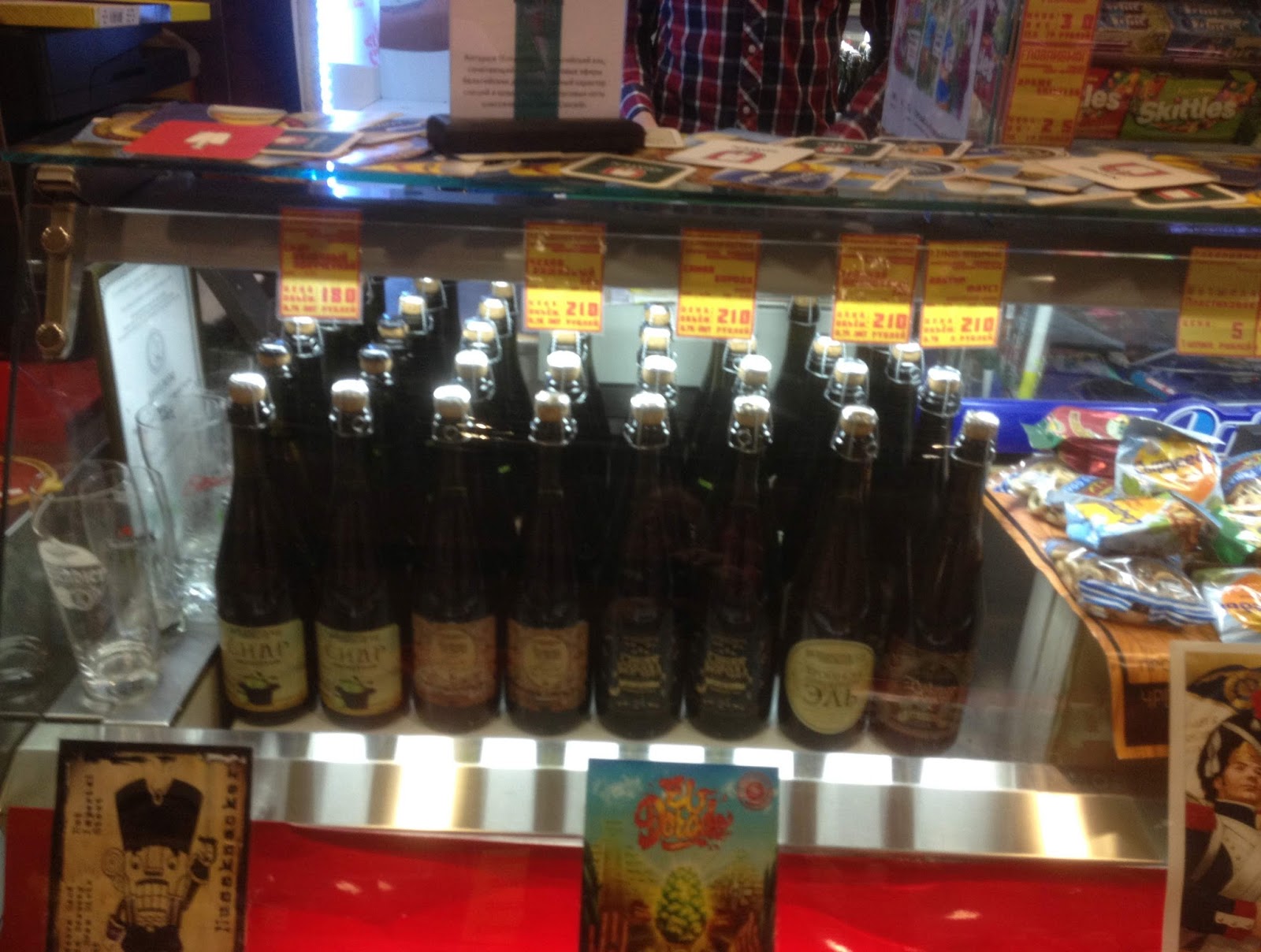
Barrie and I visited Allan in Moscow in 1999, and "craft" beer existed, kinda sorta; it's a story I've told before, and will repeat some day. The following is a recent note from Allan and a few photos. They illustrate the growth of "craft beer" in Russia.

It sure wasn't this way in 1987.

---

Rog,

Just visited my local beer pusher at the local market. He now has more than 50 Russian brews on sale, all from microbreweries. Some are in bottles, some are tapped into one liter brown plastic bottles. Many are nasty, some are quite good. See low quality photos attached.

On the last photos, the three I bought this time.

I think it is time for you to come to Russia, and take a one week beer excursion around the country. I will join you. Would be fun and educating.

Hope you are all well there.

Best,

Allan


Sunday, October 26, 2014

Being a "local hero" may require the use of a different set of muscles.


Let's expand upon this:

No, we'll likely never return to the time when three huge brewers dominate the entire beer marketplace. However, as the big "craft" players from the West Coast continue to establish production facilities on the Eastern Seaboard (Sierra, Oskar Blues, New Belgium and now Stone), aren't we looking at a scenario wherein retail shelf space comes to be their province in much the same way?

Schumacher offers an interesting comparison, one that points to another level of the brewery proliferation discussion.

How do 2,000 wineries in California survive?

Knowing quite little about it, I'd guess that their business models radically differ. Gallo has wine in every supermarket nationwide. Conversely, a small mom 'n' pop vintner ships a few hundred cases a year of something not at all plonk, and achieves his or her goals. California wineries predate "craft" breweries. Legal regimes vary. They've had time to dope it out, evolve and rationalize.

If every community is to play host to its own brewery, and all of them thrive, my guess is that the avoidance of a bubble bursting depends on economies of scale, and accompanying business plans. What worries me are all the new brewers who posit growth (and assume debt in accordance) according to outside distribution. It simply cannot be the case in the way this market currently works. I weary of collective 13% growth blurbs unaccompanied by a breakdown of production size. How much of that percentage is Sierra, and how much the brewpub in Anywheretown?

To be more succinct, it is the case now, and will be so increasingly in the future, that the interests and strategies of a 300-bbl pub brewer and a 30,000-bbl production brewer differ. NABC and Sam Adams are not alike. We're very different. We may both be "craft" in some nebulous way, but the differences are becoming wider, not narrower.

The practical consequences? I'll save those for another day.

The Beer Curmudgeon: LOCAL HERO, by Harry Schuhmacher (All About Beer Magazine)

 ... One of the most commonly asked questions within the beer industry today is: How many new breweries can the market support? Are we becoming saturated with too many breweries opening up? The answer is: not yet, not even close. There are over 2,000 wineries in California alone. If this local thing keeps going, every community will play host to its own brewery, and that’s not such a bad thing.

Sunday, August 17, 2014

About that wasteland of craft-drinking promiscuity.

I would like to be the first to thank Summit Brewing's Mark Stutrud for coining a phrase that's destined to make me smile more often than a well-turned Ordinary Bitter.

America Now Has Over 3,000 Craft Breweries—and That's Not Necessarily Great for Beer Drinkers, by Joshua M. Bernstein (BON APPÉTIT)

... Endless choice is not always the be-all and end-all. “The promiscuous drinkers are never satisfied,” says Summit’s Stutrud.

Let's consult the dictionary -- not the primary definition of promiscuous, which is outdated and derogatory, but the second line down.

pro·mis·cu·ous
prəˈmiskyo͞oəs

adjective

demonstrating or implying an undiscriminating or unselective approach; indiscriminate or casual.

"the city fathers were promiscuous with their honors"

synonyms: indiscriminate, undiscriminating, unselective, random, haphazard, irresponsible, unthinking, unconsidered

RateAdvocate reviewers nationwide may now angrily reply as one:


Yawn.

Here's another excerpt.

... On a recent summer morning, you could plop beside Dogfish Head president Sam Calagione and discuss craft beer’s coming bottleneck.

“We’re heading into an incredibly competitive era of craft brewing,” he says. “There’s a bloodbath coming.”

It seems plausible to me that the growth rate of "craft" beer can be maintained, as better beer continually erodes the American monolith of swill. But there really isn't a metric for predicting which among the 3,000+ stand to enjoy the benefits of growth. I'm no mathematician, but it also seems plausible that there could be an increase in overall "craft" beer sales even if 20% of the breweries ceased functioning -- if the ones closing were small breweries.

Sierra Appalachia's volume alone would make up for how many failed nanos?

That's why the coming bloodbath is worrisome to me.

Friday, August 15, 2014

Muzzling myself: "5 Restaurant Chains Banking on Craft Beer."

Maybe so, but seeing as two of the five are brewpub chains, this article isn't exactly telling us what we'd like to know, and what might actually change the game: When will Ruby Tuesday, Olive Garden and other casuals address their sales decline by getting in the game?

Do their cookie-cutter concepts simply not permit experimentation? Is it better MBA strategy just to spin off new concepts?

What do they do with all those unredeemed gift cards in the checkout lane at WalMart?

5 Restaurant Chains Banking on Craft Beer, by Jason Notte (The Street)

... As of February, visits to casual dining establishments including Olive Garden and Ruby Tuesday are at a six-year low.

People ages 18 through 47 have been shunning such establishments in huge numbers and have dragged down their sales every quarter since 2010, but the numbers get a little better once there's some beer involved. We took a look around the restaurant landscape and found five establishments that are making either the brewpub or taproom model work, with craft beer as a whole benefiting from their efforts.

Friday, August 08, 2014

Baseball's craft beer market explodes ... everywhere except Louisville Philistine Field.

On July 27, we attended a Minnesota Twins game at Target Field in downtown Minneapolis. Here I am, enjoying the scene with a can of Summit IPA.


Behind us was a concession stand featuring local and regional beers. Out in right-center field, there was another area with good beers on draft. I bought a Surly. After the game, we walked to Fulton Brewery, which is located roughly two hundred yards from the ballpark.


Meanwhile, Great American Ballpark in Cincinnati continues to attract attention for its Reds Brewery District, and at the Slugger Craft Beer page at Facebook, Joel Z. makes an astute observation.

Too bad that the powers that be at the Bats/Slugger Field are still refusing to follow the example set by their parent club.

Joel, that's because they're incurable, unrepentant Philistines, even if certain local "craft" beer luminaries habitually apologize for them.

Have you ever looked for the word Philistine in the dictionary?

Gary Ulmer's photograph is there.

The Best Beer in Baseball, by Kevin Schaul, Kelyn Soong and Dan Steinberg (Washington Post)

Several years ago, craft beer started taking off at Cincinnati’s Great American Ballpark. From 2011-2012, sales went up by 20 percent. From 2012-2013, they were up 47 percent.

So when it came time to create a new hangout in a highly trafficked spot on the third-base concourse, the ballpark went all-in on craft-style beers. The new Reds Brewery District – an 84-foot-long bar with more than 50 taps – included more than 20 craft offerings when it opened this spring. There were local beers from Cincinnati brewers like Christian Moerlein, MadTree, Blank Slate, Fifty West, Rhinegeist, Mt. Carmel, and Rivertown. There were national options from well-regarded breweries like Founders, Bell’s, West Sixth and Great Lakes.

Wednesday, July 30, 2014

Bud and Miller hijack ALL beer cultural values, not just craft's.

Phony, ersatz and "craft" -- these words aptly summarize the situation. Kudos to Tom Philpott for a clear-headed analysis.

Big Beer has been, and shall remain, the oppressor. Being the oppressor is how it came to be Big Beer in the first place. That's what robber baron capitalism is all about, and if you doubt it, perhaps it's time to read a history book.

When you tithe for ersatz, whether it's Blue Moon or the 100%, fully-owned-by-the-oppressor Goose Island, you're providing the familiar oppressor with even more money to continue its oppressive tactics.

To oppress YOU.

Sorry if saying this aloud bugs you, but truth is truth ... and sometimes, truth hurts.


Bud and Miller Are Trying to Hijack Craft Beer—and It’s Totally Backfiring, by Tom Philpott (Mother Jones)

 ... For its part, Big Beer has responded to the declining popularity of its goods in two ways. The first is relentless cost cutting. When Belgian mega-brewer InBev bought US corporate beer giant Bud in 2008, it very quickly slashed 1,400 jobs, about 6 percent of its US workforce. And the laser-like focus on slashing costs has continued, as this aptly titled 2012 BusinessWeek piece, "The Plot to Destroy America's Beer," shows.

The second is to roll out phony craft beers—brands like Shock Top and Blue Moon—and buy up legit craft brewers like Chicago's Goose Island, which InBev did in 2011. Other ersatz "craft" beers include Leinenkugel, Killian's, Batch 19, and Third Shift. The strategy has been successful, to a point. Bloomberg reports that InBev has seen its Goose Island and Shock Top sales surge.

Thursday, January 23, 2014

"We're giving fans what they want," except at Louisville Slugger Field.

A local insider forwarded this article to me, as transmitted via Craft Business Daily.

I hear periodic rumors that the lamentable situation at Louisville Slugger Field will change for the better during the forthcoming Louisville Bats campaign, but much like human rights in North Korea, it's best not to believe Gary Ulmer and Centerplate until they actually do something. Since there is no substantive record of action to improve beer choice and to grasp the utility of local beer for local sports, my advice in 2014 is the same as in the past: Don't hold your breath; it deprives you of much-needed oxygen and does nothing to alter their purely mass-market instincts.

The Sahara of Slugger Field (LouisvilleBeer.com; April 15, 2013)

However, in 2013 the beer-loving stewards of the stadium are giving us something even worse: Taste the Best of Belgium, a stand-alone beer kiosk featuring Hoegaarden, Stella Artois and that other universally known Belgian masterpiece, Bud Light, as guaranteed to give Centerplate, the Bats front office and AB-InBev’s foreign management the very first sustained tumescence, sans-Viagra, that they’ve welcomed in decades.

Now, read about sports venues in the modern world.

---

Craft Becoming Major Contender at Sports Venues (Really)

If this Sports Business Daily piece is right, sports venues are a lot more craft-centric than is apparent, and growing. Ovations Food Services executive VP Doug Drewes told the outlet that craft beer now represents 25% of total beer sales at its facilities, while import beers have another 25% share. Its facilities include 100-plus convention centers, fairgrounds, casinos and stadiums across the United States. "We're giving fans what they want, and it's turned into a 50-50 mix throughout the industry now," Doug said.

(In fact, Ovations is becoming a craft brewer too. The concessionaire is developing "its first brewery at Jungle Island, a tropical theme park in Miami," per a related Sports Business Daily story. It's not an isolated venture: "Ovations officials believe they could partner with teams to develop microbreweries at arenas and stadiums.")

Giant concessionaire Aramark told the outlet how it has seen craft grow at its 11 Major League Baseball accounts: Vice president of marketing Andrew Shipe said 69% of consumption at baseball fields still comes from A-B and MillerCoors. "But over the past three years, there has been a shift of 5 share points and now the craft beer category is worth about 20%," he said. "Ten to 15 years ago, that category hardly existed." He believes domestics will continue to decrease in share based on industry data and their own trends. (Interestingly, a December Turnkey Sports Poll of 2,000 senior level sports executives revealed that 34% would be "more likely to buy" a 12 oz. craft beer for $7 at a large sporting event, while 47% said they'd be more likely to buy a 16 oz. domestic beer for the same price.)

To these guys, the economics are easy. Centerplate, which serves the Denver Broncos' Sports Authority Field at Mile High, has seen taps dedicated to pouring crafts at Broncos games jump from 15% to 21% over the last three years, and craft has even more share if you count its bottles and cans. They've also opened two craft-centric, 50 yard-line bars this season as part of $32 million in upgrades at the field. But at $8.25 per 20 oz. craft draft to $6.25 for a domestic at Broncos games, "the allocation speaks for itself," per Justin Kizima, Centerplate's general manager at Sports Authority Field at Mile High.

And many sports arenas are converting underperforming areas to craft venues, which often end up "churning out sponsorship dollars for teams such as the Bobcats and Pistons to cover the cost of converting those areas."

Friday, February 15, 2013

At LouisvilleBeer.com: "Let’s Explore Anti-Local Craft Beer Unconsciousness."

Shall we?
“Art can never take the place of social action … but its task remains forever the same: to change consciousness.”
– Amos Vogel, from “Film as a Subversive Art”
When will craft beer finally change the consciousness of the American beer-drinking mainstream?”
I’m tempted to answer one question with another:
Should mainstream consciousness ever be the desired outcome for craft beer?
But let’s play it straight. Some might say that craft beer consciousness already has arrived. Craft beer’s availability is wider than ever before, and statistically, most Americans live within close proximity to a craft brewer, even if the average measurement is skewed by Michigan as compared to the Deep South.
Slowly, even this imbalance is changing, and craft beer consciousness is penetrating all geographical areas of the country.


Wednesday, November 28, 2012

Paris Hilton doesn't care who makes your beer, which is why you should.

Julia Herz's piece is appended with a poll, and currently 94% of respondents agree that it's important to know who makes your beer.

Covering similar territory, Beer Pulse picked up a recent PC posting, prompting a richly amusing dialogue at Facebook. The Publican as Paris Hilton? Who'd have thunk it?

Who Makes Your Beer?, by Julia Herz (CraftBeer.com)

... In a recent CNN Money article,"Big Beer dresses up in craft brewers' clothing," Greg Koch, CEO and co-founder of Stone Brewing Co., said: “Craft brewers are creative. We don't follow trends—we create them. We specifically went against the mass-homogenized, corporatized business model…. When that very empire, the multinational conglomerate, starts giving the impression to unsuspecting consumers that they're a part of our world, of course that's offensive.”

What Koch is referring to are recent changes from big brewers including the creation of separate divisions featuring fuller-flavored beers (e.g., Blue Moon Brewing Company, Tenth & Blake Beer Company, and Green Valley Brewery), and purchasing all or part of existing small breweries (e.g., Anheuser Busch’s recent purchase of Goose Island).

So what is a craft brewer anyway?

Tuesday, November 20, 2012

Queenan: "Lately I seem incapable of escaping from the kraftbierkulturkampf."

First reaction: If I appreciated miserable teetotalers telling me how to live, I'd have voted for Mitt Romney.

Foaming at the Mouth About Craft Beer, by Joe Queenan (Wall Street Journal)

... Meanwhile, I sit there, meekly sipping my Diet Coke. I am an outcast at life's rich fest.

I used to be able to hold up my end in barroom conversations, because I knew a lot about sports. "What'd you think of the Cowboys running a double reverse on fourth and one Sunday?" I would ask. "Did you know that Barry Bonds has a career on-base percentage of .444?" "OK, which brothers hold the record for most career home runs? If you said 'the DiMaggios,' you guessed wrong." But that was back in the day when people in bars talked about sports. Now they talk about beer. Craft beer.

Lately I seem incapable of escaping from the kraftbierkulturkampf.

Wait: It's the Wall Street Journal, a Romneyite rag if ever there was (formerly) one.

But seriously: Queenan's a humorist of sorts, so I suppose he gets a pass. It's far better than that humorless guy from Pittsburgh a few years back.

Final thought: Humorous or serious, Queenan's point is well taken. It just can't come from a teetotaler. It ain't his gig, folks. Now, coming from someone like me -- an insider, not an outlier -- no, never mind. The use of Bud Light apart from pet shampoo simply isn't possible.

Wednesday, August 01, 2012

Baylor on Beer: "The World According to Spike," at LouisvilleBeer.com

Might as well be set in the present time. Craft beer evolves, but swill -- well, it never changes, does it?


The World According to Spike

I was looking through some old files and discovered the following essay, which was written … well, you’ll just have to read it first, and then I’ll reveal the date.
“Rog, the beer business just isn’t fun any more. This used to be a people business. Now it’s all about market shares and buy-outs.”
–Spike (the fellow on the beer truck)
“Of the displacement of dignity by merchandising that trivializes, there is no end.”
–George Will (the syndicated columnist)

Wednesday, May 09, 2012

Six headlines in one day.

Powered by solar panels and the combined efforts of three highly accomplished homebrewers, Apocalypse Brew Works opens on Friday, May 11.

Meanwhile, largely ignored, a familiar chain brewpub is slated to open downtown -- and yes, they'll actually be brewing some of their beers there: Gordon Biersch Brewery Restaurant to open May 21 in Louisville’s Fourth Street Live! (Steve Coomes; Insider Louisville)

Other prime Louisville locations for better beer appreciation get a look-see at Hoosier Beer Geek in "The Louisville Beer Trail," with proper emphasis on the role of localism hereabouts.

Are you "Building International Coalitions Through Beer and Pavement?" If so, I was happy to be interviewed there, and the results are here: Indie-Craft Interview #8: New Albanian’s Roger Baylor.

From humble beginnings as an offshoot of Alltech, the Lexington (KY) Brewing and Distilling Company sees its Kentucky Bourbon Barrel Ale going national, international and even lunar.

Last, perhaps the clearest explication ever of the reason why macro vs. craft is in fact an evolutionary/revolutionary struggle, one that demands we espouse principled positions and just plain take sides, is offered by the author David Sirota. Unfortunately, some beer geeks are choosing to focus on Sirota's simplified  descriptions of flavor components rather than accepting the veracity of the larger argument. It's the forest, guys -- not the trees.

Can beer save America? The redemption of the economy may start with the type of brew you keep in your fridge, by David Sirota (Salon)

 ... Nowhere, though, is the battle between the low-price/quantity business model and the higher-price/quality business model more clear than in the world of beer. In the fevered battle between the macrobrew behemoths and the craftbrew insurgents, both sides are digging in for an epic confrontation ...

... A Macrobrew Economy — a high-volume, low-price model — asks us to compete with other such economies throughout the world, and the problem is that countries like China will always have lower-priced labor, more lax environmental regulations and lower production standards to win a battle that rewards more and cheaper for more’s and cheaper’s sake. By contrast, a Craft Brew Economy — a high-quality, lower-volume model — is a different proposition. It follows the German model, which, as Time magazine notes, is all about being “committed to making the sort of high-quality, high-performance, innovative products for which the world will pay extra.”

Saturday, March 31, 2012

Great reading: "The Beer War on American Soil."

Thanks to BC for the link.

The Beer War on American Soil, by Wolf Richter

Disclosure: I love beer. Particularly certain kinds of what the industry calls craft beer. I’m a sucker for a good IPA, or an amber, or a pale ale. For special occasions, there is the expensive stuff. If I’m traveling, I try to discover local brews. And the first swig is one of the simplest great pleasures in life. But for now, I’ll stick to the numbers. And they’re morose for the US beer industry. Yet there is an astonishing exception: craft brewers.


Friday, September 16, 2011

Long-distance localism: Talk about a talking point!

Courtesy of the ever-informative www.beernews.org, comes this observation, as though timed to coincide with the kick-off of Louisville Craft Beer Week and the discussion that preceded it.


Cerevisia Communications Founder, Horst Dornbusch, raises questions about the practice of breweries expanding distribution over thousands of miles versus doing it locally.

"It is obviously a positive sign that craft breweries are gaining strength through higher volumes, but such expansion, when associated with greater distribution areas and longer shipping distances by land and even by sea, may not be the most environmentally responsible way to grow. Considering that foreign breweries of all sizes have been exporting beer to the New World for decades, it seems a natural impulse for the burgeoning American craft brew industry to turn the tables and try to enter the export game as well. But is long-distance beer transport regardless of direction really a good thing?"

Full article via Brewers Association | The Case for Low Mileage Beer

Sunday, June 19, 2011

Four (!) new Louisville breweries are in the planning stages.

Here’s a long overdue report on Louisville start-up brewing news, as relayed by a number of sources, whom I’ll try and properly identify. To greater or lesser extent, we've known about these projects for a while, and have been patiently awaiting as they've come together. One would not want to rush a good thing.

First, from Insider Louisville, Steve Coomes reports that the O’Shea’s Family of Pubs, Louisville pioneers in imported and craft beer presentation, will begin brewing some time in 2011 from the Flanagan's location.

Then, at the Louisville Restaurants Forum, NABC’s David Pierce has been monitoring the situation with Against the Grain Brewing, which comes to us courtesy of some familiar faces in Louisville brewing:

There is a new and welcomed addition coming to the Louisville craft brewing scene, Against the Grain Brewing. Check them out on FaceBook: Against the Grain.

But there’s even more. LouBrew, a nanobrewery in Germantown, is being planned: LouBrew on FaceBook. To contribute to the effort, go to KickStart LouBrew. A while back, Jason Lyvers reviewed the nanobrew: LouBrew is coming, LouBrew is coming!! (Lville Beer)

Back at David's Louisville Restaurants Forum post, frequent contributor and beer enthusiast Rob Coffey mentions his own plans to brew commercially. When details are forthcoming, I’ll try to post them here.

Four new breweries in Louisville? My liver simply cannot wait.

Saturday, May 14, 2011

Harrison County Summerfest in Corydon to feature a craft beer garden on Saturday, July 2, Noon - 9 p.m.

For readers unfamiliar with Southern Indiana geography, historic Corydon is right down the road from New Albany, perhaps 20 miles away and westbound on I-64.

Among other claims to fame, the town was Indiana’s first state capital. In fact, a little bird tells me that Corydon may soon experience another historic first: A group of townies apparently are exploring options for opening a brewpub on the square.

Wouldn’t that be delighfully epochal?

In the meantime, NABC is perfectly happy to be among the craft brewers represented at Harrison County Summerfest on the weekend before the 4th of July.

The craft beer action is on Saturday, July 2. The morning begins in nearby Lanesville, where there’ll be a charity 5k run/walk to benefit Shelby Richert.

After the race, the astute organizers have cleverly arranged for awards to be presented at the county fairgrounds in Corydon, where by sheer coincidence, a craft beer garden will begin operating at 12 Noon. Here’s the tentative draft list:

Barley Island Sheet Metal Blonde
BBC Amber
Bell’s Oberon,
Flat 12 Half Cycle IPA,
NABC Community Dark
Schlafly Kolsch
Upland Preservation Pils

The craft beer garden will run on Saturday from Noon until 9:00 p.m. More information can be found here: http://www.facebook.com/home.php?ref=home#!/event.php?eid=116169881797121

As someone who has spent a lifetime hereabouts, I cannot describe how excited I am at the prospect of showcasing craft beer in Corydon. It's a holiday weekend, so consider lining up a designated driver and heading that way.

Furthermore, there's a Dubois County Bombers baseball game (with NABC beer) later the same afternoon, approximately 45 minutes further west, in Huntingburg. Anyone up for a combined roadtrip -- Corydon, Bombers and craft beer?