Showing posts with label Christmas. Show all posts

Tuesday, December 15, 2015

Let the taps speak, because the blue law's gone, and Indiana's dry Christmas Day is no more.

Unrelated to the topic at hand, but cool.

Readers, hear my confession: I completely missed it. Totally; 100%. I did not know the law had been changed.

It's about time, isn't it?

Maybe the Freedom from Religion Foundation intervened. After all, the prohibition of alcohol sales on Christmas Day was a blatant imposition of selective religious blue law on what should be secular tippling.

Indiana may be a basket case, but at least this one's finally right.

Hoosiers can buy alcohol on Christmas for the first time since Prohibition (Fox59)

The Indiana Alcohol and Tobacco Commission (ATC) announced today you can buy alcohol on Christmas.

Although many businesses are closed on Christmas, restaurants, bars, liquor stores and grocery stores that are open will be allowed to sell alcohol to you.

Friday, December 26, 2014

Plymouth pub landlord lays down the law for "once-a-year" Christmas drinkers.

A man very much after my own heart. Initially I passed over this article, until I noticed the reference to Plymouth, where we spent a fair amount of time in 2009 and 2013. That said, I don't recall having a pint at the Stoke Inn. I wish I had done so.

Don't order cranberry juice and hot girls get served first: Pub landlord posts hilarious list of rules for once-a-year Christmas drinkers to abide by in his bar, by Luke Salkeld (Daily Mail)

It's supposed to be the season of goodwill – but it seems no one has told one curmudgeonly landlord who has laid down the law to festive drinkers.

Steve Bowen claims his bar is plagued by Christmas revellers who are clueless about pub etiquette. So in a tongue-in-cheek attempt to remedy the situation, he has drawn up a list of rules directed at the kind of 'awful human beings who buy their beer from supermarkets'.

Hit the link and read the entire piece. I'll feature just two of Bowen's rules.

HOT GIRLS GET SERVED FIRST
* Welcome to Western Civilization.

PREFERENTIAL TREATMENT
* If an old bloke sat at the bar gets served before you do, and the bartender knows him by name and even seems to know what he's drinking before he orders it - that's Bob. Bob drinks here all the time. Bob drinks here five times a week, every week. Bob's custom pays the bills. Bob and the other Regulars keep the pub open eleven months of the year whilst you're having dinner parties and bulk-buying booze from the supermarket. Yes, they get preferential treatment. Accept it.

Monday, December 22, 2014

The PC: A trick of the Christmas tale (2014).

The PC: A trick of the Christmas tale (2014).

A weekly web column by Roger A. Baylor.

This column originally was published in December, 2013, at LouisvilleBeer.com, and is reprinted here mostly unaltered. I usually watch How the Grinch Stole Christmas at some point during the holiday season, exercising care to stop the showing just before his heart grows three sizes. It's so very depressing ...

It happens each holiday season. During an otherwise random conversation about Trojan Goose, the superiority of two-way street grids or the many edifying reasons why the Confederacy got whipped in the Civil War in spite of the present-day Republican’s wet pipe dreams, eventually someone looks at me with dismay.

“Roger, you’re such a Grinch.”

My response never varies: “Thank you very much.”

The roots of my longstanding Yuletide antipathy might be traced to Freudian conceits, Jungian counter-thrusts, references to childhood toilet training habits or the sheer pervasiveness of psychological repression stemming from residency in a fascist state, but in truth, it’s far simpler.

It goes back to that original, defining moment in every American boy’s life – not when it becomes clear that he’ll die some day without the saving grace of being able to hit a curveball, but the sudden, gut-wrenching discovery that in spite of the shameless propaganda fed to us by adults, who’d assured us that excruciating behavioral self-regulation would be rewarded by a gaudily costumed fat man parking his tricked-out sleigh on the roof and descending the chimney, that nope, in the end, it was nothing more than a transparent ruse.

Then it hits you: Santa Claus doesn’t really exist at all.

Our house didn’t even have a chimney, and you’d think this would have made me suspicious, but I was oblivious. When the shameful day of infamy arrived and my chum chided me -- “c’mon, don’t tell me you still believe in Santa?” -- I did much more than merely shake Santa’s grip, cold turkey, right there on the spot.

I irrevocably disavowed the whole contrived Christmas spectacle, because even at such a tender age, I could see the dominoes falling as the previously sacrosanct Santa myth vaporized in plain sight. If the grownups could mislead us about Santa, where would it end? They might also be fibbing about those other edicts demanding compliance and conformity, from the civic foundational edifices of religion, patriotism and obedience to the logic of the crosswalk.

The worst of it was sitting alone in my room, cross-legged on the cold tile floor, and experiencing the devastating frustration of knowing that I was far too young to properly drink my way through the rampant disappointment.

Santa’s unused cookies and milk were the best I could do, and then, as now, I detest milk.

---

In 1991, at 31, I spent Christmas in the city of Kosice -- today located in sovereign Slovakia, which then comprised the easternmost lands of Czechoslovakia. It was the mid-point of a six-month stint teaching conversational English to doctors and nurses at the city’s main hospital, an experience made possible by the Cold War’s end. Upon returning stateside in 1992, there was a brief break, and then I went into the food and drink business, where I’ve been ever since.

Grinch or not, the approach of the holiday season in Kosice proved fascinating. With no Thanksgiving to serve as mile marker, few signs were evident that that Christmas was coming until the eve of St. Nicholas Day (December 6), when children scrubbed and polished their shoes, placing them on windowsills to be filled with candy and chocolate. Presumably, bad children would receive a bundle of twigs bound together for swatting their butts … as it should be.

In Communist times, the regime attempted to persuade the populace that a chap named Grandfather Frost brought these goodies, presumably on behalf of the benevolent leadership. After the Velvet Revolution in 1989, back came Christmas trees and caroling in the streets, and while these were familiar to me, decorations didn't even begin to appear until the first part of December. I remarked to my uncomprehending students that they should contrive a holiday like Halloween to mark the true beginning of the shopping season.

Shopping season? It was quite ephemeral. Surely it’s different in 2014, but in 1991, only a few understated window displays were to be seen in shops, and high ¬pressure, guilt laced sales tactics were nowhere to be found. However, one necessary seasonal item became ubiquitous during the week preceding Christmas.

This was carp, raised and fattened in farm ponds, not river bottoms, and brought to market in street-side barrels and oversized plastic tubs. Some buyers brought their own buckets to take the living fish home for a few days of further bathtub cleansing. Others had their purchase killed, weighed and wrapped on the spot.

Carp is the traditional Slovak meal for Christmas, accompanied by an array of special side dishes, and perhaps some steaming sauerkraut soup. There always was plenty of bottled lager, but the Christmas Eve toast in 1991 was chased with homemade peach brandy from a student’s village nearby: “To peace, health and a good harvest.”

---

Two or three lifetimes later, there was a second chance to be in Europe for Christmas. I hope it doesn’t prove to be the last.

In 2009, we stayed in a rental apartment in Bamberg, Germany, a mere stone's throw from the Fässla and Spezial breweries. With the requisite open-air Christmas market, mulled wine and naturalistic decorations, Franconia’s version of the Yuletide season was obvious without being garish. The Grinch in me was shaken, if as yet unbowed.

On Christmas morning, we strolled through the Altstadt’s deserted streets and climbed Altenburg hill to the medieval castle, affording a sweeping view of the valley and Bamberg's dizzying number of church spires. Most businesses were closed, but pleasingly, some food and drink purveyors were open in a city blessedly free of the archaic blue laws still existing in Indiana, which prevent alcohol from being served on Dec. 25 – a purely Christian holiday.

Clouds rolled overhead, and it was a bracing and exhilarating walk. Descending the commanding heights back to our riverside starting point, we passed the city museum in the old town hall astride the Regnitz and saw that the doors were open. Inside was a fine collection of 18th century Porcelain from Meissen, and one of 38 nativity scenes on display in and around Bamberg during the holiday season.

A reconnaissance of Ludwigstrasse's expanse revealed that Bamberg's Chinese restaurant owners are not as ambitious as metro Louisville's, with all three closed for the day. However, at the train station, the bakery and small grocery both were open, and I bought a handful of half-liter Schlenkerla Märzen lagers to accompany the evening's home cooked vegetable soup.

With no close friends in Bamberg, we kept ourselves company, having procured groceries and libations in advance. With bottles of Fässla in support, Christmas evening selections on the telly revealed a diverse Euro holiday tableau.

There was a Basque celebration from Bilbao, with crazy costumes, quasi-operatic tunes and the inexplicable, pre-historic language spoken by the world's first cod fishermen. The whole time, I kept expecting a Muse concert to break out.

We watched a performance in Salzburg of Mozart's "The Magic Flute”; snippets of a schlocky Bavarian idyll, rather like the Osmonds meeting Lawrence Welk in lederhösen and dirndls; and then a Berlin performance by Max Raab and the Hotel Palast Orchestra, a stagey society presence reminiscent of Joel Grey’s role in "Cabaret."

Finally came "City Lights," the not-so-silent masterpiece by Charlie Chaplin, without dialogue but featuring a musical soundtrack as a concession to new 1931 technology. The Little Tramp falls for a blind flower girl ... and meets a drunken millionaire along the way.

On the 26th, Café Abseits beckoned again, with a fine draft list of regional, seasonal Bockbier. Later, at Spezial, delightful Ochsenbrust in horseradish sauce with a dumpling was accompanied by several of the brewpub’s quintessential smoked lagers.

I don’t “do” Christmas. Occasionally, there are exceptions.

Tuesday, December 24, 2013

The PC: A trick of the Christmas tale.

(Published at LouisvilleBeer.com on December 23, 2013)

---

A trick of the Christmas tale

It happens each holiday season.
During an otherwise random conversation about Trojan Goose, the superiority of two-way street grids or the many edifying reasons why the Confederacy got whipped in the Civil War in spite of the present-day Republican’s pipe dreams, eventually someone looks at me with dismay.
“Roger, you’re such a Grinch.”
My response never varies: “Thank you very much.”
The roots of my longstanding Yuletide antipathy might be traced to Freudian conceits, Jungian counter-thrusts, references to childhood toilet training habits or the sheer pervasiveness of psychological repression stemming from residency in a fascist state, but in truth, it’s far simpler.
It goes back to that original, defining moment in every American boy’s life – not when it becomes clear that he’ll die some day without the saving grace of being able to hit a curveball, but the sudden, gut-wrenching discovery that in spite of the shameless propaganda fed to us by adults, who’d assured us that excruciating behavioral self-regulation would be rewarded by a gaudily costumed fat man parking his tricked-out sleigh on the roof and descending the chimney, that nope, in the end, it was nothing more than a transparent ruse.
It hits you: Santa Claus doesn’t really exist at all.
Our house didn’t even have a chimney, and you’d think this would have made me suspicious, but I was oblivious. When the shameful day of infamy arrived and my chum chided me — “c’mon, don’t tell me you still believe in Santa?” — I did much more than merely shake Santa’s grip, cold turkey, right there on the spot.
I irrevocably disavowed the whole contrived Christmas spectacle, because even at such a tender age, I could see the dominoes falling as the previously sacrosanct Santa myth vaporized in plain sight. If the grownups could mislead us about Santa, where would it end? They might also be fibbing about those other edicts demanding compliance and conformity, from the civic foundational edifices of religion, patriotism and obedience to the logic of the crosswalk.
The worst of it was sitting alone in my room, cross-legged on the cold tile floor, and experiencing the devastating frustration of knowing that I was far too young to properly drink my way through the rampant disappointment.
Santa’s unused cookies and milk were the best I could do, and then, as now, I detest milk.
In 1991, at 31, I spent Christmas in the city of Kosice — now located in sovereign Slovakia, which then comprised the easternmost lands of Czechoslovakia. It was the mid-point of a six-month stint teaching conversational English to doctors and nurses at the city’s main hospital, an experience made possible by the Cold War’s end. Upon returning stateside in 1992, there was a brief break, and then I went into the food and drink business, where I’ve been ever since.
Grinch or not, the approach of the holiday season in Kosice proved fascinating. With no Thanksgiving as mile marker, few signs were evident that that Christmas was coming until the eve of St. Nicholas Day (December 6), when children scrubbed and polished their shoes, placing them on windowsills to be filled with candy and chocolate. Presumably, bad children would receive a bundle of twigs bound together for swatting their butts … as it should be.
In Communist times, the regime attempted to persuade the populace that a chap named Grandfather Frost brought these goodies, presumably on behalf of the benevolent leadership. After the Velvet Revolution in 1989, back came Christmas trees and caroling in the streets, and while these were familiar to me, decorations didn’t even begin to appear until the first part of December. I remarked to my uncomprehending students that they should contrive a holiday like Halloween to mark the true beginning of the shopping season.
Shopping season? It was quite ephemeral. Surely it’s different in 2013, but in 1991, only a few understated window displays were to be seen in shops, and high ¬pressure, guilt laced sales tactics were nowhere to be found. However, one necessary seasonal item became ubiquitous during the week preceding Christmas.
It was carp, raised and fattened in farm ponds, not river bottoms, and brought to market in streetside barrels and oversized plastic tubs. Some buyers brought their own buckets to take the living fish home for a few days of further bathtub cleansing. Others had their purchase killed, weighed and wrapped on the spot.
Carp is the traditional Slovak meal for Christmas, accompanied by an array of special side dishes, and perhaps some steaming sauerkraut soup. There always was plenty of bottled lager beer, but the Christmas Eve toast in 1991 was chased with homemade peach brandy from a student’s village nearby: “To peace, health and a good harvest.”
Two or three lifetimes later, there was a second chance to be in Europe for Christmas. I hope it doesn’t prove to be the last.
In 2009, the Baylors stayed in a rental apartment in Bamberg, Germany, a mere stone’s throw from the Fässla and Spezial breweries. With the requisite open-air Christmas market, mulled wine and naturalistic decorations, Franconia’s version of the Yuletide season was obvious without being garish. The Grinch in me was shaken, if as yet unbowed.
On Christmas morning, we strolled through the Altstadt’s deserted streets and climbed Altenburg hill to the medieval castle, affording a sweeping view of the valley and Bamberg’s dizzying number of church spires. Most businesses were closed, but pleasingly, some food and drink purveyors were open in a city blessedly free of the archaic blue laws still existing in Indiana, which prevent alcohol from being served on Dec. 25 – a purely Christian holiday.
Clouds rolled overhead, and it was a bracing and exhilarating walk. Descending the commanding heights back to our riverside starting point, we passed the city museum in the old town hall astride the Regnitz and saw that the doors were open. Inside was a fine collection of 18th century Porcelain from Meissen, and one of 38 nativity scenes on display in and around Bamberg during the holiday season.
A reconnaissance of Ludwigstrasse’s expanse revealed that Bamberg’s Chinese restaurant owners are not as ambitious as metro Louisville’s, with all three closed for the day. However, at the train station, the bakery and small grocery both were open, and I bought a handful of half-liter Schlenkerla Märzen lagers to accompany the evening’s home cooked vegetable soup.
With no close friends in Bamberg, we kept ourselves company, having procured groceries and libations in advance. With bottles of Fässla in support, Christmas evening selections on the telly revealed a diverse Euro holiday tableau.
There was a Basque celebration from Bilbao, with crazy costumes, quasi-operatic tunes and the inexplicable, pre-historic language spoken by the world’s first cod fishermen. The whole time, I kept expecting a Muse concert to break out.
We watched a performance in Salzburg of Mozart’s “The Magic Flute”; snippets of a schlocky Bavarian idyll, rather like the Osmonds meeting Lawrence Welk in lederhösen and dirndls; and then a Berlin performance by Max Raab and the Hotel Palast Orchestra, a stagey society presence reminiscent of Joel Grey’s role in “Cabaret.”
Finally came “City Lights,” the not-so-silent masterpiece by Charlie Chaplin, without dialogue but featuring a musical soundtrack as a concession to new 1931 technology. The Little Tramp falls for a blind flower girl … and meets a drunken millionaire along the way.
On the 26th, Café Abseits beckoned again, with a fine draft list of regional, seasonal Bockbier. Later, at Spezial, delightful Ochsenbrust in horseradish sauce with a dumpling was accompanied by several of the brewpub’s quintessential smoked lagers.
I don’t “do” Christmas. Occasionally, there are exceptions.

Saturday, December 11, 2010

Pre-Christmas Kentuckiana craft beer bus with Rick and Jeff Tours.

On Thursday evening, December 23, Rick and Jeff Tours will be piloting a beer bus tour of all the pubs where craft beer is brewed locally: BBC (I'm assuming both St. Matthews and the Tap Room); Browning's; Cumberland Brews; and NABC (Pizzeria & Public House).

Jeff Gesser says: "It's a last chance trip to buy brewery gift cards and/or t-shirts for friends and family before Christmas."

The cost is $25 per person, and includes transportation (the bus starts and finishes in Louisville), refreshments on the bus between stops and a catered meal. Call Jeff at 502-807-7531, or e-mail for details and reservations.

Sunday, December 13, 2009

Thursday, December 25, 2008

Christmas Eve recap: A wee bit o' shopping, and multitudinous ale.


Our annual Christmas Eve “shopping” excursion proceeded as always in 2008, although this year there was a request (unusual in recent years) to go somewhere and actually buy something approximating a gift prior to lunch at Bluegrass Brewing Company in St. Matthews.

But first, there was the third yearly pre-shopping toast at my kitchen counter, with the lads and I splitting a 750 ml bottle of De Dolle Stille Nacht Reserva (2000) before debarking. It was brilliant, though starting to show slight signs of deterioration. The final bottle in my stash awaits for 2009.

With nothing to buy and time to kill, I browsed tacky calendars at the Oxmoor Mall before braving the equatorial downpour and locating the front entrance to BJ’s Restaurant and Brewhouse, considered here earlier in the year.

I was thrilled neither by the prospect of reneging on my goal of spending all my money at locally-owned businesses, nor drinking a letter-perfect (and entirely uninteresting) house ale brewed somewhere in Nevada, but was spared the ignominy of weakness by noticing the presence on tap of Browning’s She-Devil. Thanking my lucky stars that Brian Reymiller is still brewing at Browning’s even if the restaurants there are history, I savored the hoppy essence and arrive back at the meeting spot with moments to spare.

Next, BBC … and the expected reunion with numerous old friends, brewpub employees and a plate of chicken wings. Brewer Jerry Gnagy was generous with samples of his most recent specialties, and all were quite good, including a Belgian Quad, Belgian Tripel (with wormwood for bittering), a “caliente” pepper ale, and previews of two excellent, funky lambics.

I enjoyed an informative chat with fellow brewpub owner Pat Hagan. Note that Christmas, 2009, will be Becca’s last behind the bar before she finished her nursing studies. I trust she’ll return on Christmas Eves to come and drink with the gang.

After a fruitful (and expensive) stop at Ear-x-tacy for CDs and DVDs, we ended the Louisville portion of the program with a round of pints at Cumberland Brews. My choice was Yerba Mate Pale Ale, and I continue to enjoy the combination of tea and hop flavors.

Back across the Sherman Minton Bridge, we ended the day at Connor’s Place in downtown New Albany. I drank one of NABC’s own, Flat Tyre. Counting the wee sample of BBC Bourbon Barrel Stout (brewed at BBC on Main & Clay, served at the St. Matthews location) I drank earlier in the day, there was something from all Louisville-area breweries circulating through my system.

Mission accomplished ... and see you next year for that last De Dolle.

Wednesday, December 24, 2008

A holiday Mug Shot: "Smoke 'em on up, Santa."

Here's my biweekly LEO article for Christmas Eve: Mug Shot: Smoke 'em on up, Santa.

----

“You’re such a Grinch,” said one of my friends recently, presumably intending it as a form of rebuke.

I responded, “Thank you very much.”

It all goes back to finding out that Santa Claus doesn’t exist. As an incredibly gullible child, the discovery took a while, but when it finally occurred, I disavowed Christmas on the spot. It was only a short step to outright atheism, and both revelations came from being consciously misled by so-called authority figures. Once they’ve lied to you about Santa, anything is possible.

Considering that Santa Claus is a myth, can we really know anything about his personal lifestyle choices?

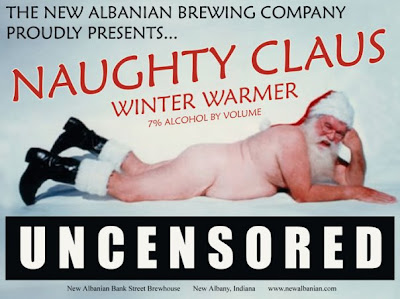
I ask this question because recently, one of my helpers designed an NABC promotional poster depicting Santa Claus smoking a cigarette. The illustration was borrowed directly from 1950s-era advertising copy. In the end, you probably didn’t see it, because most of the posters were taken down, ostensibly because, “you can’t show Santa Claus smoking!” Someone else asked, “What if children see it?”

Hmm. Would that be the same children who aren’t legally permitted to drink beer in the first place?

Am I to conclude that we can cram as many images of bikini-clad Swedish beauties onto cardboard as possible, with no ill effect whatsoever on children and adults as pertains to the larger issue of female self-image, but we must protect the reputation of a completely fictional character?

But I do celebrate the holiday after a fashion. Christmas Eve is the occasion for the annual “shopping” expedition of Roger and the lads. We’ll make appearances at Bluegrass Brewing Company (St. Matthews) for lunch, followed a bit later by a visit to Cumberland Brews, with a stop at ear X-tacy falling conveniently in between.

If you’re out and about today, look us up. Happy holidaze, folks.