Monday, September 15, 2014

THE PC: Law-abiding by weenie was never this viral.

THE PC: Law-abiding by weenie was never this viral

A weekly web column by Roger A. Baylor.

This week's column is a reprint of last week's ON THE AVENUES at NA Confidential. Next week I'm taking a vacation day. 

Those of you who are reading locally, or are familiar with the recent history of the New Albanian Brewing Company, already know that in May we suspended the kitchen at Bank Street Brewhouse for purely financial reasons. We couldn't figure out a way to make money from a menu we all loved, and so we stopped to consider other possibilities.

It wasn't easy, but of course good things seldom are. We're trying to reboot BSB as a brewery taproom, freely borrowing ideas from other places near and far, and it will take time for the new concept to take shape. One of the central pillars of this evolving plan is to determine ways to encourage our customers to continue eating -- just not food we're preparing on site (with occasional exception, like the two pop-up dinners to date).

The possibilities are endless, and they reflect the multitude of options within minutes of our building:

Carry-in from nearby eateries
Takeout Taxi (see below)
Delivery from those who do so
Vendors cooking in the beer garden
Picnic baskets
Food trucks, at least as they begin arriving in New Albany

But here's the rub: Even with all of these options, it is impossible for us to continue serving alcoholic beverages by the glass without complying with an Indiana state law dating from the time before color television that defines bars as restaurants serving drinks.

From the moment the kitchen change at BSB was announced, I was well aware of this fact; after all, the law is 13 years older than me. I spoke with the regional Alcohol and Tobacco Commission and made sure we had the materials necessary to comply with the rule (note that this is not uncommon): Frozen weenies, buns, cans of soup, instant coffee, powdered milk and soft drinks enough to serve 25 persons.

To make a long and annoying story shorter, we failed our first test of this new "menu," and so I went back to the drawing board. In order to keep ourselves aware of the responsibility not just to store these foodstuffs, but to serve them, I decided to incorporate them in a real, tactile menu and to price them based on the surreal nature of the law itself, which does not stipulate mark-ups. Moreover, we needed to collate the carry-in and delivery information in one place. Perhaps one well aimed stone would do the trick.

Hence, the menu reprinted below. Much to my surprise, it landed on the front page of Reddit on Tuesday, generating more than 1,700 often amusing comments, and since then it has been picked up by a dozen other internet sites.


Knock me over with the proverbial feather.

There's an undeniable element of Chicken Little (nuggets?) to all this. For once, I've not sought the notoriety, and I have absolutely no beef (teriyaki, perhaps) with the ATC. They're the police, and the police enforce laws; end of story.

However, in perfect sincerity, I feel as though we're doing our level best to honor the obvious intent of the 1947 statute by offering ways for our customers to eat while they drink. Dragon King's Daughter keeps longer hours than BSB, and its kitchen is closer to the BSB front door than many service bars are to their patio seats.

Isn't the law somewhat archaic? It doesn't mention pizza, and both the sandwiches and the soup must be "hot," ruling out chicken salad on rye and gazpacho. Is a taco a sandwich? We now know that coffee plays no sobering role, and perhaps the Dairy Council inserted the milk provision as a sop to Indiana milk cows. Today's service industry realities are light years removed from a shots 'n' beer roadhouse in 1947, and the law does not take these realities into account.

The BSB kitchen remains licensed, and we continue to sift through ideas to restore a cost-effective food service to the limited space we have to utilize. The options are countless, and as they are considered, it is my hope that the following "compliance" menu suffices as proper statutory observance, as we've always prided ourselves on adhering to the rules defining our daily business.

---

Yes, There Is Food at Bank Street Brewhouse, and Here Is the Menu.
Updated August 10, 2014

As of May, 2014, Bank Street Brewhouse is a brewery taproom dedicated to providing creative edible options to our patrons, ranging from carry-in to delivery every day, to periodic pop-up dinners, special catering and mobile “food truck” appearances as the latter become available. Menus for local eateries are kept at the bar. Please note: Outside alcoholic beverages cannot be brought into Bank Street Brewhouse.

Our Top Choices of Eateries … Close By for Carry Out or Delivery
WICK’S PIZZA
225 State Street
Pizza, Sandwiches, Pasta
Delivery:  812-945-9425
Wick’s takes 20% off deliveries to Bank Street Brewhouse

MANDARIN CAFÉ
 2602 Charlestown Road
Traditional Chinese
Delivery: 812-945-6789

DRAGON KING’S DAUGHTER
Japanese-Mexican Fusion
Bank Street
Carry-out: 812-725-8600
DKD is 75 yds from BSB

Pair the city's best food with the city's best beer. Multi-Restaurant Meal Delivery & Drop Off Catering Service Serving Southern Indiana
----
TAKEOUT TAXI
Food from local restaurants, delivered
http://www.takeouttaxiindiana.com/
Call (502) 895-8808
Takeout Taxi brings restaurant meals directly to you at your office, home or More Variety and Choices than anyone while giving you more time to take care of family, friends or business.
Delivery is $5.99 plus 5% of the order.

ALADDIN'S CAFE
Mediterranean/Greek
111 W. MARKET STREET

BELLA ROMA
ITALIAN RESTAURANT
Italian
134 EAST MARKET STREET

HABANA BLUES
Cuban/Spanish
148 EAST MARKET STREET

LOUIS LE FRANCAIS
French
133 EAST MARKET STREET

MIMO'S
NEW YORK STYLE PIZZERIA
Italian, Pizza, Pasta, Subs
2708 PAOLI PIKE

MUSCLE MONKEY GRILL
Smoothies, Wraps & Coffee
147 EAST MARKET STREET

PRIMO’S DELICATESSEN
Sandwiches, Salads & Soups
155 EAST MAIN STREET

SHAWN'S SOUTHERN BBQ
Barbecue
822 STATE STREET

More local eateries - call them to order carry-out.

CAFÉ 27 (Modern American) … 149 E. Main … 812-948-9999
COMFY COW (Ice Cream Parlor) … 109 E. Market … 812-924-7197
EXCHANGE PUB + KITCHEN (Gastropub)  … 118 W. Main … 812-948-6501
FEAST BBQ (Barbecue) … 116 W. Main … 812-920-0454
JR’S PUB (Pub Grub/Fish Sandwiches) … 826 W. Main … 812-920-0030
RIVER CITY WINERY (Bistro/Pizza) … 321 Pearl Street … 812-945-9463
TUCKER’S (Sports Bar) … 2441 State Street … 812-944-9999

NABC’S Pizzeria & Public House is located 3.5 miles away from Bank Street Brewhouse at 3312 Plaza Drive, phone 812-944-2577

----

Bank Street Brewhouse's Indiana Statutory Compliance Restaurant Menu.

Statutory Overview:

Permit premises where alcoholic beverages are consumed by the "drink" are required to have food service available, at all times, for at least 25 persons. Minimum food service required consists of hot soups, hot sandwiches, coffee, milk, and soft drinks (see attached rule). (IC 7.1-3-20-9 & 905 IAC 1-20-1) … see complete and unexpurgated statutory language on page 4 of this menu.

Our Famous Hotdog Sandwich
Microwaved to perfection, including both weenie and bun, sans condiments.
$10.00

Chef Campbell’s Soup of the Day
Served in a bowl. Your choice of whichever can is on top of the stack.
$10.00

Instant Coffee
Caffeinated only. Available black, or black.
$5.00

Powdered Milk
With or without water.
$5.00

Sprecher Craft Soft Drinks
Different flavors … market pricing

This menu is available all of the time.

----

The Fine Print: Indiana State Law.

In order to possess an Indiana retail alcoholic beverage sales permit, Bank Street Brewhouse must comply with a 67-year-old state law that compels us to maintain a restaurant located on the premises. 

Rule 20. Food Requirements
905 IAC 1-20-1 Minimum menu requirements
Authority: IC 7.1-2-3-7; IC 7.1-3-24-1
Affected: IC 7.1-3-20-9

Sec. 1. Under the qualification requiring that a retail permittee to sell alcoholic beverages by the drink for consumption on the premises must be the proprietor of a restaurant located, and being operated, on the premises described in the application of the permittee; and under the definition of a "restaurant" as "any establishment provided with special space and accommodations where, in consideration of payment, food without lodging is habitually furnished to travelers,"–and "wherein at least twenty-five (25) persons may be served at one time;" the Commission will, hereafter, require that the retail permittee be prepared to serve a food menu to consist of not less than the following:

Hot soups.
Hot sandwiches.
Coffee and milk.
Soft drinks.

Hereafter, retail permittees will be equipped and prepared to serve the foregoing foods or more in a sanitary manner as required by law.


(Alcohol and Tobacco Commission; Reg 36; filed Jun 27, 1947, 3:00 pm: Rules and Regs. 1948, p. 58; readopted filed Oct 4, 2001, 3:15 p.m.: 25 IR 941; readopted filed Sep 18, 2007, 3:42 p.m.: 20071010-IR-905070191RFA; readopted filed Oct 29, 2013, 3:39 p.m.: 20131127-IR-905130360RFA)

Sunday, September 14, 2014

A photo a day while I was away: Spezial Keller in Bamberg.


What else is there to say? Bavaria overflows with appropriately situated beer gardens that offer delicious beer, bountiful food and slices of local life in equal measure ... but Spezial Keller is my favorite. It's on a hill overlooking Bamberg, and while lightly attended on the chilly September Sunday of our visit, welcomes huge crowds in optimum weather.

The beer is the lightly smoky Spezial, itself perhaps a Top Ten selection on my all-time list. It is brewed at Brauerei Spezial, a mile or so away; management of the brewery and beer garden is separate, but the beer just as lip-smacking. To get to the Spezial Keller, one must walk past the actual brewing site of Schlenkerla, as opposed to its tavern nearby.

I advise knee pads, given that opportunities for kissing the ground come fast and furious n Bamberg.

Saturday, September 13, 2014

A photo a day while I was away: Berliner Kindl Weisse.


My aims these days tend to be modest. Berlin evidently is the über-center for beer geekiness, with numerous new wave breweries and brewers and beers, and with only two days on the ground, I chose instead to ignore them all and honor a solitary indigenous virtue by enjoying a Berliner Weisse.

This I did, sans schuss/syrup, in a beer garden located within the Volkspark Friedrichshain. It's where I worked as a volunteer in 1989, just before the Berlin Wall came down. The more recent beer garden in question stands on the spot where a simpler Imbiss once operated, one serving half-liter mugs of East German-brewed Berliner Kindl Weisse with raspberry syrup for less than 50 cents.

My work crew drank lunch there almost every day in 1989. I had just one in 2014, and enjoyed it very much. My ghosts were just as impressed.

Friday, September 12, 2014

A photo a day while I was away: Gaststätte Ambrosius in Berlin.


Our Berlin "hotel" was a wonderful Airbnb property located on Einemstrasse, south of the Tiergarten park and east of Zoo Station. Recalling that 70% of the city was destroyed in WWII, the area around our lodging is mostly newer construction, but with a sprinkling of surviving older buildings. It's a genuine neighborhood.

Often we speak of hotel bars, and how most are wretched but some quite good. Obviously our host didn't have a bar attached to her apartment, although just meters away, to the left of the building's entrance and facing the main street, lies this solid local eatery: Gaststätte Ambrosius.

Here's the draft list (with 0,3 liter and 0,4 liter pricing ... actually a bit higher at the time of our visit):

Berliner Pilsener 2,30 € 2,80 €
Warsteiner 2,40 € 2,90 €
Krusovice Schwarzbier 2,40 € 2,90 €

I didn't bother with Warsteiner. The Pilsner was nicely representative, and the Czech dark lager pleasingly dry, and less sweet than these usually are.

For dinner, there was goulash soup (beef) and East Prussian meatballs with white caper sauce, boiled potatoes and beet root. It seemed an appropriate choice, given that my ancestors spent quite some millenia working as peasants on Junker estates.

Monday, September 08, 2014

The PC: The steamy sweetness of watery boats.

THE PC: The steamy sweetness of watery boats.

A weekly web column by Roger A. Baylor.

Lately my Twitter feed has been invaded on a daily basis by sponsored tweets touting the city of Louisville’s Centennial Festival of Riverboats in October.

Obviously, the prominent player in this celebration is the birthday girl herself, the 100-year-old Belle of Louisville, a steamboat locally owned and operated by none other than the city of Louisville itself.

Before I return to this historic event, it’s useful to recall that earlier this summer, Mayor Greg Fischer commissioned a study group of local beer industry people, of whom I was one, to meet and discuss ways the city of Louisville might help promote locally brewed “craft” beer.

(As a side note, I was (and remain) genuinely flattered to be included in the group. Owing to the state line, NABC both is and isn’t a part of Louisville, depending on the definition used to determine such judgments. We’re here, and then we aren’t. It’s just the way it’s always been, and I appreciate Fischer’s team being broad-minded about it)

After three substantive meetings, the study group emerged with a document containing five points, with recommendations:

1. Develop an official beer trail/beer map/website/video combination
2. Change ABC laws to be more beer friendly
3. Represent local breweries in more city events, functions and venues
4. Create a bourbon-barrel event that will be recognized nationally or internationally
5. Reconnect Louisville with its brewing heritage

My committee assignment was Number Three, and here is our recommendation. You might even be able to tell who wrote it.

Louisville Metro Breweries in local city owned venues

The mayors work group recommends that more local breweries be included in city-sponsored events and on city owned property. Louisville Metro breweries would like the opportunity to sell beer at such events like Waterfront Wednesday, Slugger Field, Iroquois Park, Yum! Center. Also noted, Louisville Metro breweries like to be included in city sponsored events or festivals such as Hike, Bike, and Paddle, Worldfest, and Blues, Brews, and BBQ.

Details for Recommendations

It is widely understood and accepted that Metro Louisville government is an equal opportunity employer, one that seeks to utilize minority, female and handicapped employees, whether when hired directly, or indirectly through contractors, suppliers and vendors. The importance of these precepts extends far beyond beer and brewing, to government’s fundamental aim of providing conditions for the improvement of daily life.

In like fashion, metro Louisville government understands the critical importance of the local economy in a sustainable future, as well as the key position that locally generated food and drink businesses occupy in the city’s outreach, whether within the community itself, or directed toward visitors from elsewhere. Alongside urban bourbon heritage and an explosion in innovative dining, Louisville’s breweries serve as exemplars of this new economy.

Aspects of pre-existing “older” economic systems sometimes must be modified to fit new and evolving realities. As an example, it has remained the case that customary concessions practices in venues for sports and music have evolved from the three-tier alcoholic beverage distribution system at state and federal levels, and to a certain degree, reflect private commercial matters between concessionaires and wholesalers.

And yet, there is nothing fundamentally ‘Louisville” about concessions choices emanating solely from contractual arrangements that the general public never sees. For native and tourist alike, viewing a baseball game at a venue such as Louisville Slugger Field should present the opportunity to inform and offer choices that pertain to the community which laid for the venue’s construction – that speak to Louisville itself.

Reflecting the reality that private for-profit businesses entities and drinks vendors utilize publicly financed venues and facilities, Metro Louisville government seeks to be a positive force in encouraging these entities and vendors to provide equal opportunities for local brewers, precisely because public financing of these venues implies acceptance of the merits of equal opportunity, as well as providing the ideal forum to educate attendees as to the merits of local, sustainable economies.

Metro Louisville government supports the creation of branded, destination concessions areas unique to the venues its taxpayers have financed. It works to educate concessionaires as to the benefits of a contemporary local economy as it pertains to beer and brewing, safe in the knowledge that profit margins for handcrafted beers can be equal to or greater than those for products supplied by multinational breweries.

In short, Metro Louisville government enthusiastically greets the chance to expand local brewing consciousness by use of the landlord’s bully pulpit in venues/events that include, but are not limited to, Slugger Field; Waterfront Wednesday; Iroquois Amphitheater; YUM! Center and Hike, Bike and Paddle.

It figures, doesn’t it? The one city-owned venue/property/object we forgot the mention was the Belle of Louisville, and this morning’s sponsored tweet reveals the reason why the omission rankles.


That’s right. For a once-in-a-lifetime event purporting to exalt all things metaphorically Louisvillian, there’ll be a special Belle of Louisville cruise featuring beers from … Atlanta, and yes, of course I understand that Sweetwater and River City Distributing are helping to sponsor the shindig by paying for whatever expedient combination of program ads and titles were up for grabs, but you see, it’s just that the idea itself sounds so very much like something emanating from the brain of a small-time marketer (“Georgia, Schmorgia – the beer’s got WATER in the name, and it’s a BOAT!) that my gag factor is heightened another notch or two.

I’ve got nothing against Sweetwater, and in fact, if I were to be marooned in Atlanta any time soon, I’d seek out the beers – you know, localism and all that.

It’s just to me, and I’m probably in the minority like always, there is no substantive difference between AB InBev’s ability to alter the marketplace with cash from very far away, and Sweetwater’s.

Look, I’m sure the sweetsteamwaterboat event was planned long before the advent of the study committee and its recommendations. At the same time, the study committee’s recommendations specifically pertain to a situation like this, even if we didn’t think to refer to it by name. And so, I will, because someone’s got to do it.

Perhaps by the time the Belle of Louisville’s bicentennial hits the Ohio River in 2114, there’ll be firm and abiding localist beer principles in place, although it’s far more likely that by then, we’ll have reverted to the brewery population distribution of 1980, and will require a “craft” brewing revolution all over again.

Too bad I’ll miss it. They’re fun, at least until they aren’t.

Saturday, September 06, 2014

Diary: From platinum to unplugged in a six-pack or less.

My diaries are intended to be extemporaneous utterings of ideas, without gloss or sheen. Sometimes I come back to them and polish, other times not.

In the music business, it used to be that a band toured relentlessly with low remuneration to build a market for its album releases, and if albums and songs hit it big, the returns were huge. Notice how every member of any band that had a 10-million selling album in the 1980s owns one or more castles?

Nowadays, and album is huge if it sells a couple hundred thousand copies in tactile format. Bands give away their music to build interest in touring, or perhaps songs are marketed on television commercials and on-line apps.

The point is that business model has changed completely. I suspect that in coming years, analogous considerations will pertain to the "craft" beer business as it becomes saturated. There'll be the top tier of players -- New Belgium and Bell's and Whomever Else playing the roles of the Stones, Springsteen and other major touring acts. Then there'll be the remainder, finding that the daily production undertow required to get by increasingly resembles those CD sales figures.

There'll have to be other ways of making bank. Probably those on a brewpub/on-premise scale will find it easier. Those on a production scale, with declining outlets, will need to determine how they become the equivalent of touring bands. In short, I think the business model is changing in my world, too.

The question is, how to survive? Not sticking with what are about to become outmoded strategies is an obvious first move.

The analogies aren't exact ... but they're intriguing.

Friday, September 05, 2014

Kevin Gibson will perform selections from his new book at these fine venues in September.

As noted previously, Kevin Gibson’s new book is wonderful, and you need to get one. It’s called Louisville Beer: Derby City History on Draft.

My review: THE PC: Kevin, meet Tony. I’ll just take notes and drink beer.

Kevin writes chronologically, beginning with Louisville’s earliest Anglo-Scottish ale traditions and concluding with today’s local craft beer boom. He detours briefly to consider the brewing process and beer styles, including our indigenous Kentucky Common and the Bock beers that once proliferated in springtime.

Wisely, he does not detour from the beer tale at hand to attempt a detailed examination of the alpha acid content of bittering hops used in pre-Prohibition Pilsner. Rather, he describes the experience of Louisville beer in everyday life, and documents how it has changed over time.

Kevin is mounting a considerable personal appearance campaign to promote the book. Here is a listing, with more information available at Facebook.

Events
Here is a list of events where you can purchase a book and/or meet the author:
Sept. 5 – Buffalo Wild Wings, Highlands, 6-9 p.m.
Sept. 6 – WAVE-3 Sunrise, 6:30 a.m.
Sept. 10 – Against the Grain, 401 E. Main St., 8 p.m.
Sept. 13 – Karen’s Book Barn, 127 E Main St, La Grange, Ky. , 2-4 p.m.
Sept. 13 – Apocalypse Brew Works, 1612 Mellwood Ave., 6-9 p.m.
Sept. 17 – BBC Taproom, 636 E. Main Street. 6:30 p.m.
Sept. 18 – WHAS Great Day Live, WHAS-11 TV, Time TBD
Sept. 18 – Salsarita’s, St. Matthews, 4-5:30 p.m.
Sept. 18 – Great Flood Brewing, 2120 Bardstown Rd, 6:30 p.m. (as part of Gus Bus Trivia)
Sept. 20 – Seven Sense Festival, 11-2 p.m.
Sept. 20 – Lock Stock and Smoking Barrels, Copper & Kings Distillery, 4-7 p.m.
Sept. 25 – New Albanian Brewing Company (Public House), 3312 Plaza Drive, 6-7:30 p.m.
Sept. 26 – Trolley Hop at A Reader’s Corner, 2044 Frankfort Ave., 7-9 p.m.
Sept. 27 – Nulu Fest, East Market Street (time TBD)
Oct. 9 – Beer Garden on Main (details TBA)
Oct. 11 – Costco, 12-2 (pending)

Oct. 17 – Louisville Brewfest, Slugger Field (time TBD)

Wednesday, September 03, 2014

Every state in the USA, ranked by its beer narcissism quotient. How very unexciting.

Hey look: It's a state by state ranking of "craft" beer, based entirely on highly-rated beers desired by beer narcissists.

How incredibly useful.

Not.

It would make better sense, and be far more relevant, to rank states based on an aggregate index seeking to gauge the prevalence of good beer on a daily basis. Establishing rankings based on beers that aren't always available means little. Rather, it's the daily reality: Are good beers available? Where? How far away are they?

I'd take the time to compile such a list ... if I had the time.

Every State in the USA, Ranked by its Beer, by Ben Robinson, Andy Kryza and Matt Lynch

Monday, September 01, 2014

THE PC: Kevin, meet Tony. I’ll just take notes and drink beer.

THE PC: Kevin, meet Tony. I’ll just take notes and drink beer.

A weekly web column by Roger A. Baylor.

Like so many other local beer people, I’ve been reading Kevin Gibson’s new book. It’s called Louisville Beer: Derby City History on Draft, and I picked it up just as I was finishing another, arguably weightier tome: Thinking the Twentieth Century, by the late Tony Judt, with Timothy Snyder.

One is a specific account of beer’s rise, fall and resurgence in Louisville, and the other a series of far-ranging conversations about 20th-century intellectual history. These may seem unrelated, and in many respects they are. However, there are points of convergence; more about that in a moment.

The last book to be written about Louisville beer was Louisville Breweries: A History of the Brewing Industry in Louisville, by Conrad Selle and Peter Guetig. It was published in 1997 and printed only once (I understand Peter is contemplating a revised edition). Obviously, much has changed since then, with breweries coming and going, and Kevin’s Louisville Beer provides ample coverage of our contemporary period.

I haven’t yet gotten to this second, more recent half of Kevin’s story. Rather, it is the first sections of his book that I find compelling, as he seeks to depict what beer really meant, day in and day out, in a place like Louisville prior to the era of Prohibition.

Broadly speaking to post-Colonial times and the early 1800s, beer arguably was of secondary consideration to cider and whisky – until substantial numbers of Germans began coming to this area following the disruptive revolutions of 1848.

Germans brought with them the technological underpinnings of lager brewing, which was about to explode into a worldwide phenomenon. More importantly to daily life in Louisville, they came equipped with cultural proclivities, which included beer as an integral part of social life. Because these immigrants enjoyed their tankards, it was a natural next step for “Know Nothing” nativists to conflate beer with immigration, and to incorporate xenophobia into what evolved as the temperance movement.

In short, there was Carrie Nation-building: God says drinking is bad, but forget that; just look at those non-English speaking, beer-drinking immigrants taking our jobs … and what’s more, we’d all work harder and be more efficient cogs of capitalism if we were sober. Hatchets fly, and nutrition becomes a crime. Rinse and repeat in the here and now.

---

And so we see that in the late 19th-century, some Louisville neighborhoods closely resembled the Fatherland, and these areas would have reminded me very much of those German milieus I was so eager to experience a century later during the 1980s.

It should suffice to note that beer was consumed voluminously at work and play, while bowling and playing baseball, during weddings and funerals, and in morning and nighttime. There were dozens of breweries, and rushing the growler meant dispatching one’s 10-year-old to the corner saloon, laden with a metal bucket. Some people succumbed to alcohol-induced diseases, while others sweated out the beer and lived to ripe old ages. Life went on, as it tends to do.

Prohibition came very close to wiping the slate clean. There were surviving breweries after Repeal, and some (Falls City, Oertel’s, Fehr’s) did quite well for a long time, but by the time of the Reagan administration, none remained in operation. Around 1990, David Pierce fortuitously brewed a batch at Charley’s Restaurant on Main Street in Louisville, and then he opened the Silo in 1992. Times began changing.

Since then, we’ve spent countless hours and brain cells debating whether this new “craft” beer era represents a restoration of the past, or a revolution. This consideration brings me back to Tony Judt, the historian.

---

During the course of his reflections, Judt asks a question: “What is the purpose or nature of history?” He follows it with another statement, “You cannot invent or exploit the past for present purposes.”

As I think about Kevin’s depiction of pre-1900 Louisville beer as an all-pervasive cultural norm, it seems to me that quite often I’ve done precisely as Judt admonishes. In fact, we all have. We’ve exploited the previous history of local beer to explain our present purposes, and to claim cultural (and mercantile) territory for ourselves. The problem is that by doing so, we consistently fail to account for how pervasively craft- and locally-driven 19th-century beer and beer culture really were.

Yes, beer came from elsewhere in America, floating down the river on boats and later in railway cars. Occasionally, beer came from very far away (see below). But the bulk of the beer produced in the neighborhood breweries of old were consumed nearby, within the neighborhood. Brewpubs of the current era generally have remained true to this model, production breweries of any size, less so.

In the end, it would be fascinating to know more about the business motivations of these 19th-century brewers. Were they content with being small and local, with limited range, or were they open to the idea of acquiring capital through hook or crook, and expanding to ship beer longer distances according to the capitalist export-driven ideal? We probably can’t know, although speculation’s worth a beer or three.

Judt also makes this observation:

“A history book – assuming its facts are correct – stands or falls by the conviction with which it tells its story. If it rings true to an intelligent, informed reader, then it is a good history book. If it rings false, then it is not good history, even if it’s well written by a great historian on the basis of sound scholarship.”

Louisville Beer passes this test. We can quibble over details, and yet it matters less what we know now about brewing methods and stylistic categorization, and more that in olden times, people were not aware of these details. Being a beer drinker in Louisville in the year 1890 was not about checking-in, chasing and hoarding. Rather, it likely involved a healthy dollop of German-ness; came accompanied with a good deal of child-like mystery as to the process; and resulted in prodigious intake in the relative absence of plasticized tap water, smoothies and teeth-corroding “soft” drinks.

In a future column, I’ll survey the “contemporary” section of Kevin’s book. Until then, we close with something posted to the Louisville Restaurants Forum many years ago. It’s a restaurant menu, with wine list and libations, from the Louisville Hotel, circa 1857.


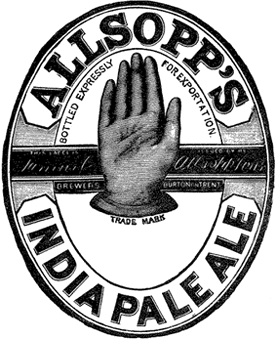
All the essentials are in place, with a purely French approach to cooking, ample quantities of meats, purely dispensable veggies, abundant wine from around the world, and the requisite “correct” imported beer list; none of that new-fangled German beer, and heaven forbid the inclusion of locally-made “Porter and Ale.” Instead, the beer stars are Guinness (then as now, imported from Dublin) and Allsop’s India Pale Ale from the United Kingdom.

Amazing. This still would have been the best beer list in Louisville in 1957, and as recently as the 1970s. We’ve come a long way, baby … and sometimes, not at all.

Photo credits:


Monday, August 25, 2014

The PC: Anti-local craft beer unconsciousness, revisited.

The PC: Anti-local craft beer unconsciousness, revisited. 

A weekly web column by Roger A. Baylor.

The Crescent Hill Craft House has opened on Frankfort Avenue in Louisville, and while I haven't yet had the chance to visit, I already know what I'll be drinking first.

It will be a BBC beer from the St. Matthews location. The exact one doesn't matter. My reasoning is that BBC's owner Pat Hagan is involved in the Craft House as well, and the Craft House pours only local and regional beers. It's an elastic definition, as it should be, and the point remains valid: Pat's kept BBC in the game for 22 years, and I'll drink one of his beers to thank him for it, and to celebrate the all-local concept.

It's been a year and a half since I wrote the following column, and in retrospect, nothing's changed for me. Consider it as one dedicated to the advent of the Craft House, and the hope that the concept embraced by Pat and his partners yields solid returns.

---

“Art can never take the place of social action … but its task remains forever the same: to change consciousness.”
-- Amos Vogel, from “Film as a Subversive Art”

When will craft beer finally change the consciousness of the American beer-drinking mainstream?”

I’m tempted to answer one question with another: Should mainstream consciousness ever be the desired outcome for craft beer?

But let’s play it straight. Some might say that craft beer consciousness already has arrived. Craft beer’s availability is wider than ever before, and statistically, most Americans live within close proximity to a craft brewer, even if the average measurement is skewed by Michigan as compared to the Deep South.

Slowly, even this imbalance is changing, and craft beer consciousness is penetrating all geographical areas of the country.

More tellingly, America’s copycat megabrewers are quite conscious of craft’s escalating impact. Through imitation and outright, unrepentant piracy – the only recourses for corporate regimes cruelly deprived of the creative gene – mass-market mockrobrews, from Blue Moon and Shock Top to zombie craft beers like those from the late, lamented Goose Island, now are routinely positioned to distract truth seekers. As always, bucket loads of marketing cash are wielded to pull soothing layers of mistruth and gloss over the eyes of the undiscerning.

Overall, my personal view about craft beer’s consciousness is that for all our obvious gains, we’re not quite “there,” at least yet.

Rather, when sociologists and psychologists at last begin studying craft beer drinkers close up and personal, we’ll know that mainstream consciousness has drawn to within a whisker, because there is no more reliable indicator of mass-market impact than the urgent need to understand the behavior of those consumers inhabiting segments poised for profit. That’s how the real money gets made.

While the analysts and shrinks are cogitating, perhaps they can help me with persistent examples of what might be termed cognitive dissonance in craft consciousness.

A prime example includes the inability (read: unwillingness) on the part of credentialed craft beer enthusiasts to tell the difference between craft and crafty as they avert their eyes from the Goose Gambit’s shelf-space-seeking drones, which are intended primarily to shift money to faraway corporate shareholders. It’s the most patently obvious bait-and-switch tactic since door-to-door driveway resealing, and yet it is ignored by many who plainly know better.

---

While we’re at it, these battered and blotted Rorschach findings also may help explain the most disquieting aspect of craft beer consumer behavior, at least to me: Anti-local craft beer unconsciousness.

It is my aim to re-situate the burgeoning craft beer movement within a context of economic localization, to revert the revolution to its point of origin, and to describe how the very consciousness of buying local is important both in non-beer terms, and in the specific way it impacts the craft beer ethos. Recently I wrote:

Shift happens. It is perhaps the single, fundamental tenet of emerging economic localism, and when it comes time to have a beer, the concept of shift means putting this principle into liquid practice.

Having acknowledged the efficacy of buying local, as measured by factual indices consistently recognizing that localism keeps more money in one’s community, my household is incrementally shifting toward local sources of goods and services, whenever practical.

Shift is a process, not an all-or-nothing crusade. If my shift to locally brewed beer implied being compelled to drink an inferior product, obviously I would think differently. Fortunately, it does not.

And yet for some otherwise knowledgeable practitioners of the craft beer ethos, “local” and “inferior” remain synonymous terms.

Why?

It is interesting to consider the contrasting reaction to “buying local” that exists, quite apart from the merits of local beer, when we speak of the retail sector: Hardware, groceries, clothing, floral arrangements and the like. I hear it often:

"But wait: You cannot compel me to spend more money than I wish to spend."

The perception is that buying local always entails higher expense to the consumer. Actually, numerous studies have addressed this perception, and the price differences therein typically are not as profound as imagined, if they even exist at all. Probably what doubters mean to say is that they cannot be compelled to surrender the big box, exurban shopping ease of finding all consumables under one roof – and that’s a different topic, one falling outside my parameters today.

But when it comes to craft beer, independent small brewers seldom hear objections about price, because craft beer enthusiasts understand that handcrafted products using higher quality ingredients within smaller economies of scale cost more than mass produced ones do. Consequently, a different and less readily explicable form of pushback occurs in the context of local beer and brewing.

How about some locally brewed beer, guys?

“No, because you cannot compel me to drink poorer quality beer. Only the best for me, you know."

This reply never fails to utterly befuddle me.

I’m a trained BJCP beer judge, and after thirty years in the beer business, obviously I’ve been around the block a few times – just ask my liver.

When I attend beer festivals these days, my samples invariably are drawn from “everyday” beers as made by small, local breweries, if only to remind me that seldom are these beers in any way unsuitable. On those rare occasion when there’s a quality problem, I’m constructively honest in identifying it, and if I can do so, in proposing a solution. Without dialogue, there cannot be a community. Without community, very little about craft beer interests me, anyway. Craft beer consciousness isn’t me against the world.

It’s us against the world.

Unfortunately, there exists a minority of self-identified craft beer opinion shapers for whom it’s never quite enough for local beer to be good, solid or sessionable.

What’s more, for them, local beer by definition simply cannot ever be “sexy” enough to justify a variant of beer enthusiasm sated only through insularity, exclusivity and narcissism, and before readers take me to task for erecting a straw man, permit me to add that I’m well aware of what such snobbery entails, because I’ve spent years now slowly recovering from its debilitating influence.

You’re damned right I’ve sinned, but consciousness is subject to evolution, and so is conscience. When I look back at my career in beer, I’m not always happy with my modes of expression, but know this: Narcissism’s not my gig, and never was. Expertise isn’t about keeping; with me, it’s all about teaching, and my record should speak for itself in that regard.

In my opinion, the breezy and frankly disdainful attitude that local beer cannot be good is a form of misplaced elitism and condescending snobbery ultimately injurious to craft beer’s larger interests. Attack mass-market swill at will; it deserves censure, but craft beer cannibalism is another matter entirely.

Beer as we know and love it does not exist in a societal, historical or ethical vacuum. Rather, craft beer consciousness exists within a community, and if we wish our community to grow sustainably, we must share our expertise broadly, not narrowly.

Consequently, I challenge the shadowy sect of narcissistic beer enthusiasts to help spread wisdom, not hoard it; to enhance local brewing and not detract from it; and in summary, to be part of the solution, not a collection of snarky Wonkas in the making. We have enough of that, already.

---

Nevertheless, at the end of the day, I remain a realist. Nothing I write or say in this column can substantively change attitudes that derive from a wide variety of wants, needs and experiences. Life’s too complicated for simplicity and we’re all different as people, but what I can make absolutely clear is this:

I’ve got the backs of local, independent brewers in this region, and when the smack starts getting talked, I’ll be there to answer it. It’s a matter of deeply held principle.

Consider joining me by waving potential craft beer converts into the tent, not erecting barriers to their enlightenment. In such a fashion, consciousness changes – and grows.

Friday, August 22, 2014

Crescent Hill Craft House opens on Monday, August 25.


Looking for a wonderful draft beer list that refutes the oft-heard lament that one must drink beer from elsewhere, not from around Louisville, because our local beer isn't as interesting?

Pfui. Meet the Crescent Hill Craft House,  opening Monday, August 25. It is located at 2636 Frankfort Avenue in Louisville.

From the Crescent Hill Craft House page at Facebook comes the following overview (and the photo).

Beer: 40 'all-local taps' including BBC, NABC, Country Boy, Flat 12, & all the other locals.

Menu: Busy - everything local, from bologna to fried quail $7-19; coca-cola: $2.25; Weekend brunch 9-2.

Kitchen: "Chef-driven-food" from Chef Tim Smith, formerly with Napa River Grill & 60 West Martini Bar. Served indoors & out.

Meet: Brad Culver, owner/partner/GM, started with BBC "Bluegrass Brewing Company Restaurant & Brew Pub, Brewpub, Brewery" in 2003. Beau Kerley, owner/partner & GM, worked at Dark Star & BBC, the out-of-town investor, and Pat Hagan, owner/partner/founder BBC St. Matthews, and last but not least, Gordon, from BBC 4th St, tending a full bar.

Entertainment: Sports on TV. Piped-in, & occasional live music, small sound system.

Decor: Minimalist, quite bare. New patio out back.

Atmosphere: Rough, unfinished ceiling with bare concrete floor & brick; brutal lighting.

Bicycles: Racks in the back alley, but no entrance/exit.

Opening: Monday August 25.

Wednesday, August 20, 2014

Pop-up beer garden: ReSurfaced is coming to West Main Street in Louisville.


This posting includes some previously released palaver.

Yesterday in Louisville, Mayor Greg Fischer announced a "pop-up plaza and beer garden" coming to West Main Street in Louisville.

The web site is www.resurfaced.org.

Mayor Announces Vacant Space on Main St. to be Transformed into Arts, Performance Space

ReSurfaced initiative is a six-week project -- Sept. 19-Oct. 25

LOUISVILLE (Aug. 19, 2014) – A vacant block of West Main Street downtown will be turned into a temporary plaza with art, music, movies and craft beer, Mayor Greg Fischer announced today.

The project, called ReSurfaced, will take place Sept. 19 to Oct. 25 and involve local arts groups and architects, food trucks and local craft beer brewers, transforming 615 W. Main St. into a pop-up plaza and beer garden ...

As usual, a wee bit of local history is in order. Once upon a time in Louisville, there was to have been a 62-story skyscraper to be called the Museum Plaza.


It was not built, and the plan has been officially "dead" for at least three years.

In the run-up to Museum Plaza, several infrastructure improvement projects were completed by the city. One of them was on the 600 block of West Main Street, where four buildings were demolished, but their historic facades buttressed and kept intact. This was slated to be developed as the entrance to Museum Plaza from the Main Street corridor.

The space has remained vacant since 2007. Here is the bird's eye view of the hollow cavity.


This is the space intended to host ReSurfaced, and the beer is to be entirely locally brewed, which is a welcome development. The overall plan was discussed during recent meetings of a special committee to advise Mayor Greg Fisher on what the city might do with respect to supporting local breweries. I was happy to be a part of it. Now we'll see what happens next. ReSurfaced is a great idea, but as I've learned, implementation can be a real bear.

Tuesday, August 19, 2014

Details coming today: ReSurfaced, a six-week pop-up art space and beer garden.

FYI

---

10 a.m. Tuesday news conference

Louisville Metro sent this bulletin at 08/18/2014 03:07 PM EDT

MEDIA ADVISORY

WHO:
Mayor Greg Fischer and the non-profit group City Collaborative

WHAT:
Will announce details of ReSurfaced, a six-week pop-up art space and beer garden on Main Street.

WHEN:
10 a.m.
Tuesday, August 19, 2014

WHERE:
615 W. Main Street (behind the facades)
Enter the site from the alley in the back


MEDIA CONTACTS:
Chris Poynter, 574-4546 / 396-2015
Phil Miller, 574-1901 / 439-4726

Monday, August 18, 2014

The PC: Slave to words.

The PC: Slave to words.

A weekly web column by Roger A. Baylor.

Words matter, and so I decided to do some brainstorming.

In the amount of time required to listen to the album The Jazz Age by the Bryan Ferry Orchestra (roughly 35 minutes), I’d do some free association, letters A to Z, and compile a list of words in reply to a simple question: “What does the world of better beer really mean to me?”

My only self-imposed caveat was that these freely-associated words had to be non-specific to beer and brewing. The idea was to chart how better beer affects my brain as a concept, beyond its familiar chemical effects. Here are the results.

Authenticity, anti-fascist, agitprop
Broad-minded, breakthrough, bona fide
Community, cadres, credibility
Diversity, development, dissenter, Dionysian
Education, exercise, egalitarian
Foment, fun, feisty
Genuine, gadfly
Heterodoxy, healthy, heretical
Integrity, insurgency, idiosyncratic
Jamboree, jamming
Knowledge, kinship
Localism, leadership, liberal
Multicultural, mythological, militancy
Non-negotiable, neighborhood
Original, openness
Pride, placemaking, passionate, progressive, polemics
Qualified, quantifiable
Revolt, restoration, reuse
Substantive, subversive
Tactile, transformation, truth, timelessness
Unapologetic, underground
Viva la Revolution, validity, venerable
Walkability, work ethic
X
Yummy, yearning
Zealotry, zymurgy

Admittedly, there were times when I caught myself daydreaming, even though the music was chosen quite purposefully to be instrumental, without words and distractions. You’ll notice that the letter “x” was a problem, and yes, zymurgy is a beer-specific term. Exceptions, and all that.

Something else is obvious. I’ve consciously avoided attaching the word “craft” to any of it. Slowly and inexorably, I’m engaged in the process of purging this beer descriptor from written and spoken usage. Like so many other useful processes, doing so involves a steady shift, and there’ll be lapses.

It’s clear to me that as the market share of better beer gets ever larger, and efforts to explain what “craft” actually means in terms of process – say, as a maker of handmade furniture might compare and contrast his hand-driven methods to that of a room-sized machine – are downplayed, we’ll increasingly turn to economic descriptors like those of the “buy local” movement. Consciousness about matters like independent ownership will become necessary to help dispel the craftiness of Trojan Goose.

I’ve been saying it for a long time, and generally find myself heckled for it. That’s okay, because at some point, the pendulum will swing back. To indulge in drinking without thinking isn’t drinking at all. It’s just swallowing.

Which brings me to the point of the exercise: I didn’t get into better beer merely to swallow or “drink” reservoirs of it, although doing so might be a collateral result of proximity for three decades. Rather, I got into it so as to change the world, or as much of the world as I could reach.

Grasp is another matter.

---

Perhaps appropriately, the book currently occupying space atop my nightstand is wonderful: Thinking the Twentieth Century: Intellectuals and Politics in the Twentieth Century, by Tony Judt and Timothy Snyder. In The Guardian, reviewer Neal Ascherson sets the scene.

In this marvelous book, two explorers set out on a journey from which only one of them will return. Their unknown land is that often fearsome continent we call the 20th century. Their route is through their own minds and memories. Both travelers are professional historians still tormented by their own unanswered questions. They needed to talk to one another, and the time was short.

Tony Judt, author of Postwar, found that he was suffering from ALS (amyotrophic lateral sclerosis), an incurable degenerative disease. His friend Timothy Snyder, a younger American historian, offered to help Judt create his final work. It takes the form of a series of conversations, recorded and then transcribed for Judt's approval over the best part of two years. Judt died in August 2010, a few weeks after dictating a long "afterword", which is as lucid as anything he had written. He was 62 years old.

I’m only hallway through it, but already the two historians have discussed a panoply of ideas, some still an active part of the political lexicon (Zionism, the Jewish experience), while others (Marxist theory) currently are situated just offstage, perhaps to return some day. George Orwell, Arthur Koestler and Stefan Zweig are among the writers popping up in these chats, along with Communism, Nazism, Fascism, Stalinism, Reaganism and Thatcherism.

While reading this book, I’ve experienced much familiarity with the historical contexts, personages and schools of thought therein, but at times it has been necessary to reach for the iPhone and research who a Romanian poet or English trade unionist actually was. Overall, it has been exhilarating, serving as a timely reintroduction to ideas and the life of the mind, these being what inspired me to study philosophy and history at college in the first place.

In turn, it’s probably why I can’t keep various hop varieties straight in my mind, and couldn’t remember a fermentation temperature if you held a Lite to my temple. Science doesn’t scratch the itch. The idea of better beer is what matters to me – the history, theory, sociology, geography and culture of it. If you want to watch yeast mate under a microscopic eye, marvelous. I’d rather draw political insights from Woody Guthrie or find ways of connecting urban revitalization to the ready availability of Porter.

The most important word of all just might be the first one that popped into my head, with an assist from my former co-worker Joe. It’s authenticity, and as ideas go, it’s one of the best. It is my goal to combine authenticity with fun, polemics and localism, and see where they lead in my better beer life these coming months.

As for the Bryan Ferry album, I still go with “Avalon”. It’s the island from Arthurian legend, named for the apple trees located there – and cider’s always a pragmatic second choice to beer.

Sunday, August 17, 2014

About that wasteland of craft-drinking promiscuity.

I would like to be the first to thank Summit Brewing's Mark Stutrud for coining a phrase that's destined to make me smile more often than a well-turned Ordinary Bitter.

America Now Has Over 3,000 Craft Breweries—and That's Not Necessarily Great for Beer Drinkers, by Joshua M. Bernstein (BON APPÉTIT)

... Endless choice is not always the be-all and end-all. “The promiscuous drinkers are never satisfied,” says Summit’s Stutrud.

Let's consult the dictionary -- not the primary definition of promiscuous, which is outdated and derogatory, but the second line down.

pro·mis·cu·ous
prəˈmiskyo͞oəs

adjective

demonstrating or implying an undiscriminating or unselective approach; indiscriminate or casual.

"the city fathers were promiscuous with their honors"

synonyms: indiscriminate, undiscriminating, unselective, random, haphazard, irresponsible, unthinking, unconsidered

RateAdvocate reviewers nationwide may now angrily reply as one:


Yawn.

Here's another excerpt.

... On a recent summer morning, you could plop beside Dogfish Head president Sam Calagione and discuss craft beer’s coming bottleneck.

“We’re heading into an incredibly competitive era of craft brewing,” he says. “There’s a bloodbath coming.”

It seems plausible to me that the growth rate of "craft" beer can be maintained, as better beer continually erodes the American monolith of swill. But there really isn't a metric for predicting which among the 3,000+ stand to enjoy the benefits of growth. I'm no mathematician, but it also seems plausible that there could be an increase in overall "craft" beer sales even if 20% of the breweries ceased functioning -- if the ones closing were small breweries.

Sierra Appalachia's volume alone would make up for how many failed nanos?

That's why the coming bloodbath is worrisome to me.

Saturday, August 16, 2014

These requests from abroad, volume three: "I am writing to ask if you could help me to increase my collection."

(Other instances of voyeurism are here and here)

If you own a brewery or work for one, you may have fielded e-mail inquiries from overseas asking for beer labels, crown caps and the like, as destined to become cherished keepsakes of private collectors who've heard of your beer, even in far-off Belarus or the Kalahari.

To me, there is something haunting about the foreign requests, which tend to come from Central/Eastern European locales, these being places of longtime personal interest to me historically and geographically. They stoke my inner melancholic, and for the life of me, I don't know why.

Lately, I've been pasting their addresses into Google Map and seeing what their places of residence look like. Here are the most recent ones.

Krzysztof lives in Wrocław, the fourth-largest city in Poland. It appears to be a pleasant, newer housing development outside the city center.


It took some thought and head-scratching to find Roman's and Igor's house in Lviv, Ukraine, which is a place I almost visited once in the mid-1990s until the length of the train ride from Slovakia deterred me. Instead, we went to Hungary and got juiced in Eger.

In their request, the brothers' chosen English transliteration of the Cyrillic came out as Ogienka Street, which would not register as a search. Fortunately, I have a bare-bones familiarity with the Cyrillic alphabet (actual language proficiency is another matter), and eventually got the right letters in a process that can be quite variable: Not Ogienka, but Ohijenka Street.


Is it one of them coming out the door in this 2011 street view?

Let's hope no privacy protocols are being violated by my depicting their buildings, seeing as there's a drone hovering outside my front door even as I type.

It's just that I can't help wondering: What's the rest of the story?

Friday, August 15, 2014

Muzzling myself: "5 Restaurant Chains Banking on Craft Beer."

Maybe so, but seeing as two of the five are brewpub chains, this article isn't exactly telling us what we'd like to know, and what might actually change the game: When will Ruby Tuesday, Olive Garden and other casuals address their sales decline by getting in the game?

Do their cookie-cutter concepts simply not permit experimentation? Is it better MBA strategy just to spin off new concepts?

What do they do with all those unredeemed gift cards in the checkout lane at WalMart?

5 Restaurant Chains Banking on Craft Beer, by Jason Notte (The Street)

... As of February, visits to casual dining establishments including Olive Garden and Ruby Tuesday are at a six-year low.

People ages 18 through 47 have been shunning such establishments in huge numbers and have dragged down their sales every quarter since 2010, but the numbers get a little better once there's some beer involved. We took a look around the restaurant landscape and found five establishments that are making either the brewpub or taproom model work, with craft beer as a whole benefiting from their efforts.

Tuesday, August 12, 2014

One night stand: "Hot fried chicken pop-up coming to New Albany."

For the menu, visit the NABC listing:

Danny Joe’s “Nashville Style” Hot Fried Chicken pop-up kitchen comes to Bank Street Brewhouse on Saturday, August 16

Meanwhile, Chef Thomas does publicity, too.
Dish | Hot fried chicken pop-up coming to New Albany, by Dana McMahan (Special to The Courier-Journal)

“Danny Joe’s Hot Chicken Pop-Up at NABC Bank St.” will bring Nashville-style hot fried chicken to New Albany on Saturday from 5 to 10:30 p.m. Dan Thomas is setting up shop at Bank Street Brewhouse, 415 Bank St., for a “one night show” with the Nashville-inspired fare.

Monday, August 11, 2014

The PC: Well, ya gotta start somewhere, part five, and a closing rumination about revolution, orthodoxy and contrarianism.

The PC: Well, ya gotta start somewhere, part five, and a closing rumination about revolution, orthodoxy and contrarianism.

A weekly web column by Roger A. Baylor.

If you feel like having a beer, and better choices are limited or even non-existent, what do you do?

For quite a few years now, my thoughts on this matter have been simple: Go somewhere else, do something else, or drink something else, even if this means water, coffee, wine, or something even stronger.

Or nothing at all. The older I get, the fewer years remain … and life becomes even shorter for drinking wretched mass market swill.

Sorting through available options resembles a process of triage, and it requires principled thinking. There are considerations of flavor, and these exist alongside equally compelling explorations of origin.

It’s true that I have periodic issues with Samuel Adams, but in a pinch, I’ll drink Boston Lager in an airport. The same goes for Sierra Nevada Pale Ale … for now, but as Sierra Nevada inexorably morphs into Sierra Appalachia, my thoughts might well change.

Those ubiquitous house mockrobrewed atrocities trotted out by the big boys, from Blue Moon to Landshark and back, might as well not exist in my world. I’m far too loving of my greenbacks to sacrifice them on charades, and there is too much preying on the gullible already.

The same reasoning applies to the late Goose Island, as reduced perhaps forever to inert zombie bondage. Goose Island is little more than a Craft Shaped Hologram, and the money spent on it goes straight to Leuven, hence to Chardonnay-sipping shareholders the world over. Sorry, but I cannot support subsidizing leeches.

Leinenkugel? Spare me. Not since the decline of its Indian Head stubbies in the 1980s has this Wisconsin brewery been remotely independent. Neither do I know which offshore corporate bank accounts benefits from abominations like Summer Shandy, nor do I care. It’s all legal documents under a watery bridge at this juncture.

By the same token, every now and then I’ll drink a Pilsner Urquell or a Guinness, and my doing so strikes some as hypocritical. It isn’t, because the self-awareness of shift precludes it. First and foremost, thinking and drinking locally (regionally, nationally, in ever-widening circles of consciousness from “often” to “much more rarely”) involve shift. “Perfection” is a stupid and non-existent term meant for marring the verbiage on restaurant menus.

Yes, Pilsner Urquell, Guinness and a few other beers worth considering are entirely owned by multi-national conglomerates, from which I shift my interest and cash as often as possible, but the difference to me is that these brands are not incessantly framed to deceive in the fashion of AB-InBev’s Trojan Goose, which is a shelf-space-monopolizing chess piece in a game I don’t care to play.

---

Long ago in the 1990s, when I first composed the essay that has provided the inspiration for these past five updates, it was my observation that mass market swill continued to exercise a hold on me many years past the point where I knew far better, and that this grip did not strictly owe to considerations of cost.

Rather, it was something almost cultural, which required a process not unlike active daily therapy to properly expunge. A few passages are worth revisiting.

You can’t know what you’re missing if you haven’t been exposed to it, and when you have, familiar habits and conveniences don’t change easily. It takes an act of calculated volition to escape the subtle noose of conformity that American consumer culture imperceptibly tightens with every ubiquitous ploy in its considerable arsenal, with every billboard, television advertisement and sponsorship agreement that assaults our senses in a typical day. To begin escaping it, you have to be willing to question beliefs that seem all the more sacrosanct owing to the almost religious conviction with which they are advanced.

You must try to cease thinking in terms of packaging and presentation, and begin thinking in terms of essences and ultimates, to abandon the orthodoxy that more for less is always better, and to recognize that enlightenment is far preferable to ignorance even when broader understanding brings with it "unpatriotic" and "antisocial" perceptions and connotations on the part of your peers.

These many years later, the last part remains most difficult, except that now, while having no interest whatever in returning to the intellectually bankrupt ethos of mass market swill, I’m finding myself equally at odds with it and with the “craft” worldview succeeding it, the latter being a book I’ve helped write.

Alas, once a contrarian, always a contrarian. I wondered what would happen in my cranium when revolution mutated into orthodoxy, and now I have the privilege of finding out.

For my money, the sociology of human beings making alcoholic beverages and drinking them, both privately and publicly, is the most complex, intimate and fascinating of all such systems that seek to explain our behavior in the context of interaction with others. All the elements are there: Religiosity, education, science, individual and group psychology … on and on, with all aspects of the human experience, the bodies and the blood, capable of being poured into a glass and consumed. The power and intensity of the metaphor is enhanced by knowledge, and this alters your relationship with the people who are taking part, and with the elixir in the glass.

Not bad. In the original, I was riffing on St. Augustine of Hippo, hence the atypical (for me) religious ale-legory.

Of course, one tinkers with these fragile relationships at his own peril; once released, the genie might be reluctant to crawl meekly back into the bottle, and so it has been with me. It takes a certain hardness of heart to realize that your beliefs are beyond compromise, even if the result is a schism with the past. I’ve come a long way toward achieving my goal of being a better beer drinker than all the rest of them – not in terms of volume, but in terms of understanding. If celebrating this accomplishment means sharing with them the detestable liquid that started us all down this path, and partaking of the liquid they still venerate, as though nothing has changed in twenty years of incessant, clamorous change, then I’ll have to regrettably pass, and urge them to come to me on my terms … or not at all.

“Detestable” aptly covers swill, though not the far better beer I still choose to the exclusion of watery alcohol-delivery devices. It’s the wrong word to describe where I am now, given that “better” beer is precisely that. Where does it go from here? I can’t predict, but I’m fairly serene in the plan I’m devising for myself and my business.

I’m not going anywhere … at least physically, and this fifth segment is the last in the series.

Next week, it’s on to something else.

Sunday, August 10, 2014

What the wineries can do, and the breweries cannot.


At the New Albany Farmers Market on Saturday morning, both the Indian Creek Winery and Best Vineyards were on hand. Both are small, local farm wineries. They seemed to be doing a brisk trade.

In Indiana, wineries set up and conduct their trade at farmers markets, and what they're doing is both legal and generally lauded. Meanwhile, small breweries are not permitted to follow suit. Presumably, this discrepancy owes to a lingering suspicion on the part of undereducated legislators that while wineries make a product suitable for civilization, breweries corrode civilization with malt liquor and keg stands.

Note that the state representative for NABC's legislative district is Ed Clere, who labors mightily to change the discriminatory law governing breweries at the farmers market. He is to be applauded for this, and there'll be another spin of the wheel next spring.

In my world, wineries and breweries are precisely the same, except that one uses grapes and fruit to render adult libations, while the other deploys grain. After all, fermentation is a natural process. The continued existence of one set of rules for small wineries and another for small breweries is plainly ludicrous.

Parity. Why is this such a difficult concept?

Saturday, August 09, 2014

Diary: Take your IPA Day and shove it.

I believe it was on Thursday last week that it was revealed to me. Someone, somewhere had declared it to be IPA Day.

The identity of the governing authority behind such utterances remains unclear, but there it was. I've long been contemptuous of "Hallmark Holidays," wherein PT Barnum is regularly proven right, and consumers will spend money chasing cards and gifts on First Cousin Day, or Deceased Pet Turtle Day, or whatever else has been dreamt up by a marketing firm as an effective means of pinpointing the location of fools, and relieving them of spare cash.

Now, for all my rampant and escalating cynicism, I can't honestly say that IPA Day as a concept is quite this wretched. I like IPAs, albeit it less so than in the past. At the same time, if all beers are IPAs -- as increasingly seems the case -- then we must return to the timeless wisdom of "stamp out and abolish redundancy," because IPA Day becomes the "craft" beer equivalent of Mass Market Lager Day.

I said as much on Twitter, and not content to dip a tepid toe into the Coors Light, went even further: Notions like IPA Day are hokum, to which I am grievously allergic.

Naturally, no more than an hour passed before one of my own employees posted on Facebook about celebrating IPA Day with NABC's Progressive Pints, and immediately I was exposed as some variety of hypocrite, and left to dangle from a gallow's pole of my own construction.

But not really, because pesky concepts like freedom of speech exist, even within  NABC. If you want uniform, monolithic thinking, then go visit RateAdvocate.

In the final consideration, what remains is fairly basic: Hallmark Holidays annoy me tremendously and are likely to continue doing so, and when every beer is an IPA, IPA is meaningless.

This is why I'm here today to announce the Session Gruit IPA Revolution. 

We'll brew a session-strength Pale Ale without hops, substituting a range of botanicals sources primarily in Indochina, hence the acronym. We'll sell a half-pint in a half-empty full sized glass, into which the drinker will add a bottle of Q tonic water ... you know, for bitterness.

Voila!

Have I won a Pulitzer yet?

The saddest thing of all is that in the time it's taken me to write this diary entry, someone's already pitching the idea to AB InBev.

Maybe Goose Island will do it.

Friday, August 08, 2014

Baseball's craft beer market explodes ... everywhere except Louisville Philistine Field.

On July 27, we attended a Minnesota Twins game at Target Field in downtown Minneapolis. Here I am, enjoying the scene with a can of Summit IPA.


Behind us was a concession stand featuring local and regional beers. Out in right-center field, there was another area with good beers on draft. I bought a Surly. After the game, we walked to Fulton Brewery, which is located roughly two hundred yards from the ballpark.


Meanwhile, Great American Ballpark in Cincinnati continues to attract attention for its Reds Brewery District, and at the Slugger Craft Beer page at Facebook, Joel Z. makes an astute observation.

Too bad that the powers that be at the Bats/Slugger Field are still refusing to follow the example set by their parent club.

Joel, that's because they're incurable, unrepentant Philistines, even if certain local "craft" beer luminaries habitually apologize for them.

Have you ever looked for the word Philistine in the dictionary?

Gary Ulmer's photograph is there.

The Best Beer in Baseball, by Kevin Schaul, Kelyn Soong and Dan Steinberg (Washington Post)

Several years ago, craft beer started taking off at Cincinnati’s Great American Ballpark. From 2011-2012, sales went up by 20 percent. From 2012-2013, they were up 47 percent.

So when it came time to create a new hangout in a highly trafficked spot on the third-base concourse, the ballpark went all-in on craft-style beers. The new Reds Brewery District – an 84-foot-long bar with more than 50 taps – included more than 20 craft offerings when it opened this spring. There were local beers from Cincinnati brewers like Christian Moerlein, MadTree, Blank Slate, Fifty West, Rhinegeist, Mt. Carmel, and Rivertown. There were national options from well-regarded breweries like Founders, Bell’s, West Sixth and Great Lakes.

Thursday, August 07, 2014

In 2014, we conducted a different, and yet still great, taste of the Midwest.


Usually at this precise moment I'd be at the Great Dane, Vintage Brewing or the Capital Brewing beer garden, getting primed for the Great taste of the Midwest.

However, this being a period of relative transition for NABC since the shuttering of Bank Street Brewhouse's kitchen in May, we'd decided long ago to scale back the crew at GTMW in 2014, all the better to restore full (and expensive) debauchery in 2015.

Tonight like always, the boys and girls are on site in Madison, and I'm not, but oddly, my wife and I just returned from a road trip that included the Wisconsin state capital.

It's all quite simple, really. She had an unexpected opportunity to change jobs, and grabbed the advancement, leaving us with a window to load up the car and embark on a Great American Road Trip, just not at the same time as the Great Taste of the Midwest.

We had our own great taste, of Madison, Minneapolis-St. Paul, Duluth and Dubuque. I've backdated daily trip renderings and photos at my other blog, where you can find all the links collected in one place.

All the Northern Road Trip posting links collected in one place.


Over the next few days I'll be backdating postings here, and getting caught up. Kindly bear with me, anc cheers to all who'll be at the nation's best-run and most authentic beer fest this Saturday.

Tuesday, August 05, 2014

Diary: Inspiration from the Beer Compurgator. Thank you, sir.

The article at Beer Compurgation is the thing, and this one strikes near and dear to my jaundiced, beer-loving heart. It's worth every bit of the time, although American readers need to maintain a sense of context as it pertains to cask ale, CAMRA and the like. That said,

However, a single sentence from Pete Brown's comment also encapsulates the mood I'm trying quite desperately to honor.

But the petty debates only matter if you pay attention to them: the momentum behind beer is now bigger and more powerful than a bunch of bloggers and hopheads can have any control over.

That's right, Pete.

For the past two months, perhaps slightly longer, I've been consciously removing myself from proximity to the pettiness and preening idiocy, and having done so, I feel much relieved about the future of better beer. Granted, as indicated by my choice of words in this paragraph, the recovery is ongoing. I'm a polemicist to the very core of my being, after all.

But it is a recovery, nonetheless. I am, in fact, a "recovering" beer geek/enthusiast/nerd/snob," and it's going to take a while to return to a state of bliss.

I've resolved to reach it. Apologies if I'm occasionally a part of the problem. As ever, I'd rather be part of the solution.

EVERYTHING wrong with Beer at this moment, at Beer Compurgation

Exposed piping. As many mis-matched stools as you can find from your old Science classroom. Religious style beards. And all the pulled pork you'll ever want to eat. We know the formula for opening a "Craft Beer" bar by now and it's tiresome. I miss the pub. I've spoken recently about how much I've enjoyed being in the pub. I like small tap rooms with cosy stools and a fireplace. I like random brass and copper utensils on the walls. I like bar flies that know your name and sit in the same spot with the racing post every day. I like Sky Sports on the television and maybe a pool table around the back. I like inexpensive bar snacks from Big D and Mr. Porky. I just wish this was where I could get a good beer. I've said it before and will say again, when drinking in Leeds I'd rather be sat in the delightful Grove Inn on Back Row than in Tapped Leeds. Yet the remarkable choice of beers always leads me to the grey and soulless new bar. There are no flashing games machines here. There is no memorabilia of bygone days in Yorkshire adorning the walls. There are no locals starting a random conversation with you about the problems Joiners have had in the past six years. There is just beer and I've allowed that to be enough. I've become the embodiment of everything I am criticizing. I like Tapped - and the bar staff have always been delightful here - it just makes me question myself.

Sunday, August 03, 2014

More requests from abroad: "I would like to ask you to send me some beer items."

(The first instance of my overt voyeurism is here)

If you own a brewery or work for one, you probably know the drill.

E-mails constantly arrive from overseas (oddly, with the exception of Nigeria), asking you to send beer labels, crown caps and the like to become the cherished keepsakes of private collectors who've heard of your beer, even in far-off Warsaw or the Amazon Basin.

No SASE, no service; still, there's something that haunts me about the foreign requests, which tend to come from Central/Eastern European locales, these being places of longtime personal interest to me historically and geographically. Lately, I've been pasting their addresses into Google Map and seeing what their places of residence look like. For some reason, I find it a melancholy exercise, and I'm unsure why. My best guess is transferral. Here are the most recent ones.

First, Vlad from Russia. He lives in Novocherkassk, near Rostov-on-Don, near the Sea of Azov. The city is only a few years older than New Albany.


Pavel also lives in Russia. His home in the Moskovsky district of St. Petersburg is well removed from the city center, but the subway runs relatively nearby. It's a typical apartment house, but at least it appears leafy.


I hope no protocols are being violated by my depicting their buildings, seeing as there's a drone hovering outside my front door even as I type. I just can't help wondering: What's the rest of the story?

Saturday, August 02, 2014

GnawBrew apparently was quite good.

Damn it, John -- I hated to miss it. Maybe next year, but not with me camping ... rain or shine.

GNAWBREW FESTIVAL 2014: WHY THE THREAT OF WEATHER WILL NEVER RUIN THE TRIPLE THREAT OF CRAFT BEER, ART & MUSIC, by Jon McNabb of Indiana On Tap

... Gnawbrew is an event that founder Douglas Talley started 5 years ago in his backyard as a way to gather friends, drink craft beer and play music with his band Gravel Mouth. It has now turned into an event with several bands, lots of breweries, camping, comedy, movies and hundreds of people in attendance. As far as I’m concerned, it's one of the best festivals you could ever attend.