Showing posts with label Russia. Show all posts

Monday, March 21, 2016

THE POTABLE CURMUDGEON: Euro ’85, Part 30 … Or, as it was called at the time, Leningrad.

THE POTABLE CURMUDGEON: Euro ’85, Part 30 … Or, as it was called at the time, Leningrad.

A weekly column by Roger A. Baylor.

(Thirtieth in a series chronicling my travel year 1985)

---

In my early twenties, I was gripped by an interest in all things Russian. Significantly, this evolving infatuation was primarily bookish, not to be directly linked to the usual cultural suspects, like potent vodka, Slavic women, winter sports or taboo Communism.

Both hard liquor and girls were intimidating, and what’s more, they could be a dangerous temptation for an overly shy guy perpetually in search of liquid courage. This I'd learned the hard way. As for ice, snow, and frozen tundra, moderation is key; once in a while suffices, not six solid months. Small wonder the Russians drank so much.

To be fair, Communism was a demonstrable aspect of the attraction, albeit in a strictly voyeuristic sense, best assayed from afar, and not to be confused with any desire to live it. The Scandinavian socialist model struck me as a viable alternative. Just the same, I wanted to be able to say that I’d been there and seen the other kind. Professor Thackeray’s lectures on history had found a sweet spot, indeed. I was hooked.

What was it about the Tsarist Russia that managed to produce Lenin, Stalin and seven decades of so-called dialectical materialism, when even the Marxist revolutionaries themselves had been schooled to reject the possibility of it happening in such a backward place?

Yet, for all the poverty and reactionary tendencies, Tsarist times also gave the world Dostoevsky, Chekhov, Tchaikovsky and Borodin; many were the nights I struggled drunkenly through passages of obscure Russian literature (in translation) while playing and replaying Rimsky-Korsakov’s Russian Easter Overture.

Then came the biggest question of all: After Russia’s catastrophe in the Great War – society’s meltdown, the Tsar’s murder, the bloody creation of the USSR – how did the country survive Stalin’s famines, purges and gulags, and still rally to bludgeon the Nazi dragon?

This was my father’s constant fascination, and I came to share it.

---

These many years later, it is impossible to point to a single epiphany, that one moment when the bulb was illuminated and the possibility of dipping behind the Iron Curtain as a tourist first took hold.

It took two years to save enough money to visit Europe, allowing plenty of time to plan, so it’s probably the same old story: I must have read about it somewhere.

Given that one of my essential texts was Let’s Go: Europe, a quick glance at the 1984 edition reveals a reference to the Travela agency in the chapter on Helsinki. That’s surely it, as Travela was highly recommended as an organizer of budget youth and student tours to Leningrad, the once and future St. Petersburg. I dimly recall sending for the brochure and pricing.

If memory serves, there were several longer guided Travela jaunts planned for 1985. There wouldn’t be enough time and money for any of those, and Moscow, Kiev and the Trans-Siberian railway would have to wait. However, one of several Leningrad motor coach excursions looked to fit my projected summer’s itinerary.

Thursday 1 August: Helsinki to Leningrad
Friday 2 August: Leningrad
Saturday 3 August: Leningrad
Sunday 4 August: Leningrad to Helsinki

It cost a scandalous $195, and would leave me with a very long haul from Helsinki back to Luxembourg for the flight home on the morning of the 8th. But, verily, I might not ever pass so close again. A few extra shifts at the liquor store was all it took to pre-pay my trip to Leningrad, and the wait began.

---

The only firm memories I have of Helsinki on the morning of departure involve all-consuming nervous apprehension. Tour documents listed the meeting place at Travela’s office in downtown Helsinki, easily reached by public transportation from the youth hostel. I got there early, and gradually, my fellow travelers trickled in.

It galls me to remember so little about them. Names and addresses from 1985 were lost forever in 1987, when the little blue book tumbled from my pocket in Vienna. Only broad outlines remain.

There were around 25 of us on the tour, which was expressly designered to be for English speakers. Many were Americans, but not all. The Finnish tour guide’s name was Ari. He was blonde, urbane and multi-lingual. I recall being surprised that a Mexican family was with us. Dad was a corporate executive on the cheap, just like the rest of us. They were charming.

A balding Swiss schoolteacher soon would have his star turn at the Peter & Paul Fortress. An Australian my age named Mark, who had been away from home for a year and a half, working his way across the globe, tried mightily to get me into trouble throughout our stay -- and almost succeeded.

The bus eventually loaded, and away we went. I experienced a thinly suppressed panic, borne of too many Cold War movies, upon arrival at the Finno-Soviet border, where several uniformed guards came aboard to examine passports and visas. The latter were procured by Travela, this being a prime selling point of such a tour; otherwise, the process was said to be exhausting.

Several pieces of luggage were removed and searched, but overall, it was slightly less of a hassle than I’d expected, although within eyesight was a VW van with West German license plates. It was parked over what looked like a grease pit, and seemingly was being disassembled bolt by bolt.

We made good time until the outskirts of Leningrad. Few cars were using the highway, and the landscape was rural and wooded, reminiscent of Michigan. There was a rest stop in the middle of a dreary town by the main road near Vyborg, in a region that once belonged to Finland before being extracted by Uncle Joe in WWII.

Our stopover offered a first glimpse at the bizarre institution of the Beriozka shop, albeit a poorly stocked example compared with the ones about to be plundered in Leningrad. At the Beriozka, only foreign currency was legal tender. Rubles weren’t accepted at all.

The reason we’d been discouraged from indulging in black market currency transactions on the street wasn’t so much their illegality (small-scale trading posed far greater dangers for Soviets than foreigners) as the plain fact that having amassed a fortune in rubles, there’d be absolutely nothing of quality upon which to spend them.

By designer, the quality goods went to the Beriozka, because the hard currency spent in the Beriozka went straight to the government, without grubby middlemen – capitalists, and all that.

When departing the USSR, you were not allowed to cash rubles back into hard currency without a receipt (which black market traders obviously didn’t give), and it wasn’t legal to export rubles.

This is the reason why foreigners indulging in black market currency swaps inevitably wound up splurging at better restaurants. At least there one could eat, drink and be exceedingly sloppy – and invite half the tour group along for the ride for what it would cost (in dollars) to dine at McDonald’s back home.

Whatever this place near Vyborg was called, it was a thoroughly depressing locale. Older buildings were chipped and faded, and newer ones built with pre-fabricated concrete sections that looked nothing like similar structures in Western Europe. It was my first good look at the “rabbit hutches,” as the Czech dissident Vaclav Havel described these ubiquitous housing towers.

There weren’t many people on the street, and the ones I saw didn’t hustle and bustle. They drooped and shuffled. My memory isn’t a perfect snapshot, but it’s a reliable recollection of moroseness. It was a shock.

However, there’s an important corollary, because these people surely were flesh and blood humans like us, not the ideological automatons depicted by the hardcore patriots back home. This counted for something, didn't it?

On the outskirts of Leningrad, the rabbit hutches began multiplying, appearing like M.C. Escher mazes viewed from afar. Near the waterway, industrial complexes squatted, their messy dishevelment punctuated by clusters of heavy work cranes.

Impenetrable propaganda displays appeared on billboards and buildings. Eventually, I’d learn the Cyrillic alphabet. In the interim, many of us aboard the bus practiced simple words and phrases: Please, thank you, beer and toilet.

Perhaps seven hours after leaving Helskini, maybe a bit longer, the bus finally stopped at the Hotel Sovetskaya. I found a more recent description of the hotel, which still exists under a different name.


The Sovetskaya Hotel is located on the south edge of the historical center of St. Petersburg, near the intersection of Lermontovsky Prospekt and the Fontanka River. Rooms on the upper floors of the hotel feature fantastic views of the city center with the domes of St. Isaac's Cathedral, the Trinity Cathedral and St. Nicholas' Cathedral dominating the skyline.


The hotel was reasonably modern, of 1960s vintage, and from the window of Room 1031 (exactly how did I merit a single room?), there was indeed a commanding view of downtown. St. Isaac’s Cathedral’s gold dome looked so close as to be just up the block, but as my feet were about to learn, it was two-to-three miles away by foot, as was Nevsky Prospekt and the other main historic sites.

The room was musty and bedraggled. Well, I’d seen worse. An old radio occupied much of a worn tabletop. It had two knobs, one to turn it on and off, and the other to adjust the volume. The radio dial was tuned to a single frequency. The channel could not be changed.

I clicked the button. Knowledge of Russian was not required to glean that these two men were talking about Lenin, primarily because after every couple dozen words, “V.I. Lenin” would be repeated. It was like listening to the Communist Gospel Hour, hypnotizing and metronomic.

There it was. I’d finally crossed a border too far, and was being brainwashed right there, in my hotel room. Would I become part of a secret cell, whispering passwords?

What if I wasn’t even allowed to leave the USSR?

Was my room phone bugged?

It didn’t matter. I never learned how to use the damn thing, anyway.

---

Previously:

The PC: Euro ’85, Part 29 … Helsinki beneath my feet, but Leningrad on my mind.

The PC: Euro ’85, Part 28 … A Finnish detour to Tampere for beer and sausages.

The PC: Euro ’85, Part 27 … Stockholm's blonde ambition, with or without mead-balls.

The PC: Euro ’85, Part 26 … The Hansa brewery tour, and a farewell to Norway.

The PC: Euro ’85, Part 25 … Frantic pickled Norway.

The PC: Euro ’85, Part 24 … An aspiring “beer hunter” amid Carlsberg’s considerable charms.

The PC: Euro ’85, Part 23 … A fleeting first glimpse of Copenhagen.

The PC: Euro ’85, Part 22 … It's how the tulips were relegated.

The PC: Euro ’85, Part 21 … A long day in Normandy, though not "The Longest Day."

The PC: Euro ’85, Part 20 … War stories, from neutral Ireland to Omaha Beach.

The PC: Euro ’85, Part 19 … Sligo, Knocknarea, Guinness and Freddie.

The PC: Euro ’85, Part 18 … Irish history with a musical chaser.

The PC: Euro '85, Part 17 ... A first glimpse of Ireland.

The PC: Euro ’85, Part 16 … Lizard King in the City of Light.

The PC: Euro ’85, Part 15 … The traveler at 55, and a strange interlude.

The PC: We pause Euro '85 to remember the Mathäser Bierstadt in Munich.

The PC: Euro ’85, Part 14 … Beers and breakfast in Munich.

The PC: Euro ’85, Part 13 … Tears of overdue joy at Salzburg's Augustiner.

The PC: Euro ’85, Part 12 … Stefan Zweig and his world of yesterday.

The PC: Euro ’85, Part 11: My Franz Ferdinand obsession takes root.

The PC: Euro ’85, Part 10: Habsburgs, history and sausages in Vienna.

The PC: Euro ’85, Part 9 … Milan, Venice and a farewell to Northern Italy.

The PC: Euro ’85, Part 8 … Pecetto idyll, with a Parisian chaser.

The PC: Euro ’85, Part 7 … An eventful detour to Pecetto.

The PC: Euro ’85, Part 6 … When in Rome, critical mass.

The PC: Euro ’85, Part 5 … From Istanbul to Rome, with Greece in between.

The PC: Euro ’85, Part 4 … With Hassan in Pithion.

The PC: Euro ’85, Part 3 … Growing up in Greece.

The PC: Euro '85, Part 2 ... Hitting the ground crawling in Luxembourg.

The PC: Euro ’85, Part 1 … Where it all began.

_

Tuesday, November 17, 2015

Allan visits his local beer pusher in Moscow -- and the beer is local.


My friend Allan is a Dane who has lived in Moscow for at least 17 years. He's one of the Three Danes of the Apocalypse, and formerly was Keeper of the Orange Couch.

We first met in Leningrad (St. Petersburg) in 1987, over booze.

We moved on to Leningrad by overnight express train just in time for an impromptu Fourth of July celebration. Kim, Barrie and I gathered on the grassy, mosquito-infested bank of an urban canal, a scene made complete when a bottle of the finest Russian vodka materialized from Kim’s backpack. Illuminated by the White Night, we were introduced for the first time to Allan, who was passing through the city with a tour group of his own.

Ominously, as the bottle was passed around, its contents ingested and people slowly got to know each other, Kim and Allan began speaking in hushed tones about Denmark’s answer to Barrie: Kim Andersen, hereafter to be known as Big Kim. Their descriptions of Big Kim were offered to us in impeccable English, although occasionally they would lapse into Danish or even Russian in search of the proper words to explain this larger-than-life phenomenon.

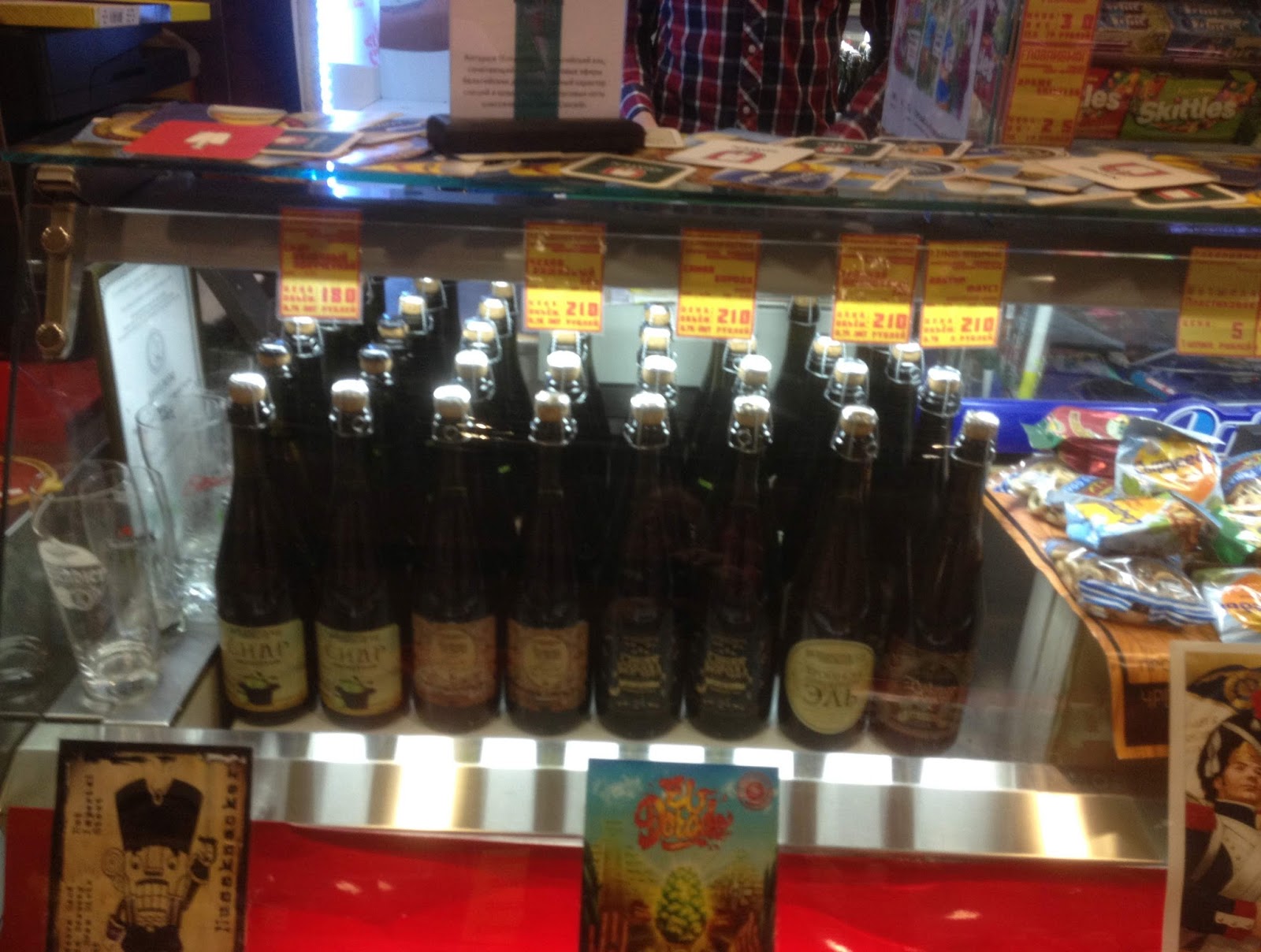
Barrie and I visited Allan in Moscow in 1999, and "craft" beer existed, kinda sorta; it's a story I've told before, and will repeat some day. The following is a recent note from Allan and a few photos. They illustrate the growth of "craft beer" in Russia.

It sure wasn't this way in 1987.

---

Rog,

Just visited my local beer pusher at the local market. He now has more than 50 Russian brews on sale, all from microbreweries. Some are in bottles, some are tapped into one liter brown plastic bottles. Many are nasty, some are quite good. See low quality photos attached.

On the last photos, the three I bought this time.

I think it is time for you to come to Russia, and take a one week beer excursion around the country. I will join you. Would be fun and educating.

Hope you are all well there.

Best,

Allan


Sunday, December 07, 2014

These requests from abroad, Vol. 6: "I wish you prosperity and development!"


If you own a brewery or work for one, you've probably fielded numerous e-mail inquiries from overseas asking for beer labels, crown caps and the like, as destined to become the cherished keepsakes of private collectors who've somehow heard of your portfolio, even in far-off Montenegro or Macao.

To me, there is something compelling and yet haunting about these foreign requests, which tend most often to come from Central/Eastern European locales, places of longtime personal interest to me historically and geographically. They speak to my inner melancholic.

Lately, I've been pasting their addresses into Google Map and seeing what their places of residence look like. After all, they can look at my business, and it seems only fair for me to see where they live, so very far away. In this spirit of introductions, meet Pavel from St. Petersburg, Russia

"Good day! Ladies and gentlemen, may I ask you a favor? I am interested in beer coasters/beer mats from around the world."

The last time I visited St. Petersburg, it was called Leningrad, and that was in 1987. Two years before, in 1985, my introduction to the Russian capital of old ... a real-life figment of Peter the Great's imagination ... came aboard a bus from Helsinki with a group of youthful tourists just like me, and it seems so much like a dream now. It was still the USSR, fully Communist, and Mikhail Gorbachev had been the head cheese for only a few scant months.

Leningrad was a big city even then, and the industrial suburbs coming in seemed endless, but in the historic city center, near the Winter Palace and other historic sites lifted directly from all the damn books I read in college, seemingly in preparation for those three slim days on the ground, it was so quiet you could hear a crown cap drop. Nevski Prospekt, the main shopping street, seemed perpetually deserted apart from the street cars, which cost the equivalent of about five cents to ride.

Forlorn vending machines dispensed still or fizzy water into communal glasses -- not paper, not plastic, but glass; two or three might be lined up atop the contraption, with a "sanitizer" function that occasionally worked. I celebrated my 25th birthday at a Central Asian joint, in the company of an entertaining Aussie named Mark, who regaled me with tales of the Smiths.

Leningrad was punished severely at the hands of the invading Germans during World War II (the Great Patriotic War, in regional usage). There was a 900-day-long siege, and the city bent but didn't break. A half-million people died, most of them civilians, and among the sites my tour group visited was the Piskariovskoye Memorial Cemetery. At the time, it was a favored pilgrimage spot for newlyweds. Sure enough, upon arrival, we saw a bride and groom posing for photos with the cemetery as backdrop. Somewhere I have a slide to prove it.

My point in recounting all this is that in all likelihood, Pavel hadn't yet been born when I was there. His apartment block on Turistskaya, which appears quite new, looks to be roughly 8-10 miles away from where I spent most of my time 29 years ago, which is labeled "Tsentralny" on the map above.


At least he has a nice shopping mall right across the street.


I wonder if there is beer for sale there?

Monday, April 14, 2014

The PC: My shoes are filled with Volga mud: (3) Beer hunters lurking nearby.

(Published at LouisvilleBeer.com on April 14, 2014)

---

My shoes are filled with Volga mud: (3) Beer hunters lurking nearby.

A 1999 travelogue in three parts.

March 31: (1) A tale of a fateful trip.
April 7: (2) The future is the past.
April 14: (3) Beer hunters lurking nearby.

(3) Beer hunters lurking nearby.

I awoke groggy and disoriented. We had retreated indoors quite early the previous evening, aiming to avoid mosquitoes of Biblical proportions, and sat inside talking and drinking Baltika Porter in the odd glow of a never quite black summer’s night.

Allan’s local helper had been commissioned to prepare fish soup for a midday meal to be consumed just prior to making the drive back to Moscow, and this left us with several hours to explore. Allan proposed a drive to a nearby town.

Armed with bootlegged Jackson Browne and Bad Company CD’s procured for next to nothing at the thriving music market back in Moscow, we set out for the scenic trek to Kolyazin, a dusty and isolated nowhere town that has the eternal good fortune to be dusty and isolated less than four hours away from Moscow – this being “good fortune” because a brief look at any reputable map of Russia will reveal there to be hundreds of Kolyazins, most of them located in places that are so lost in the middle of nothingness that they might as well be on another planet.

Monday, April 07, 2014

The PC: My shoes are filled with Volga mud: (2) The future is the past.

(Published at LouisvilleBeer.com on April 14, 2014)

---

My shoes are filled with Volga mud: (2) The future is the past.

A 1999 travelogue in three parts.

March 31: (1) A tale of a fateful trip.
April 7: (2) The future is the past.
April 14: (3) Beer hunters lurking nearby.

(2) The future is the past.

It was 1999, and from the beginning of the trip, it seemed a strange and disjointing sensation to be returning at last to a land that had captivated me so intensely earlier in my life.

In particular, it seemed quite wrong to be entering Russia by airplane. Before, back in the decidedly dark ages of the 1980s, I’d arrived in the Soviet capital only after long journeys by train, taking me eastward over a period of days through ever more mysterious and primitive concentric circles of the Warsaw Pact. Being able to effortlessly glide into an airport while ensconced in the belly of a Swissair jet seemed positively corrupt and decadent by comparison. The proletariat would harshly judge me.

A decade later, sprawling, brooding Moscow remained the imperial capital of Communism, at least in physical appearance. Seventy years of urban methodology was loosely draped with the familiar veneer of capitalism’s purported victory in the long running saga of the Cold War. Garish neons, intrusive billboards, cellular phones, car alarms — even the occasional coat of paint — all conspired to trick the unthinking visitor into believing that Moscow had become somehow Western.

Monday, March 31, 2014

The PC: My shoes are filled with Volga mud: (1) A tale of a fateful trip.

(Published at LouisvilleBeer.com on March 31, 2014)

---

My shoes are filled with Volga mud: (1) A tale of a fateful trip.

A 1999 travelogue in three parts.

March 31: (1) A tale of a fateful trip.
April 7: (2) The future is the past.
April 14: (3) Beer hunters lurking nearby.

(1) A tale of a fateful trip.

I knew we were in trouble from the moment the weather-beaten boat came into view. It had been hired by Allan Gamborg to take us out into the expanse of water that he swore was a river, but looked to me like a vast inland ocean.

A handful of pasty male natives in flowery swimming trunks eyed us with curiosity from behind their reeking cigarette stubs. There was an odor of gasoline in the air … or was it vodka?

Thursday, March 27, 2014

Allan's beer pusher in Moscow, Part Two ... salting the roaches.


When my friend Allan wrote to describe the new Russian beer "growler" filling station doing business in his Moscow market, he made it a point to include reference to fish sold there, too, presumably in lieu of peanuts or nachos.

Allan did this in part because it echoes our experience in the Russian countryside in 1999, but it also prompts an exceedingly dim recollection of visiting a beer hall of some sort, all metal and tile, somewhere off Kalinin Prospekt in Moscow in 1989, and having a couple of draft beers (Zhiguli?) with salted fish, and as many fish rinds on the floor as peanut shells in a Texas Roadhouse.

I replied to Allan: What about a recipe for salting those fish?

He answered with the video (above) and voluminous instructions, and before I pass along two excerpts, the first thing to remember is that when you initiate your google translation of Russian-language passages devoted to explaining how to go about salting fish, there'll be a common word come back to you: Roach.

First, the skewed snippets, followed by an explanation that will still your queasy stomach.

In the early 70s, I once bought a porter fishmarket "Lighthouse" that Leningradke for "Falcon", two bags of roach. By ruble twenty per kilogram. Here it was summer! We ate roach continuously. Beer for me was free and make profit (standing in a pub drinking beer and chewing dried fish - every one suit and ask the price. Took the tail or a couple of beers, or fifty dollars, it was very cheap). In Odessa, I rented a room for three in the Carolino Bugaz per bag roach month. And the hosts were extremely happy and accommodating.

Or this:

You have successfully went fishing and brought home a solid catch roach. Note: to run for beer and invite friends early conversion of fish notable roach take more than a month.
Take a bucket or large enamel pot. Pour on the bottom layer of coarse salt and put a layer of fish. Then another layer of the layer of salt and fish. And more. A top placing oppression. Roach under the yoke should prosalivatsya a week. And a pot or bucket is better to put in a cool place - for example to the balcony. But not in the refrigerator.

Roach: It's neither a clip for curing river creatures nor the common American insidious insect, but is, in fact, a fish: Vobla in Russian.

Vobla (Rutilus caspicus), also termed the Caspian roach, is a species of cyprinid fish inhabiting the Caspian Sea and inflowing rivers. It is closely related to the common roach (Rutilus rutilus) and often considered its subspecies, Rutilus rutilus caspicus.

Salt-dried vobla is a common Russian meal or snack that goes well with beer. It is popular in many Russian households and beer restaurants.

Salted, jerked roach. Sounds like the perfect menu item for the new generation of star gastropub chefs. I'm checking the Ohio River for carp as we speak.

Allan's beer pusher in Moscow, Part One ... the plastic bottles.


From Moscow, my old buddy Allan Gamborg writes:

In my local market, a guy has set up a booth selling beers from about 20 different microbreweries from Moscow, and the towns around Moscow. He sells both bottles and on tap in 1 liter plastic bottles filled on the spot. Around 6 pm there is always a line of men after work. He also sells dried fish. Wonderful place. Beer is not so good though, at least not to my taste. For some reason, most of the beer is pale ale or stout. Well. I'll make some better photos next time I'm there if you want some inspiration on how to run your business.

PS – It probably cannot match the place we visited out of town, in 1999, on the way home from my dacha. Not much can.

He's referring to this.

It was the quintessential roadside beer stand, the mysterious local brewery’s de facto open-air tap room, nestled under the welcomed shade of trees in a farmyard littered with puddles, chicken droppings and fish bones, where a lady poured beer from a rigged faucet attached to a single keg, minus the needless expense of extras like refrigeration or television advertising.

At her disposal were six mugs, a basin of well water for rinsing them, and a bowl of rubles for making change. A half-liter of draft beer cost 25 cents, and the origin of the bones was revealed when I offered her a 20-ruble banknote for two beers, and in lieu of coins, she offered two small, leathery smoked fish in return.

I've actually been working on an updated version of this tale of Americans and Danes in Russia back in '99, and am considering publishing it at LouisvilleBeer.com as a multi-part Potable Curmudgeon column. But before that ... what is it about fish and beer in Russia, anyway?