Monday, June 19, 2017

Headlines from May 2017 on THE BEER BEAT.


Okay, okay -- I'm two weeks late.

Previously, I explained several reasons why this blog has gone on hiatus, and explained that my thoughts about beer will be posted alongside my utterances about everything else, over yonder at NA Confidential. You'll find them there via the all-purpose tag, The Beer Beat.

However, whenever the urge strikes -- probably monthly -- I'll collect a few of these links right here. Following are May's ruminations, with the oldest listed first. Some are more topical than others, and I'm past the point of caring about it.

Thanks for reading, if belatedly.

---

THE BEER BEAT: Schaller’s Pump has closed, but why was Chicago's oldest bar called a "Pump," anyway?


The demise of any 136-year-old bar is both newsworthy and regrettable. What strikes me about Schaller's Pump is the name itself. Nowadays, you simply don't see too many bars referring to themselves as "pumps," although there are a few newer establishments around the country that have borrowed the rare old-school usage.

---

THE BEER BEAT: The Pour Fool nails it yet again, as "Budweiser Finds Another Sell-Out" -- this time, Wicked Weed.


Like others before it, Wicked Weed Brewing has died. That's unfortunate, indeed, but from the moment the ownership of Wicked Weed passed to AB InBev, this previously independent brewery was transformed into something else. Now it's Wicked Trojan Zombie Afterlife Weed. We'll always have our memories.

Speaking only for myself, I wouldn't drink a WTZAW beer with Donald Trump's lips.

---

THE BEER BEAT: Wicked, Weed -- Whatever: "Tastes of paradise can shatter mirrors" (2014).


Tastes of Paradise: A Social History of Spices, Stimulants and Intoxicants (is) by the wonderfully named Wolfgang Schivelbusch. He is not a Groucho Marx character from Duck Soup, but a German-born cultural historian operating from a decidedly (Karl) Marxist perspective.

---

THE BEER BEAT: Wicked, Weed -- Whatever: "This week in solipsistic beer narcissism" (2014).


Given the perpetual linkages between education and personal advancement, why is it that people choose to devalue the notion of education, eschewing the why, how and wherefore, and substituting in their place a solipsistic, narcissism-driven, knee-jerk, me-first hedonism?

---

THE BEER BEAT: Wicked, Weed -- Whatever: "Let's explore anti-local craft beer unconsciousness" (2013).


We don't need Bourbon County Stout when other versions of wood-aged stouts (and other styles) produced by genuine indies are in the same league.

We don't need whatever sour specialty used to be brewed by Wicked Weed before its untimely demise.

Instead, we need to log off Untappd, hide the phone, find a local brewery and enjoy a fresh beer with living, breathing humans.

---

THE BEER BEAT: Wicked, Weed -- Whatever: "Localism + Beer" (2012).


It makes no sense to labor over writing a fresh new essay when we've all been here before, and whether or not the "keep politics out of my narcissism" caste
realizes it, we've been here ever since Goose Island died.

---

THE BEER BEAT: Wicked, Weed -- Whatever. Localism is the salve for your cognitive dissonance.


There are plenty of laws that might be enacted to put AB InBev in its place, but these are unlikely to be written, because who benefits the most from robber baron multinationals if not the politicians accepting their campaign contributions?

Accordingly, if vile politicians give money to AB InBev with the aim of preserving monopolies and suppressing choice, why would you even consider doing the same -- even if it's your precious Bourbon County Stout?

---

THE BEER BEAT: It has been three years since BSB's original kitchen closed, so let's return to "Ice Cold WCTU (A Modest Proposal)."


By January of 2015, I'd decided to run for mayor and take a leave of absence, which turned permanent shortly thereafter -- and no, they haven't paid me a dime yet. Perhaps it's time to make an attorney rich.

All in all, it's been a charmed life, and I have few regrets. One of them is that it wasn't possible to follow through on what undoubtedly was my greatest idea: Ice Cold WCTU, a museum and conceptual memorial to the victims of Prohibition, doubling as the unique shtick to draw customers to the brewery.

---

THE BEER BEAT: Moss the Boss and his L’ Eblouissant (The Dazzling), one of my favorite pubs in the world.


Even then, we almost missed The Dazzling. There was no sign apart from a back-lit Murphy’s Stout oval, adorning an accurate facsimile of an Irish pub front. We stepped inside, only to find the pub officially closed to make room for at least two dozen Namur locals gathered there to celebrate their recent return from a tour of Sri Lanka.

At this juncture, our first acquaintance was made with the Belgo-Irish force of nature known as Alain Mossiat, to be forever known as “Moss the Boss.” Moss welcomed us, albeit a bit warily at first. His resistance began to crumble when it became evident that our beer pilgrim credentials were exemplary, and so an impromptu compromise was reached.

---

THE BEER BEAT: Starlight Distribution's entire inventory was destroyed by Friday's flooding.


Condolences to Starlight Distribution and solidarity with the recovery. The same goes for all the folks north of us who suffered damage from yesterday's flooding.

---

THE BEER BEAT: It should be in a museum, but the original Public House keg box has a new, loving home.


It was dubbed the Jouett Meekin Memorial Keg Box. For a while, I kept beer tapped to drink at home, and used the keg box for Harvest Homecoming Parade parties and occasional social gatherings. I’m quite attached to this hunk of metal and draft lines, but the time has come to find her a better home.

---

THE BEER BEAT: Odds and ends from the month of May. I can't remember anything before that.


It's good by me. Any effective strategy for dealing with sexism in "craft" beer is likely to be incremental. We're talking attitudes, and these take time. Speaking of time, I'm a history nut, and "extinct" styles fascinate me.

---

THE BEER BEAT: Fest of Ale is almost here, though New Albany Craft Beer Week wasn't.


In 2016, I took a stab at organizing a New Albany Craft Beer Week to precede Fest of Ale, and to culminate with it. It's a common promotional device, and one exercised widely. It didn't happen in New Albany this year.

Saturday, May 13, 2017

Headlines from April 2017 on THE BEER BEAT.


Previously, I explained several reasons why this blog has gone on hiatus, and explained that my thoughts about beer will be posted alongside my utterances about everything else, over yonder at NA Confidential.

You'll find them there via the all-purpose tag, The Beer Beat.

However, whenever the urge strikes -- probably monthly -- I'll collect a few of these links right here. Following are April's ruminations, with the oldest listed first. Some are more topical than others, and I'm past the point of caring about it.

Having noted this, I found that writing about my favorite pubs made me feel good. There may be more of it.

---

THE BEER BEAT: Indie, not craft, because "There is absolutely NOTHING 'independent' about AB/InBev."


I haven't gone cold turkey on the "craft" descriptor, and find myself using the word here and there (usually in quotation marks, as intended to emphasis the escalating irony), but zero tolerance is a worthy goal to which we might aspire.

---

THE BEER BEAT: Retro and dive, tavern and free house. Stages of development. A rumination.


We’re approaching an important local anniversary in the saga of better beer, because at some point in the late summer of 1992, the first keg of Guinness was tapped at the Public House formerly known as Rich O’s.

---

THE BEER BEAT: The Hibernian (Hi-B) Bar, one of my favorite pubs in the world.


It's been 30 years since I climbed the stairs to the first floor (in Europe, that's how they're numbered) and beheld the cramped majesty of the Hi-B. Somewhere up or down another set of stairs was the loo. The publican Brian O'Donnell was a legend even then, and as I write, it is my earnest hope that he's still alive and scowling.

---

THE BEER BEAT: The Dolphin, one of my favorite pubs in the world.


Few such pubs can boast a semi-official house artist. The late Beryl Cook was a painter who moved to Plymouth after the retirement of her husband. They opened a guest house nearby, and gradually Cook gained fame as an artist. Because The Dolphin was her local, several of her paintings chronicle pub life.

---

THE BEER BEAT: BrewDog's private equity $$$ bonanza: "Not bad for ten years of being rude about the rest of the UK brewing industry."


BrewDog's antics have entertained me for a long time. The company's success reminds us that while P.T. Barnum may have been an American, hucksterism never has been confined to just one country. I hope the founders of BrewDog make a mint, whether in dollars, Euros or pounds sterling. I'll be at a local establishment somewhere, drinking myself to sleep.

---

THE BEER BEAT: Jim Koch ponders whether it's "Last Call for Craft Beer."


Just my two cents. It's hard feeling sorry for Jim Koch, though in some ways I do. Samuel Adams Boston Lager is one of the most important beers in American brewing history, whether "craft" or macro. It helped pioneer a whole segment, and it's still really good for what it is.

---

THE BEER BEAT: St. Radegund Free House, one of my favorite pubs in the world.


Regrettably, my paean to St. Radegund Free House in Cambridge, England must begin with the sadly belated report that former landlord Terry "Bunter" Kavanagh died five years ago at the age of 75.

---

THE BEER BEAT: A neighborhood dive bar for the post-craft beer world?


It's feeling like a lab rat, as though you're part of an ongoing experiment in anxiety escalation -- like an arms race, always hoppier, sourer, stronger and plain weirder; the wheel constantly is revolving, and there's nothing upon which to hang one's metaphorical chapeau for longer than one keg (a sixth barrel), lest another begin pouring the diametrical opposite.

---

THE BEER BEAT: Sometimes compliance takes a labyrinth.


Attention, oppressed Indian(a) ATC permit holders.

---

THE BEER BEAT: Valley Malt. Pioneer Valley. It all comes back to me now.


And, during two recent trips to Western Massachusetts, it never once occurred to me that Valley Malt might be located nearby, as in fact it is -- in Hadley, just a few miles from Diana's niece's family in South Hadley. We almost certainly were within minutes of the malting, and may well have passed it a half-dozen while driving back and forth.

__

Tuesday, April 11, 2017

Headlines from March 2017 on THE BEER BEAT.


Previously, I explained several reasons why this blog has gone on hiatus, and explained that my thoughts about beer will be posted alongside my utterances about everything else, over yonder at NA Confidential.

You'll find them there via the all-purpose tag, The Beer Beat. However, whenever the urge strikes -- probably monthly -- I'll collect a few of these links right here. Here is another month, with the most recent listed first. Apologies if topicality has gone out the window. I'm still groping for a working routine.

---

THE BEER BEAT: An assortment of headlines for beer and dissection.


Every year is the same, and I repeat once again: SUNDAY SALES ALREADY EXIST. Each year without fail, someone writes a column like this one lamenting Indiana's undisputed legal weirdness, and it always ends with the broad claim that there is a prohibition on Sunday sales. But beer, wine and spirits are available for carry-out on Sunday from small Indiana's brewers, vintners and distillers -- and there are virtually no restrictions pertaining to on-premise consumption.

---

THE BEER BEAT: I've decided to skip this year's Session Beer Day observance. See you in 2018.


As most readers know by now, (my mother) died two weeks ago, and I'm happy to have kept my vow of sobriety (if not outright abstinence). We're never to old to learn, or to feel. Session Beer Day was to be the resumption of normality, and yet to be honest, I'm not feeling it. I can see myself having a couple of beers somewhere, just not in the previously suggested format.

---

SHANE'S EXCELLENT NEW WORDS meets THE BEER BEAT: Boontling, a local dialect made famous by Anderson Valley Brewing Company.


Hop Ottin' was a precursor to our IPA-crazed contemporary era, and it also serves to introduce today's lingo.

---

THE BEER BEAT: Bryan Roth on sexism, anonymity and speaking openly about diversity.


If the guild is supported by the majority Indiana breweries, and it is, and if these breweries agree that it's a good thing for the guild to lobby on their behalf, then the corollary is for them to accept an obligation to be socially responsible -- precisely because the Indiana legal regime stipulates that irresponsibility (serving minors, etc) is grounds for the revocation of the brewing privilege.

---

THE BEER BEAT: "'Pinup versus pin her down': Indiana beers stoke controversy."


Last December, I was revisited by ghosts. It's a recurring phenomenon with me.

---

THE BEER BEAT: Airline pricing for movie theater drinks, although we've little idea which ones.


If I were an editor at Business First -- well, that's unlikely, given that business-oriented publications contain far too many numbers for a humanities major like me, and anyway, it's my habit to refrain from fetishizing grubby capitalists -- I'd ask the contributing writer why some of the following beers are tagged by brand name, but the wines are identified by style.

---

THE BEER BEAT: Highlights but no Lites, or a beer news roundup.


Coincidentally, as I ponder the most recent effort (fingers crossed) to bring the NABC buyout saga to a conclusion, All About Beer offers a wonderful tip about the power of realism.

---

THE BEER BEAT: No beer ... but a whole lotta mezcal in the new edition of Food & Dining, including a previously unpublished feature-length essay.


The assignment began as a column-length look at Louisville KY resident Marcos Mendoza and his Mala Idea line of mezcal, then John Carlos White turned me loose to write about mezcal at length -- and at deadline, we'd see where it took me.

---

THE BEER BEAT: "HopCat is the craft beer lover’s meow."


Since Food & Dining is a quarterly, I wait until the current issue is published, then backtrack three months for the reprint, so this profile of HopCat is from Winter 2016; Vol. 54 (Aug/Sept/Oct) -- and yes, HopCat is a chain pub and eatery.

---

THE BEER BEAT: The revenge of analog in terms of drinking beer? I like the idea.


The single most memorable beer article I came across during the past week didn't so much as mention beer, not even once. Instead, the article in question is a brief rumination on the message to be gleaned from a new book by David Sax called The Revenge Of Analog: Real Things And Why They Matter.

__

Friday, March 03, 2017

Headlines from February 2017 on THE BEER BEAT.


Previously, I explained several reasons why this blog has gone on hiatus, and explained that my thoughts about beer will be posted alongside my utterances about everything else, at NA Confidential.

You'll find them there via the all-purpose tag, The Beer Beat. However, whenever the urge strikes, I'll collect a few of these links right here.

Here are another month's worth of them, with the most recent listed first. One of my columns sneaked in there, too.

Apologies if topicality has gone out the window. I'm still groping for a working routine.

---

THE BEER BEAT: Some great ink for Floyd County Brewing Company.


Crucially for Floyd County Brewing Company, the business is a classic brewpub model. The beer is brewed and consumed in-house. It's the right model for the here and now. The object is to dial in the beer at FCBC's home base, and then become a can't miss destination for local beer lovers.

---

ON THE AVENUES: A stern side view of Gravity Head, nineteen times over.


Gravity Head might be staged differently, but as they pertain to what unexpectedly has become a bona fide tradition, an array of minor and often weirdly eccentric points adds up to a greater sum.

---

THE BEER BEAT: A compendium of local and regional craft beer headlines.


Once upon a time the pace of change in regional brewing circles was fast, but not so rapid as to defy the efforts of an intrepid observer or two to consistently document the phenomenon.

---

THE BEER BEAT: Why not a Session Beer Day pub crawl in downtown New Albany?


With Session Beer Day 2017 less than two months away, it's time for me to decide how I'll be honoring the occasion this year, and here's what I've come up with. This year, I'd like to make my Session Beer Day stroll in downtown New Albany. You're welcome to join me.

---

THE BEER BEAT: You may need pickle brine after the Stupor Bowl, or throughout Trump's term.


Welcome to the pickleback: A whiskey shot with pickle brine as a chaser. Thanks to K for the link.

---

THE BEER BEAT: "There is not ONE FREAKING IOTA of truth about how AB got started in this beautifully-crafted, button-pushing, faux-sensy-poo, piece o’ trash ad."


For those readers who may be coming late to my beer-related scribblings, know that Stevefoolbody is my hero. He is so awesome that typically I have nothing whatever to add, and merely attach a link and brief teaser to encourage you to go to his page and read.

---

THE BEER BEAT: It took a week to get the details straight, but BBC is leaving its current St. Matthews location after 23 years and hopes to reopen elsewhere in Louisville KY.


So, to recap: Owner Pat Hagan bowed (intelligently, in my view) to leasing and area development realities and now hopes to move BBC to a new location, one that will allow the expansion of brewing into bottling and/or canning. The 3rd Street brewery and restaurant remain open, and the 4th Street branch will reopen when the Kindred building is finished. The coming week will be a victory lap for BBC in St. Matthews, and I hope to make it over and learn the future of my Wort Mug, number 66.

---

THE BEER BEAT: No selfies necessary, because localism is why I believe the impending Falls City expansion is good news.


But localism as an economic doctrine provides another way of looking at the world – capitalism with a more human face, complementary to a good beer ethos, and also a different collection of information that permits tying a singular love of mine (beer) to another (the community in which I live, and how to make it better). It offers sense and sensibility out of relative scale, and suggests differing standards of value and achievement.

---

THE BEER BEAT: Tailspin Ale Fest returns to Bowman Field on Saturday, February 18.


In my view, Tailspin Ale Fest has become Louisville KY's premier beer festival, and it's the brainchild of New Albany's own Tisha Gainey.

---

THE BEER BEAT: Green Mouse sez the rumors are unsubstantiated and it's business as usual at BBC St. Matthews.


If and when further information becomes available, I'll let readers know. Until then ... can someone bring daddy a nice growler of David Pierce's signature BBC APA? I've been known to pay cash for such favors.

---

The past month on THE BEER BEAT.

Sunday, January 22, 2017

The past month on THE BEER BEAT.


Previously, I explained several reasons why this blog has gone on hiatus, and explained that my thoughts about beer will be posted alongside my utterances about everything else, at NA Confidential. You'll find them there via the all-purpose tag, The Beer Beat. However, whenever the urge strikes, I'll collect a few of these links right here.

Here are a month's worth of them, with the blockbuster first.

THE BEER BEAT: The rumorama insists that Bluegrass Brewing Company (St. Matthews) will soon cease operations, but is a plot twist coming?


As for my sporting habits, times have changed, as have the beers that used to accompany them.

THE BEER BEAT: Football, how it used to be for me, why I seldom watch it at all -- and don't even mention those horrid beers.


My recent podcast was tremendous fun.

THE BEER BEAT: In which we talk beer on the "Flies on the Wall" podcast at Crescent Hill Radio.


For greater insight as to why people would ever stand in line for rare beers, there is this wonderful essay by Bryan Roth, otherwise known as "my kind of beer writing."

THE BEER BEAT: Rarity, beer quality, authenticity, and why it's so difficult to love the beer you're with.


Lew rocks.

THE BEER BEAT: The beer and whiskey that Lew Bryson wants to drink in 2017.


There was a roundup of Southern Indiana beer news.

THE BEER BEAT: News and views from local breweries, and an incredible Uff-da.


And, if you're not aware of the Pearl Street Taphouse, you need to be.

THE BEER BEAT: The Pearl Street Taphouse in downtown Jeffersonville.

Sunday, December 18, 2016

The advent of THE BEER BEAT, and three links to it.


Previously, I explained several reasons why this blog is going on hiatus, indicating that my thoughts on beer will be posted alongside my thoughts on everything else, at NA Confidential. You'll find them there via the all-purpose tag, The Beer Beat.

However, whenever the urge strikes, I'll collect a few of these links here. First, a flashback.

THE BEER BEAT: Addressing diversity in "craft" beer, with Naughty Girl once again on the wrong side of the debate.

Let’s put an old saw to the test: Is it really true that any publicity is good publicity?

Specifically, if a New Albanian Brewing Company beer and beer label, as conceived on my watch in 2011, appears alongside an article by a national recognized blogger in 2016 and then is linked on Facebook by a brewing superstar, that’s wonderful, right?


Next, when good people succeed.


THE BEER BEAT: Localism in action, from Big Woods to Quaff On, now also Hard Times.

I've always like the people at this company, and it's been instructive to watch as they've expanded the business, geographically and in terms of product lines.


Finally, saying what you mean and meaning what you say.


THE BEER BEAT: Words like "local" and "unique," and beers for cold weather.

According to what I'm hearing, Flat12 as currently constituted has no plans to brew in Jeffersonville. Of course, this could change.

__

Saturday, December 10, 2016

Allow me to explain several reasons why this blog is going on hiatus (psst ... go to NA Confidential instead).

Ever since I began the process of disengaging from NABC, which diligent future historians will observe taking place at various intervals in the year 2015 (and which isn't yet concluded), my relationship with beer has been in flux.

This isn't necessarily a bad thing. It's just different.

The world of beer has changed considerably during the past decade, and so have I. So have all of us. At times these days I want to throw Molotov cocktails at what I perceive beer is in the process of becoming, but at other times I love it as much as I always did.

Yeah, it's complicated.

To get to the point, and stated simply, my head currently isn't in alignment with the effort required to maintain two blogs. For whatever reason, NA Confidential -- which I've always referred to as my "public affairs" outlet -- has absorbed most of my time in recent years, with results that better reflect my interests, and that have produced gains in terms of readership.

As my column there Thursday explains, it makes more sense to fold my beer writing into NA Confidential, while keeping The Potable Curmudgeon as an archive (and ready source for cannibalizing past ideas).

All of these considerations also feed into an impending personal reality check. It was planned for me to take a year off to regroup, and the missus has been patient, but now the year is over. The column explains it; just know that easing back into the game via altered circumstances is the path I'll likely be pursuing.

In the meantime, look for beer writing at NAC prefixed by THE BEER BEAT, and remember that everything I've just explained could be obsolete the day after tomorrow. I'm playing things by ear, readying to go to the mattresses, and whichever other tired cliche might be inserted here.

Of course, anyone who might be in the market for an unemployed curmudgeon who can write a bit and probably is otherwise unemployable might be able to delay my entrepreneurial plans. 

To those of you who've been eavesdropping here these many years, I cannot thank you enough. There'll yet be a few things to tidy up here, and I'll get to them soon enough. Cheers!

---

ON THE AVENUES: It’s never too late to beer all over again.

It isn’t that I’ve fallen out of love with beer. We’re not divorced or anything. A better word is estranged, which implies an alienation of affection, but doesn’t entirely rule out the possibility of reconciliation.

These thoughts occurred to me recently as I was contemplating the future of The Potable Curmudgeon, my beer-themed blog. It dates to 2005, and has enjoyed some fine moments over the years, though recently my commitment to maintaining it has waned.

Slightly less so Roger’s Simple Beer Pleasures, a page at Facebook that I started in late 2015. It is far better suited to the truncated social-media-driven attention spans ruling the planet at present, including my own, at least as it pertains to beer and brewing.

In spite of my efforts, I can’t seem to make The PC blog and Simple Pleasures work in harmony the way NA Confidential’s blog and Fb page do, primarily because my efforts are half-hearted.

There’s the rub.

I care more about what I’m writing at NA Confidential than The Potable Curmudgeon, so I’m willing to make the time at one and not the other. Taking it a step further, this indiscipline owes to my sense of estrangement from the world of beer and brewing. It isn’t that I don’t enjoy writing about beer, thinking about it and even drinking it, just that it isn’t a daily priority at present.

Consequently, I’ll be altering the routine in the weeks to come. The beer writing I undertake will be featured here at NA Confidential, and I’ll allow The Potable Curmudgeon to remain dormant as an archive.

Perhaps Fridays will be NAC’s Beer Day, or some such. Since so much of my beer writing has sought connectivity between beer and other interests in my life, putting them all in one place rather than separating them makes the most sense.

That is, until it doesn’t.

Read the rest here.

__

Monday, November 28, 2016

AFTER THE FIRE: Hip Hops ... Bourbon-barrel aged Imperial Stouts.

AFTER THE FIRE: Hip Hops ... Bourbon-barrel aged Imperial Stouts.

A weekly column by Roger A. Baylor.

I'm always an quarterly issue behind when it comes to reprinting my columns from Food & Dining Magazine. This one is from Fall 2016; Vol. 53 (August/September/October).

---

Bourbon-barrel-aged Imperial Stouts

You’ll hear one sort of pitch at a sales meeting, and see another thrown during a baseball game, but brewer’s pitch is completely different.

Brewer’s pitch is a resinous substance used to line wooden barrels so liquid doesn’t come into contact with the wood.

That’s because exposure to a wooden barrel affects the flavor of its contents, and generally over the centuries, brewers have preferred their wooden vessels to be neutral. Brewer’s pitch remains a handy means to this end, and anyway, stainless steel long ago supplanted wood for beer’s storage and serving.

But what if beer’s modification is the stated aim of the exercise?

If submerged wood can positively complement the taste of beer, as with white ash chips or oak spirals, and if wooden cooperage harboring funky microorganisms can leverage its own intended outcome (for example, in some styles of sour beer), then barrels formerly harboring spirits offer a wide potential range of flavor and aroma characteristics for beers aged inside them.

Consider an emptied oak Bourbon barrel. It was charred in order to properly host Kentucky’s indigenous corn-based liquor, and after a period of years, the mellow finished whisky was removed for bottling to proof.

However, this once-used barrel retains considerable evidence of Bourbon. Why not repurpose these flavors and aromas by aging beer in it?

It seems a forehead-slapping moment, and yet the genuinely strange thing is how long it took for someone to grasp the possibilities.

Lost Abbey brewmaster Tomme Arthur, no stranger to the nuances of barrel aging, identifies Bourbon Barrel Zero in this 2013 excerpt from All About Beer magazine.

In 1992, Greg Hall from Goose Island Beer Co. in Chicago might very well have become the first American brewer to produce a bourbon-barrel-aged beer when he filled six oak barrels that previously contained Jim Beam. He poured this experiment at the Great American Beer Festival (GABF) in Denver that fall, inducing rumors, appreciative nods and whispers of something entirely new.

I can second Arthur’s emotion, for at a GABF vintage beer tasting in 1997, the late, great beer writer Fred Eckhardt was seated next to me. When I asked him the beer he considered the festival’s finest ever, he didn’t hesitate: Goose Island Bourbon County Stout.

In our contemporary craft beer era, all manner of spirit-soaked barrels are being merrily procured by enterprising craft brewers as creative mediums for aging and experimentation.

The number of beer styles deemed appropriate for barrel again also has expanded, although certain combinations strain credulity to such an extent that I’m almost afraid to joke about Organic Free Range Mezcal-Barrel-Aged Imperial Kolsch lest it somehow comes to tragi-comic fruition.

No timelessness for the impatient

Such embellishments are hip, and I’m square. 25 years are more than enough to concede the elegant pre-eminence Hall’s foundational Bourbon-barrel-aged Imperial Stout.

Hall sourced oak Bourbon barrels in Kentucky, and he filled them with Imperial Stout, the stout family’s brawniest hitter. This inspired pairing remains the bellwether. Bourbon and Imperial Stout are burnished and challenging, richly assertive and subtly intricate. They bring out the best in each other.

At strengths typically in excess of 10% abv, Imperial Stout’s dense, black, viscous intensity lends itself to a panoply of descriptors, including roastiness, coffee, caramel, smoke, vanilla, sultana, plums, figs, cherries, chocolate, brown sugar, licorice, fruit cake and bubblegum.

A wooden barrel saturated with Bourbon offers similar and complementary flavors and aromas, as well as a pinch of added alcoholic potency. The brewer’s objective is to choreograph these delightful factors by calibrating, aging and blending with ultimate “Bourbon Stout” balance in mind.

Consequently, Bourbon-barrel aging is a thoughtful, time-consuming process. Used barrels must be visually inspected for imperfections, and kept from drying out. While uncut whiskey is an effective disinfectant, it’s better to fill the barrels with beer relatively quickly, lest undesirable microorganisms find a safe haven.

Once filled with beer, the barrels need a place to rest, and you’ll sometimes see stacks of barrels in the brewhouse. Ambient temperatures matter, as well as ready access, because brewers will need to pull samples for taste testing. Often they’ll drill holes in the wood and use stainless steel nails as plugs after regularly scheduled nipping.

Just as most Bourbons are blended to achieve uniformity of character, typically beers from multiple Bourbon barrels are, too. Brewers often blend in a second batch of base beer. Aging and blending take time and money, explaining why Bourbon-barrel-aged Imperial Stouts tend to be limited cool-weather seasonal releases, both rare and expensive.

Save that cigar for the second bottle

Imperial Stout is ideal, but it isn’t the only style of beer suitable for Bourbon-barrel-aging. From the hoppy (Double India Pale Ale, Barley Wine) to the malty (Doppelbock, Belgian Quadrupel), characteristics of Bourbon can meld with those beer styles boasting the heft and complexity to compete.

Balance, smoothness and harmony are the watchwords when seeking worthy Bourbon-barrel-aged beers. Beer and barrel must co-exist as equals, with discernible contributions from each. If they don’t, a glorified boilermaker is the likeliest outcome.

Here’s how not to do it

Head Brewer: “We’re making our Bourbon-barrel-aged beer today.”

Assistant Brewer: “Great. How many fifths of Old Rotgut should I pick up at the package store?”

A small number of Bourbon-barrel-aged beers are available year-round (Goodwood Bourbon Barrel Stout, New Holland Dragon’s Milk). Others are the sporadic targets of fervent cult appeal, like Against the Grain’s Bo and Luke.

Plan now for the approach of winter. On-line ratings aggregators like ratebeer.com and beeradvocate.com are the best sources for building your shopping list. Brewery web sites list seasonal release dates, and it’s always a good idea to befriend the beer buyer at your neighborhood package outlet.

Goose Island Bourbon County Stout endures, more widely available than ever thanks to AB-InBev, the Chicago brewery’s parent. BCS remains an impeccable example of Bourbon-barrel aged Imperial Stout, these days the elder statesman in an extensive, ever-changing yearly barrel-aged program. Even I can remember the annual release date for BCS.

It’s Black Friday, on Thanksgiving weekend.

---

November 21: AFTER THE FIRE: Hip Hops ... Goodwood Brewing Company: Touched by a Barrel.

October 17: AFTER THE FIRE: These old, old habits die hard.

October 10: AFTER THE FIRE: The Great Taste of the Midwest is the best beer fest of them all.

October 3: AFTER THE FIRE: New Albany’s Harvest Homecoming occupation isn't alleviating my "craft" beer Twitter depression.

September 26: AFTER THE FIRE: The seasonality of Oktoberfest in time, beer and year.

__

Sunday, November 27, 2016

The mustachioed man on the Birra Moretti label gets a trim.

In the mid-1980s, when I first visited Italy, the country was by no means a beer destination.

However, the scene was changing, even then. Demographics were key, as younger Italians gradually rebelled against the wine-centricity of their elders by embracing beer, which at the time meant the usual vapid international golden lagers like Carlsberg and Heineken.

These days, craft/specialty brewing is firmly established in Italy, though less so in Sicily, where we vacationed during Thanksgiving week. There is a world-class beer bar in Catania, our destination, and I'll describe it when there's time.

Of course, Italy always has had standard golden lagers of its own. In the eighties, I preferred Dreher, but it was less common than Peroni Nastro Azzurro and Birra Moretti. Michael "Beer Hunter" Jackson had a high opinion of Moretti LaRossa, an amber, malty lager somewhat after the fashion of a Vienna. Sadly, I saw none of it in Catania.

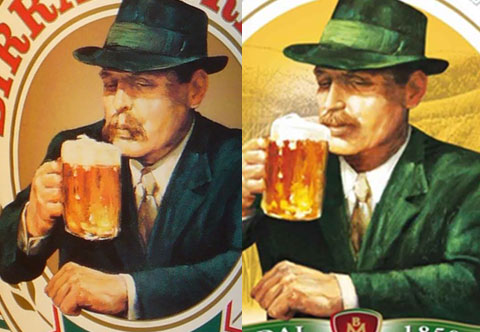
In terms of mass-market fashion sensibility, a crucial factor in stylish Italia, Birra Moretti always was the hands-down winner, and so it remains. The brewery, which is located in northeastern Italy near Austria, was purchased by Heineken 20-odd years ago, and its trademark mustachioed man has experienced ... shall we say, evolution?

Interestingly, this man was a real person. Here's the story, circa 1942, as explained at Moretti's web site, and followed by the first-generation visuals.


One day, in 1942, the nephew of Luigi Moretti, the founder of the brewery, going out for lunch saw a pleasant-looking man sitting at a table in the Trattoria Boschetti in Udine. There was something unique in that man.


By 2010, there had been a metamorphosis.


What’s changed? For starters, his Reverse Hitler ‘Stache has grown into a Flanders. Also, his de-aged designer has given him the strength to hoist the mug of Moretti with noticeable gusto.


In the 2016 label below, as gracing the bottles I recently drank in Catania, he seems a bit bleached -- and I swear, the mustache keeps getting smaller, although it's probably my imagination.


The bottom line: It's possible I won't drink another Moretti until the next time we visit Italy, but it's strangely comforting to know that this classic imagery persists.

__

Saturday, November 26, 2016

Hip Hops on HopCat: Yes, the current issue of Food and Dining Magazine is on the street.


The latest issue of Food & Dining was released just as we were boarding our flight for Sicily, so I'm a wee bit late in posting this quarter.


Food & Dining -- Winter 2016, Vol. 54 (November/December/January)


I have my usual beer column byline in the current edition. It's about the advent of HopCat Louisville KY, and to be truthful, I had a blast writing it.


HIP HOPS | HopCat is the craft beer lover’s meow ... with 132 taps, it might be a good idea to bring a sleeping bag.


Printed copies of F & D are available throughout the metro area in bars, restaurants, coffee shops and bookstores -- and they're free of charge.

__

Monday, November 21, 2016

AFTER THE FIRE: Hip Hops ... Goodwood Brewing Company: Touched by a Barrel.

AFTER THE FIRE: Hip Hops ... Goodwood Brewing Company: Touched by a Barrel.

A weekly column by Roger A. Baylor.

I'm always an quarterly issue behind when it comes to reprinting my columns from Food & Dining Magazine. This one is from Summer 2016; Vol. 52 (May/June/July).

---

Goodwood Brewing Company: Touched by a Barrel

It is a deceptively simple notion to modify the flavor of beer by aging it in Bourbon barrels.

Just as char and time transform simpler corn-based spirits into a sipper’s elixir, so a barrel’s second use with beer can create a characterful hybrid, balancing the chosen base beer with notes of vanilla and spices.

This principle holds true when using barrels previously filled with other liquors or wine, and to a more subtle extent, by exposing beer to various types of wood (most often oak) through chips or spirals.

Currently there are at least 4,200 breweries in America, and many of them have experimented with wood during the aging process. Often these are small batches for limited release, though Alltech’s Kentucky Bourbon Barrel Ale is a flagship, available year-round.

Then there is Goodwood Brewing Company, where all of its beers are touched by wood and brewed with limestone water.

Goodwood’s identity dates to 2015 and a rebranding of the entity once noted for brewing Bluegrass Brewing Company’s beers under license for packaging and distribution. The brewery’s new name is fully intentional, meant to inform beer lovers of the roles played by wood and water.

“We became Goodwood because we are known throughout the region and industry as experts in barrel aged products,” says Goodwood’s CEO, Ted Mitzlaff.

“Our barrel-aged program quality is second to none.”

Brewmaster Joel Halbleib adds, “Kentucky water is fantastic for many reasons; our yeast is happy about the extra calcium. Louisville KY has a global reputation not only for our water quality, but the unique and historic way in which we process it.”

Of course, oak barrels and limestone water are not exactly revolutionary concepts in Kentucky. They form the backbone of the state’s geographically determinate libation, and a tradition informing Goodwood’s tagline.

“What’s good for Bourbon is even better for beer.”

In fact, beer and Bourbon are grain-based cousins, beginning life similarly during the mashing stage, then diverging into fermented and distilled forms. Goodwood’s aim of reinserting beer into a Bourbon-based equation may strike some as audacious.

Others will find it a delightfully appropriate adaptive reuse, both for barrels and ideas.

Pretty used bourbon barrels, all in a row

Goodwood occupies an old industrial warehouse at 636 East Main Street in downtown Louisville KY. Beer has been brewed there since Pipkin Brewing Company opened in 1998, and in fact, Pipkin produced Louisville KY’s first Bourbon Barrel Stout in 2001.

In 2006, BBC’s began brewing its Jefferson’s Reserve Bourbon Stout here. It was a mainstay in markets outside Kentucky, and remains the basis of Goodwood Bourbon Barrel Stout.

Goodwood’s stretch of Main Street used to be lonely unless the Louisville KY Bats Triple-A baseball club was playing at Louisville KY Slugger Field, a few hundred yards to the west. These days the area is changing, and fast.

Angel’s Envy distillery will open soon opposite the ball yard, and the burgeoning NuLu district lies a block away to the southeast. A 200-unit upscale apartment complex is rising directly across from Goodwood, and adjacent industrial acreage is for sale, seemingly destined for residential construction.

Inside Goodwood, there is a tap room and production area packed with stainless steel brewing and fermenting vessels. Upstairs is a vast space that might someday host special events.

In the basement, dozens of barrels are lined in repose. The barrels are used only once by Goodwood, and before being filled, must be closely sniffed, inspected and tested for contamination. Beer remains in the barrel for 30 to 90 days, depending on the type.

Beer ages “in” these barrels, as opposed to “on” them. Mitzlaff explains the difference:

“All our beers are aged either ‘in’ or ‘on’ wood. Aging ‘in’ wood refers to barrel aging from 30 to 90 days, depending on the type of beer we are producing. Aged ‘on’ means we are adding wood to the process.”

Goodwood’s aged-in-the-barrel line includes Bourbon Barrel Stout and Bourbon Barrel Ale, as well as Red Wine Barrel Saison and Brandy Barrel Barbarian Honey Ale. Among those aged “on” wood are Louisville KY Lager (ash), Pale Ale (poplar) and Walnut Brown Ale (walnut). Intriguingly, a seasonal IPA is planned, with an uncommon twist of aging “on” native aromatic cedar.

Wood changes beer; breweries change neighborhoods

The Goodwood line of beers is available in Kentucky, Indiana, Tennessee, Ohio and Virginia, and with other states queued and ready for their share, Mitzlaff has a plan to serve them.

It is called Paristown Pointe, a $28 million project to be located approximately a mile away from Goodwood’s current location on a patch of ground where Barrett Street meets East Broadway.

Paristown Pointe is a certifiably ambitious neighborhood redevelopment proposal involving multiple investors who are seeking to leverage state tourism tax credits to create an arts and culture district.

Plans call for an enlarged Louisville KY Stoneware factory, a multi-use theater for the Kentucky Center for the Arts, renovated housing, commercial space … and yes, a new Goodwood brewery.

“We’ll have a 70,000-barrel brewery and a significant taproom, beer garden and rooftop bar in Paristown Pointe,” says Mitzlaff. “We’ll continue to operate our existing brewery and taproom.”

Make no mistake: 70,000 barrels is a substantial amount of beer. It represents a potential brewing capacity four times larger than Goodwood has today. In 2014, a craft brewery producing this much beer would have placed 44th in production for the entire country.

Yet such a rate of growth has ample precedent in craft brewing, and Goodwood’s rebranded identity can only be enhanced by participation in what might be a nationally celebrated redevelopment project.

Goodwood’s brewery at Paristown Pointe will concentrate on aged-in-the-barrel beers, and will boast a fully automated brew house as well as both bottling and canning lines. If all goes according to plan, brewing will start in summer, 2017.

Halbleib is bullish about Goodwood’s overall prospects. “Craft beer as an industry has come too far with barrel aging to think of it as a fad,” he concludes. “The sheer variety of brews aged in barrels or on wood these days is mind boggling.”

It is, and it seems only natural that a Kentucky brewery should lead the way by specializing in this emerging art.

---

October 17: AFTER THE FIRE: These old, old habits die hard.

October 10: AFTER THE FIRE: The Great Taste of the Midwest is the best beer fest of them all.

October 3: AFTER THE FIRE: New Albany’s Harvest Homecoming occupation isn't alleviating my "craft" beer Twitter depression.

September 26: AFTER THE FIRE: The seasonality of Oktoberfest in time, beer and year.


__

Thursday, November 17, 2016

I'm taking some time off.

At the Public House.


Posting will resume circa November 27.

A few weeks ago, to celebrate the memory of the late Kevin Richards, I vowed to update and republish an account of our first ever beercycling adventure in Belgium and France. 

The year was 2000, and four (later five) of us rode substandard rental bikes around the countryside in pursuit of ale. It was a blast, and set the pace for subsequent trips of ever-escalating complexity.

I began the reboot, and I have not finished it yet. There'll certainly be a conclusion, but not until December, because we'll be out of town over Thanksgiving, and my work time has expired for now.

In retrospect, the twist in the tale that snagged me most was delving into the photographic archives -- a picture is worth a thousand words, and all that rubbish, except it's actually true.

What I didn't take into consideration while trying to organize and scan these non-digital photos was the impact of 16 years of elapsed time. It's absolutely true that Kevin was the major impetus in getting me back in a saddle, circa 1998, but what I've never really considered is the extent to which this corresponded with concurrent and often wrenching changes in my life (and also rewarding).

These may have proceeded by a glacial pace, and yet the movements engendered back then have left me where I am today, in a more peaceful and comfortable place.

I'm still sorting through it. During six or seven years of tumult, biking time was my happiest time. In essence, Kevin genuinely can be said to have assisted me in saving my sanity. For this reason, revisiting the photos proves to be harder than I thought.

I knew I owed the man a debt impossible to repay. Turns out it's even more impossible than I reckoned. Like I said, I'm still sorting through it.

__

Tuesday, November 15, 2016

Bourbon's racist history: "It’s simply a warning to be careful which myths we choose to swallow."

Library of Congress.

To view an antebellum image like this is to be reminded that discussions of racist and sexist advertising in "craft" beer are perfectly legitimate, and to be encouraged, lest the Wayback Machine deposits us in unsavory locales.

The recent election outcome isn't to my taste. Let's hope it doesn't take us all the way back to the 1850s, shall we?


Sugarcoating a painful history, by Christine Sismondo (The Globe and Mail)

Marketing-driven nostalgia is bringing people back to American whiskey, whose history, like the country itself, is steeped in anti-black racism

The past decade has been soaked in bourbon, and it’s easy to see why. It tastes like sweet, boozy, butterscotch-ripple ice cream and the price point is decent compared with Scotch.

But the biggest reason for a renewed enthusiasm for the corn-based spirit, however, has been its marketing, which trades on the idea of a hand-crafted product with a long-established heritage ...

 ... The golden age wasn’t particularly golden for those who experienced the lynchings and daily terrorism that was part and parcel of the era being idealized. African-Americans know this, which is why bourbon has never sold terribly well in their communities. Around the turn of the previous century, gin was what they preferred. And ever since African-American soldiers from Jim Crow-era southern states were deployed to fight in Europe in both wars, Cognac has been the most popular liquor among African-Americans who could afford it.

___