Showing posts with label Colonial-era brewing. Show all posts

Monday, January 07, 2013

Old Lightning Rod Day is Wednesday, January 16, at both NABC locations.

For 2013, Old Lightning Rod Day moves to Wednesday, January 16, which is the day before Benjamin Franklin's actual birth date of January 17 (in 1706).


Old Lightning Rod

Let thy discontents be thy secrets

An annual January release commemorating the birthday of Benjamin Franklin, Old Lightning Rod is a throwback strong ale from Colonial American times, incorporating “triangular” molasses as an adjunct, and encapsulating Franklin’s sly founding wisdom.


The sole annual release of NABC's dark, rich Colonial-era tribute ale will be on draft at both on-premise locations (Pizzeria & Public House and Bank Street Brewhouse) on the 16th. There'll be no bottles, and draft usually evaporates in a matter of days, but you can also look for samples of Old Lightning Rod at NABC's kiosk during the Brewers of Indiana Guild Winterfest in Indianapolis on Saturday, January 26.

Here's the back story.

---

Benjamin Franklin was a multi-talented Colonial-era creative legend who brewed beer and drank beer. In his writings, Franklin referred to various types of ale and concluded that its consumption was healthy in moderation – an observation with which modern medical science concurs.

What did these ales of old taste like?

Seven years ago, as part of a nationwide promotion on the occasion of the Benjamin Franklin Tercentenary, NABC’s brewers tweaked a Colonial-era recipe provided to members of the Brewer Association, and the result was our first ever batch of Old Lightning Rod. We've repeated the experiment every year since, and the ale keeps tasting better and better.

Thursday, January 14, 2010

Powdered wig optional: Chef Josh's menu for Sunday's Old Lightning Rod release.

Previously, I previewed NABC's fifth batch of Old Lightning Rod, which will be unveiled at Bank Street Brewhouse on Sunday, January 17.

Now, with a grateful nod to Michael Burp, Louisville's finest brewery newsletter writer, editor and web site maestro, here is the menu to accompany Old Lightning Rod, as conjured by Bank Street's Chef Josh Lehman. As an added attraction, Bank Street's soon-to-be-famous, create-your-own Bloody Mary bar will be in service this (and every) Sunday.

---

Chef Josh has planned a special menu for the debut of Old Lightning Rod 2010, taking into account Franklin's own favorites, native American foods he advocated for while serving in posts in France and England and foreign staples he was instrumental in introducing here at home:

Corn Soup, served with Tarragon and Parmesan Crisp

"Indian corn, take it for all in all, is one of the most agreeable and wholesome grains in the world."

Franklin was a partisan of foods native to the New World and an advocate for their use at home and abroad. The quote above is part of his response to one of the critics of the now ubiquitous American grain. Franklin searched several years for a usable recipe for Parmesan, before finally finding one.

Apple and Tofu Salad with Toasted Pistachios, Shallots, Ginseng and Soy Vin

“We have the Pleasure of acquainting the World, that the famous Chinese or Tartarian Plant, called Gin seng, is now discovered in this Province, near Sasquehannah ... The Virtues ascrib’d to this Plant are wonderful.”

Franklin kept his own advice when it came to the Apple, imploring his wife Deborah to keep him provisioned when he was posted overseas. It seems Franklin himself may have introduced Tofu to the Colonies, its first known mention in an American text being a description of its manufacture he sent from London in 1770 to a friend in Philadelphia. His report on the discovery of Ginseng in Pennsylvania appeared in an issue of the Pennsylvania Gazette from 1738.

Potatoes Anna, a layered Potato Cake with Bacon, Onions and Crème Fraiche

Though it would eventually become a European as well as an American staple and be credited with reducing the incidence of famine in the Old World, the Potato was slow to gain popularity on both continents. At Franklin's urging, French pharmacist Antoine Augustin Parmentier held a banquet in Paris with the Potato figuring in every dish - including dessert. Franklin's promotion of the Potato at home upon his return has been credited with popularizing it here as well.

Turkey Breast, with Corn Cake, Applewood Smoked Bacon and Cranberries

Franklin would have preferred the Turkey to the Bald Eagle as an emblem for his country, finding it a truly "more respectable Bird and withal a true Native of America", one that was, "though a little vain and silly, a Bird of Courage, and would not hesitate to attack a Grenadier of the British Guards who should presume to invade his Farm Yard with a red Coat on.”

As with the Apple, Cranberries were a favorite of Franklin's and it again fell to his wife Deborah to dutifully ship him the occasional barrel when he was away.

Tuesday, January 12, 2010

NABC's fifth batch of Old Lightning Rod to be unveiled at Bank Street Brewhouse on Sunday, January 17.

NABC unveiled its first version of Poor Richard's "Old Lightning Rod" on January 17, 2006. It was Benjamin Franklin's 300th birthday, and more than 100 breweries nationwide joined the celebration by brewing a colonial-era Old Ale recipe based on an award-winning formulation.

Ben's about to be 305, and our fifth annual glimpse into the flavor profile of the 18th-century goes on tap at the Bank Street Brewhouse on Sunday, January 17. Chef Josh Lehman plans a special dish or two to celebrate the occasion.

Owing primarily to the opportunities to educate, this has become one of my favorite seasonal unveilings. Here's the story of how all this came about, as first told here in January, 2006:


----

It wasn’t enough that Benjamin Franklin was a writer, inventor, businessman, statesman, patriot and all-purpose wit.

The creative Colonial-era legend somehow found time to drink beer, too.

In his writings, Franklin refers to the consumption of ale and describes various types of the fermented beverage, concluding that it was a healthy drink if consumed in moderation – an observation with which modern medical science concurs.

Even a teetotaler might be curious as to what these ales of old were like and how they were brewed, but unfortunately, substantive information is scant.

When the Benjamin Franklin Tercentenary, a non-profit group formed to organize the celebration for Franklin’s 300th birthday on January 17, 2006, began looking for an answer to this question, they found it by teaming with the Brewers Association, which commissioned a competition among professional brewers to formulate a Poor Richard’s Ale named for the famous Almanac.

Tony Simmons of Brick Oven Brewing produced the winning recipe, chosen by a panel of experts at the 2005 Great American Beer Festival. According to Simmons, his act of historical recreation was determined by the following factors:

Style ... Based on Franklin’s own writings, other period references and records of available raw materials, it is likely that he often drank tankards of a libation similar to Old Ale (England) or Strong Scotch Ale (Scotland).

Malt … “Low” (pale malt, similar to today’s Maris Otter or English floor malt) and “High” (darker malt, perhaps approximating a combination of what we now call Biscuit, Special Roast and Black) malts probably were used.

Adjuncts … During the Colonial era, imported malt was expensive and local barley crops were unpredictable, so the use of cracked maize and molasses in brewing was common.

Hops … Hop production in America did not begin in earnest until after Franklin’s passing, making it likely that traditional East Kent Goldings imported from England were the hops of choice.

Yeast … Not until the mid-19th century did modern scientific techniques unravel the mysteries of yeast, so it’s impossible to know very much about 18th-century yeast management. Simmons suggests that contemporary English or Scottish strains of yeast (low to moderate attenuation) will suffice to replicate Colonial fermentations.

The Brewers Association asked member breweries nationwide to join in the celebration of Benjamin Franklin’s 300th birthday by brewing a special batch of Poor Richard’s Ale and having it ready for serving on January 17, 2006.

The New Albanian Brewing Company's brewers, Jesse Williams and Jared Williamson, followed the broad contours of Simmons's recipe, adding a few touches of their own like extra finishing hops and oak chips to add wooden barrel-conditioned character. They also suggested an alternative name, "Old Lightning Rod," which we've duly incorporated to identify the finished product.

The finished product is malty and on the sweet side, both expected owing to low hopping and the use of molasses and corn.

Tuesday, January 15, 2008

NABC's third annual batch of Old Lightning Rod is on tap now.

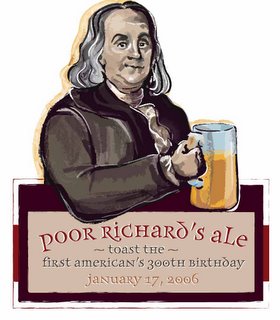
As the date on the graphic to the left attests, NABC unveiled its first version of Poor Richard's "Old Lightning Rod" Ale on January 17, 2006. It was Benjamin Franklin's 300th birthday, and more than 100 breweries nationwide joined the celebration by brewing a colonial-era Old Ale recipe based on an award-winning formulation.

Our third annual glimpse into the flavor profile of the 18th-century has gone on tap a couple of days early, and it may be the best one yet crafted by Jesse and Jared.

Owing primarily to the opportunities to educate, this has become one of my favorite seasonal unveilings. Here's the story of how all this came about, as first told here in January, 2006:

----

It wasn’t enough that Benjamin Franklin was a writer, inventor, businessman, statesman, patriot and all-purpose wit.

The creative Colonial-era legend somehow found time to drink beer, too.

In his writings, Franklin refers to the consumption of ale and describes various types of the fermented beverage, concluding that it was a healthy drink if consumed in moderation – an observation with which modern medical science concurs.

Even a teetotaler might be curious as to what these ales of old were like and how they were brewed, but unfortunately, substantive information is scant.

When the Benjamin Franklin Tercentenary, a non-profit group formed to organize the celebration for Franklin’s 300th birthday on January 17, 2006, began looking for an answer to this question, they found it by teaming with the Brewers Association, which commissioned a competition among professional brewers to formulate a Poor Richard’s Ale named for the famous Almanac.

Tony Simmons of Brick Oven Brewing produced the winning recipe, chosen by a panel of experts at the 2005 Great American Beer Festival. According to Simmons, his act of historical recreation was determined by the following factors:

Style ... Based on Franklin’s own writings, other period references and records of available raw materials, it is likely that he often drank tankards of a libation similar to Old Ale (England) or Strong Scotch Ale (Scotland).

Malt … “Low” (pale malt, similar to today’s Maris Otter or English floor malt) and “High” (darker malt, perhaps approximating a combination of what we now call Biscuit, Special Roast and Black) malts probably were used.

Adjuncts … During the Colonial era, imported malt was expensive and local barley crops were unpredictable, so the use of cracked maize and molasses in brewing was common.

Hops … Hop production in America did not begin in earnest until after Franklin’s passing, making it likely that traditional East Kent Goldings imported from England were the hops of choice.

Yeast … Not until the mid-19th century did modern scientific techniques unravel the mysteries of yeast, so it’s impossible to know very much about 18th-century yeast management. Simmons suggests that contemporary English or Scottish strains of yeast (low to moderate attenuation) will suffice to replicate Colonial fermentations.

The Brewers Association asked member breweries nationwide to join in the celebration of Benjamin Franklin’s 300th birthday by brewing a special batch of Poor Richard’s Ale and having it ready for serving on January 17, 2006.

The New Albanian Brewing Company's brewers, Jesse Williams and Jared Williamson, followed the broad contours of Simmons's recipe, adding a few touches of their own like extra finishing hops and oak chips to add wooden barrel-conditioned character. They also suggested an alternative name, "Old Lightning Rod," which we've duly incorporated to identify the finished product.


The finished product is malty and on the sweet side, both expected owing to low hopping and the use of molasses and corn as sources of fermentable sugars. We detect vanilla and banana notes alongside the unmistakable molasses component.