Showing posts with label craft brewing. Show all posts

Sunday, June 10, 2018

BEER WITH A SOCIALIST: Headlines from May 2018 on the beer beat.


This blog has gone on hiatus, probably permanently, and primarily because these days my thoughts about beer are being posted alongside my utterances about everything else, over yonder at NA Confidential.

You'll still find them there in reverse chronological order via the helpful all-purpose tag, The Beer Beat, although I'm in the process of changing the column title to Beer with a Socialist. For the foreseeable future, I'll retain both labels for ease of searching.

At the end of each month I'll still collect the links right here.

Following are May (2018) ruminations, with the oldest listed first. Some of these posts are more topical than others. On occasion, there'll be references to beer in posts using "The Beer Beat" as a label, though not a title. I hope this isn't overly confusing.

Thanks for reading, if belatedly.

---

THE BEER BEAT: The path to 6,000, or one helluva big difference in 25 years.


Yesterday, amid 14 consecutive hours of joyous Kentucky Derby downpour, I started rummaging through my collection of posters, photos and bric-a-brac suitable for hanging.

This one, called "Brewpubs and Craft Breweries," is a poster that dates from 1992.

---

THE BEER BEAT: Yuengling Golden Pilsner, or how I mourn the taste of corn in the morn (and afternoon).


Several of my friends beat me to tasting Pabst Pale Ale (I still haven't), but earlier today by sheer serendipity I walked into Keg Liquors (Clarksville) and became the first customer to buy a six-pack of Yuengling's ballyhooed Golden Pilsner.

---

THE BEER BEAT: A brief Pints & Union beer list report (yay) and a Yuengling correction (shrug).


It's ironic, although not entirely unexpected, that the more beer I drink as part of a solemn imperative to research (alas, someone's got to do it), and the greater the amount of time translating this diligent research into a beer list for Pints & Union, the less opportunity to write idly about beer in general.

---

THE BEER BEAT: U Fleků, home of "Bohemia’s definitive dark beer," really WAS founded in 1499.


I meant to attend U Fleků's 500th birthday party in 1999, but just couldn't pull it off. That's a big regret. Jeff Alworth is a great beer writer. In this brief essay, he takes us to Prague for one of those "Holy Grail" bucket list beers, originally described by the beer writer Michael Jackson, all of which packed off my butt to Europe so very long ago.

---

THE BEER BEAT: R.I.P. Jerry "Turoni's" Turner. Also: New England IPA, Mile Wide, Goose's disgrace, George Washington, and weighing a keg of beer.


As I may have mentioned earlier, though probably forgot, the current issue of Food & Dining Magazine (it's out today) has two contributions from moi: a profile of bar Vetti (lower case "b" is intentional), and a beer column about New England IPA.

Research for the latter brought me to Mile Wide Beer Co. (636 Barret Avenue, Louisville KY) a few weeks back for their release of Nomah!, which I enjoyed very much. In some ways I'm surprised by this. Not long ago, I'd have dismissed NE IPA as a fad, but now it makes perfect sense to me. May the style live long and prosper.

---

BEER WITH A SOCIALIST: Still on the "beer beat," but with a new identity and a renewed consultancy.


"Beer with a Socialist" is what happens when the Potable Curmudgeon momentarily mistakes the word "scientist" for "socialist," and after a good laugh, decides it's kismet.

---

ON THE AVENUES: Long live Keg Liquors Fest of Ale, an indisputable annual beer institution.


The 13th edition of Keg Liquors Fest of Ale will take place at New Albany’s Riverfront Amphitheater on Saturday, June 2. Up to 2,500 area beer fans will be in attendance, which might sound like a crush of humanity, but it isn’t. The major regional stops on the beer festival tour host as many as 8,000 guests, with Port-A-Lets extending around the entire perimeter like Donald Trump’s walled-in America.

However, festival founder and package store owner Todd Antz has grown Fest of Ale slowly and organically, from the parking lot adjacent to his original Clarksville store to St. Anthony’s lawn, and now the banks of the Ohio. It’s an urban area, and yet still presents a pastoral scene of greenery, passing barges and the rising sun architectural imagery of the amphitheater itself.

---

BEER WITH A SOCIALIST: Vandals strike Asheville brewery: “No more breweries” and “**** Beer City.”


My initial thought upon reading about "anti-brewery vandalism" in Asheville was something on the order of: "Just their luck the Woman's Christian Temperance Union is still alive and kicking."

---

ON THE AVENUES: Sadly, the Kentucky Derby no longer is decadent and depraved. It’s just another vacuous capitalist bait ‘n’ switch.


Let’s talk about beer. In 2018, for the first time in six years, the “official” beer of this signature institution known as Churchill Downs no longer is Stella Artois, the chosen import of AB-InBev’s payola empire.

Now it’s Corona, perhaps the most vile mainstream corn-choked Mexican lager atrocity known to man, reminding us that while the Kentucky Derby has developed intrinsic traditions since its inaugural run in 1875, locally brewed beer hasn’t always been prominent among these predispositions. After all, bourbon gets you there way faster.

Saturday, October 15, 2016

Brewers take note: Clarksville's redevelopment site has its own sewage treatment plant. Just saying.


A couple of months ago I had lunch with Dylan Fisher, the town of Clarksville's redevelopment director. I went to college with Dylan's dad, and it's always delightful to see the next generation rising.

Dylan is a sharp young man who speaks the contemporary urban language, and for a town about to pivot away from suburban-oriented development to a denser, multi-modal future, his knowledge base is a tremendous asset to the community.

He also likes good beer.

For those reading from afar, New Albany's on the west side, Jeffersonville's on the east side, and Clarksville's right in the middle.

It is no exaggeration to posit that given Clarksville's location directly across the Ohio River from Louisville KY, coupled with these sixty-plus acres of former industrial properties now open to adaptive reuse, plus the completion of regional highway and bridge projects and the Ohio River Greenway (which slices right through Clarksville's waterfront), the South Clarksville Redevelopment Plan represents some of the greatest redevelopment potential we've ever witnessed on this side of the water.

Specifically for those who may be considering the merits of brewery expansion in Louisville KY metro, the old Colgate property has its own sewage treatment plant. I believe it's currently unused, but could be restarted, and I needn't remind brewers of how important this one single fact might be (and already has become for many), not to mention the mothballed industrial and transport infrastructure already waiting there.

I'm not getting a commission for any of this, though a growler or two would be nice.

SATURDAY SPOTLIGHT: South Clarksville redevelopment captures waterfront appeal, by Elizabeth Beilman (News and Tribune)

"Right now, we are focusing on the waterfront," Clarksville Redevelopment Director Dylan Fisher said. "The waterfront is a big thing for us because we think it's not only a leverage point for development activity ... but preserving our waterfront and improving our waterfront was a big thing for the public."

A waterfront park would have a raised walking platform, fountain and three catwalks out to old fuel storage tanks that could be converted into piers. Along Riverside Drive, Fisher envisions restaurants and a hotel. More gates could be installed in the floodwall to make way for additional roads that will make access to the shore easier.

Fisher argues its the missing piece of Southern Indiana.

___

Saturday, October 01, 2016

The Pour Fool rules: "FUCK Budweiser: Your Basic Early Morning, Fed-Up Rant."

From the glorious article.

The Pour Fool induced a Vulcan mind meld, and now the contents of my own cranium have been reproduced in full, living color -- except, of course, the Pour Fool wrote these inspiring words himself.

He just might be my favorite living beer writer.

FUCK Budweiser: Your Basic Early Morning, Fed-Up Rant, by Steve Foolbody (The Pour Fool)

People don’t come out of the womb with a hankerin’ for Budweiser. Kids, in particular, love big flavors. They grow up eating nachos and Cheetos and burgers and pizza…NONE of which leads logically to drinking watery, flavorless adjunct Pilsner, that is so swamped by those food that you might as well be drinking water. People are programmed to drink BudMillerCoors. They find it in their family fridge and watch Mon and Dad and their uncles and aunts mindlessly slugging the stuff down and think, “That’s what beer is“. That knee-jerk repetition kept those wimpy-ass beers unchallenged for over a century…until beers with real flavor came along and craft brewing flourished and people found out, “Hey! I don’t have to settle for that insipid shit, anymore!” And AB/InBev is on the way out and they don’t even know it because we like these new, carefully crafted, great-tasting beers BETTER…and we are NEVER going back.


__

Wednesday, March 30, 2016

"I don't want to open a brewery."


Follows an uncommonly well-stated cautionary tale.


I Don't Want to Open a Brewery (And Maybe You Shouldn't Either) at Beer Simple

If you brew beer, it's only a matter of time before you get this question: "So, when are you opening a brewery of your own?" For me, there's a simple (of course) answer: "Never."


Especially this. Trust me. You'll never have enough money, especially if it takes a while to get on track.


This is all, admittedly, just a layperson's perspective, but I've known, overheard, interviewed, and observed a lot of new brewery owners over the past several years. Some are succeeding despite their individual limitations - but a lot are struggling and/or failing because of them, too. Maybe you'll get lucky. Maybe you'll be able to fix things on the fly. But if it were me, I don't want this to come down to luck, and at least one local brewery recently went under because they were doing a little too much learning "on the job" and ran out of money before they could get things back on track. Don't let it happen to you. You might never get another shot at this, so make it a good one.


The worst shading of reality is the very middle. If you're too good to fail but not good enough to succeed ... it's very, very hard.

___

Tuesday, March 08, 2016

Musings on Falls City, standards of longevity, and that strange word "craft."


From the outset, let's be clear. I'm a big fan of what Falls City is doing these days. My wife and I like Over the 9, the Falls City/Old 502 gastropub.

We took friends there recently, and they also enjoyed it. Verily, by doing business where it does, Falls City is playing a leading role in reconnecting Portland with downtown, and this matters to me a great deal.

Falls City's latest bottle releases, Kentucky Common and Easy Goer Session IPA, are 4% abv and 4.5% abv, respectively, and that's huge; finally, there is ballyhoo about session-strength releases, and I'll be drinking a lot of the Kentucky Common.

To summarize, I'm coming from a position of friendship and appreciation.

This said, a headline at Louisville Business First is slightly misleading, and with requisite gentleness and scrupulous objectivity, I'd like to explain why.

One of the city's oldest craft beer breweries is rolling out the biggest product line expansion in its history

Before I tell you, let's look at the story from last week's roll-out.


 ... The brewery is adding a new year-round offering, Kentucky Common, which is inspired by the city's pre-Prohibition bourbon industry, along with a family of seasonal beers, including Easy Goer Session IPA, according to WLKY-TV.

Kentucky Common has ingredients that are similar to a bourbon distiller's mash, and that style is one that originated in Louisville, the story said.

Cezary Wlodarczyk, Falls City's CEO and president, said he hopes the beer will be offered at Keeneland Racecourse in Lexington and Churchill Downs in Louisville. Wlodarczyk said the beer is iconic and deserves a presence in the state.


The headline identifies Falls City as one of Louisville's "oldest craft beer breweries." Allow me to observe that this is a tad far-fetched, although Louisville Business First merely takes its cues from Falls City's own web site.


In 1905 a group of bartenders and grocery store owners had had enough with being forced to buy, serve, and sell beer produced by a local beer monopoly. So they got together and created Falls City Beer. At that moment of rebellion and independence, Louisville’s first craft beer was born.


And ...


Craft beer before craft beer was cool. 


In fairness, I've embraced a cynical, post/pre-craft position with regard to the use of this word, and it is quite possible that "craft" currently possesses almost no coherent definition whatever. Still, as a functional curmudgeon, I strive for accuracy. In this instance, verifiable chronology is available to assist us.

  • The original Falls City Brewing Company operated in Louisville from 1905 through 1978.
  • The original American "microbrewery" was New Albion, founded in 1976.
  • In 1984, the word "craft" was used for the first time, and the New York Times did not use the word until 1997.
  • The "old" Falls City, which had nothing whatever to do with micro- or craft-brewing, was contract-brewed in Pittsburgh until 2007.
  • Today's Falls City began contract-brewing in 2010 and brews on-site, too.

If 2010 represents Falls City's contemporary inception, then it was preceded in Louisville by at least seven other breweries during the period of "craft" beer's ascendancy -- some lasting, some morphing, others folding. BBC and Cumberland Brewery predate the "new" Falls City by 17 and 10 years, respectively.

A brewery reborn in 2010, while "craft" by most any sensible modern definition, is not one of the city's "oldest" in the same chronological sense.

Concurrently, a brewery originally born in 1905 hardly can be referred to as a "craft" brewery, since neither the usage nor the concept existed then.

The "new" Falls City has brewed certain of its beers on site, in Louisville, at two locations since 2011 or thereabouts, with a short break when the Barrett Avenue taproom closed and the brewery was reinstalled at the present 10th Street location. Flagship brands continue to be contract-brewed elsewhere.

All this is admirable, and as noted, I'm a fan. But Falls City, while "craft," is not one of Louisville's "oldest" "craft" breweries.

Of course, perhaps we might dispense with "craft" altogether and move forward with the reclamation of good, real and true beer. Falls City certainly is helping fulfill this mandate, because as Cresant Smith rightly observes in her assessment of last week's brand introduction, Falls City's Kentucky Common is delicious ... as well as historically accurate.


Falls City Brewing Co Expanded Line-Up of Beers (Louisville Beer Dot Com)

I was able to try the Kentucky Common and it was very easy to drink. It very well matched the Beer Judging Certification Program standards of what a Kentucky Common should taste like. Medium amber in color, moderately grainy/corn aroma with a medium sweet flavor. Bready, toffee notes and gentle carbonation. It finishes semi-dry and clean.


Note that Over the 9 will be my first stop for Session Day 2016.

Come drink beer with me on Session Beer Day, April 7, 2016.


_

Friday, June 12, 2015

These requests from abroad, Vol. 14: "With best wishes from Russia, Alexander."


If you own or work for a brewery, you've probably fielded numerous e-mail inquiries from overseas asking for beer labels, crown caps and the like, as destined to become the cherished keepsakes of private collectors from just about anywhere -- although it seems that most of them live somewhere around eastern and central Europe.

To me, there is something compelling and yet haunting about these foreign requests, places of longtime personal interest to me both historically and geographically. I've been in or near many of them. They speak vividly to my inner melancholic. Lately, I've been pasting their addresses into Google Map and seeing what their places of residence look like.

After all, they can look at my business via the same technology, and it seems only fair for me to see where they live, so very far away. Especially coming from European locales, these are images that speak powerfully to me, conjuring memories of places I've been, people I've met ... and beers I've consumed.

Alexander lives in Tyumen, Russia. 


Tyumen is another of those big Russian cities that none of us in America is aware exists. The city lies roughly 250 miles north of Kazakhstan, occupies 90 square miles, and has a population of more than 600,000 people.

Tyumen was the first Russian settlement in Siberia. Founded in 1586 to support Russia's eastward expansion, the city has remained one of the most important industrial and economic centers east of the Ural Mountains. Located at the junction of several important trade routes and with easy access to navigable waterways, Tyumen rapidly developed from a small military settlement to a large commercial and industrial city. The central part of Old Tyumen retains many historic buildings from throughout the city's history.

Judging from the Google Map views, Alexander's area of residence is fairly typical of the newer Tyumen suburbs. He is admirably polite in making his request.
My name is Alexander, I have long been interested in the history of brewing and I have a very fascinating hobby, I collect beer coasters and beer caps. I would be very grateful if you could help me supplement my collection. I hope this is possible, and that my request will not bring you inconvenience.

There's a chain brewery restaurant in Tyumen.


Maximilian's Brauerei's slogan is "Happiness Is Where We Are,"

Each Maximilian’s Restaurant is actually a little brew house, that’s why the name – Maximilian’s Brauerei where German ‘brauerei’ means ‘brew house’ rather than ‘restaurant’. This is what makes Maximilian’s different from other beer restaurants: beer is brewed right in front of you while you’re sitting comfortably at the bar.

The other Russian branches of Maximilian's are Naberezhnye Chelny, Kazan, Samara, Yekaterinburg, Chelyabinsk, Ufa, Novosibirsk and Krasnoyarsk.

Alexander lives in Tyumen, and Tyumen is very far away. That's all I have for now.

Tuesday, April 28, 2015

These requests from abroad, Vol. 13: Two collectors from Poland.


If you own or work for a brewery, you've probably fielded numerous e-mail inquiries from overseas asking for beer labels, crown caps and the like, as destined to become the cherished keepsakes of private collectors from just about anywhere -- although it seems that most of them live somewhere around eastern and central Europe.

To me, there is something compelling and yet haunting about these foreign requests, places of longtime personal interest to me both historically and geographically. I've been in or near many of them. They speak vividly to my inner melancholic. Lately, I've been pasting their addresses into Google Map and seeing what their places of residence look like.

After all, they can look at my business via the same technology, and it seems only fair for me to see where they live, so very far away. Especially coming from European locales, these are images that speak powerfully to me, conjuring memories of places I've been, people I've met ... and beers I've consumed.

Quite a few of these seems to come from Poland. 

I'm not sure why, but they do, and my latest obsession has been to follow the street views on Google Map from the city or town's train station to the address of the inquirer, with a traveler's presumed wanderings in mind: Where would I stop for a beer in route?

My admittedly small sampling reveals that there are too few pubs in Poland. Back during my backpacking days (although in fairness, I wasn't in Poland very much), it was axiomatic that to emerge from the train station in eastern and central Europe was to see a kiosk or restaurant close at hand, packed with locals enjoying their beers.

Now there are few. Maybe they drink at home these days. So do I.

Now, on to the most recent pair of requests.


Above is the town of Gniewkowo, where Kasia lives, somewhere on this street. Gniewkowo is located northwest of Warsaw near the city of Torun. The border with Germany is about 150 miles away. There's a rail station, but it's on the edge of town to the south, with little close to it save for a Communist era housing estate and a sports complex. On the main downtown street, there is a restaurant where it's reasonable to assume Polish lager is served. I'd eat there.


Meanwhile, Kasia is more creative than most.

We could also exchange if you wish so. I have a lot of interesting polish breweries stuff to exchange. I would be very grateful if you would be so kind to send me any of your coasters, bottle openers, labels or any other items.

I like the idea of her offering to swap items, and will set this email aside for future consideration, if I ever have time.

Ironically, Kamila doesn't live very far away from Kasia, in the larger settlement of Ciechocinek, which is noted as a spa and tourist city. It's another quiet residential street, a bit removed from the center.


Kamila is more ambitious.

My name is Kamila. I am a beer items collector. This is my passion for a few years. I have a quite big collection but I do not have any item from foreign breweries. My favourite interest is collecting openers. I would be very grateful if you would be so kind and send for my address any collector's item. I would be appreciative of any bottle-opener, cap, label, coaster or glass.

Ciechocinek appears decidedly more affluent than Gniewkowo. The Wikipedia entry praises the quality of Ciechocinek's thermal springs and its saline graduation towers, pictured at the beginning of this post.

Ciechocinek is a spa town in Kuyavian-Pomeranian Voivodeship, Poland, located on the Vistula River about 10 kilometres (6.2 mi) east of Aleksandrów Kujawski and 20 kilometres (12 mi) south-east of the city of Toruń.
Ciechocinek is known for its unique 'saline graduation towers'. Experts have considered the local saline springs to be of extreme value and named the thermal spring no. 14 "a wonder of nature". The therapeutic qualities of these springs are directed toward curing cardiovascular, respiratory, orthopedic, traumatic, rheumatic, nervous system and women's diseases.

Poland. Maybe some day.

Tuesday, April 21, 2015

These requests from abroad, Vol. 12: From Munich, a young man seeking to break the bottle cap record.


If you own or work for a brewery, you've probably fielded numerous e-mail inquiries from overseas asking for beer labels, crown caps and the like, as destined to become the cherished keepsakes of private collectors from just about anywhere -- although it seems that most of them live somewhere around eastern and central Europe.

To me, there is something compelling and yet haunting about these foreign requests, places of longtime personal interest to me both historically and geographically. I've been in or near many of them. They speak vividly to my inner melancholic. Lately, I've been pasting their addresses into Google Map and seeing what their places of residence look like.

After all, they can look at my business via the same technology, and it seems only fair for me to see where they live, so very far away. Especially coming from European locales, these are images that speak powerfully to me, conjuring memories of places I've been, people I've met ... and beers I've consumed.

Say hello to Moritz, who is a resident of Munich, Germany.

It has been a decade since my last visit to Munich. Once upon a time, this would have been cause for concern, but I've been to Bamberg a few times since then, and it just goes to show how priorities change.


Moritz's residence appears to be the smudgy building in the center, which is located around eight miles from the center of town, to the northwest, just before the countryside begins. Quoted verbatim, you'll note something perhaps unusual about this request.

Dear Sir,

I am 15 years old and I am collecting bottle caps (crown caps) since four years.

Now my greatest wish is that my collection will be listed in the Guinness Book of Records. The world record is 175171 caps and therefore I am always looking for new caps to catch up and to break this record.

Therefore I would like to ask you to send me one of your bottle caps for my collection.

It would make me very happy if I could add a bottle cap of your company to my collection.

My address is: Moritz Bester, Lidelstrasse 3, D – 81245 München Germany

Thank you very much and kind regards

Moritz Bester

I returned Moritz's e-mail, informing him that alas, I could be of no help; NABC's bottle caps bear no logo or insignia. However, if anyone can give him a hand in his quest, please feel free.

Meanwhile, I'm not being flippant when I say: If I were to send him caps, would it constitute statutory breweriana?

After all, at this late date we're still plagued with many instance of Internet idiocy, wherein there must be an age verification process to read a web site about beer. I remember an episode many years ago when I was trying to access the Samuel Adams web site. Being slightly lubricated and butter-fingered, I managed to enter bad information and was blocked. Being me, I complained. Being them, a cyber-reply was forthcoming.

We understand that the age verification process may seem cumbersome. However, it is very important to us that we take every reasonable precaution to ensure that the only visitors to our site are those who can legally enjoy the great taste of a Samuel Adams beer. We take this responsibility very seriously, even to the extent that it may cause someone like you to become frustrated.

Not for the first time, I couldn’t resist the impulse to cast a line and see if there were humans somewhere on the other side.

Thanks for the template. Does this mean that we shouldn't allow children to study automobiles until they're old enough to drive? 

When it came, the reply was bureaucratic and humorless, so three cheers to censorship, to “reasonable precaution” in studying the history of fermentation science, and to those deep bows to the dictates of Puritanism that we feel like me must make.

Up the revolution ... and send Moritz some caps if you have some.

Tuesday, April 14, 2015

Gohmann: "Regulation, religion, and corporate interest (make) the South less hospitable to small breweries."

Steve Gohmann is a native of New Albany and a longtime acquaintance from the Public House. He's been a professor at U of L's School of Economics for more than two decades, and recently made the news when "tapped" to head the new John H. Schnatter Center for Free Enterprise at U of L’s College of Business.

(That's Papa John, by the way)

To me, Steve is considerably more renowned of our little known somewhat secret beer tasting board, which regrettably, I've not have the time to attend of late. In what spare time he has, Steve has concluded research on craft beer and the South. The release of his paper garnered much social media attention, so please permit me to offer belated congratulations to him. I hope we can share a beer soon.

Why the South Is the Region With the Fewest Breweries, by Joe Pinsker (The Atlantic)

It may be hard to imagine now, but American ale-drinkers previously had few alternatives to the mass-produced beers that The Economist once (not incorrectly) deemed "fizzy dishwater." In fact, there were only two craft breweries in America in 1977. By 2012, that number had risen to 2,751, and while macrobreweries such as Anheuser-Busch and MillerCoors still dominate America's beer market, craft breweries are estimated to account for about a tenth of the industry's revenues.

While observations abound about "the rise of America's craft breweries," the story has been very different on the state level. Vermont, for example, had one brewery for every 25,000 residents in 2012. Mississippi, meanwhile, had one for every 994,500. These aren't anomalous islands of booziness and temperance—they're exemplars of their regions. The nine states with the fewest breweries are all in the South. What is it about the region that might make this true?

In short, it's because of the Baptists. Steve Gohmann, a professor of economics at the University of Louisville, recently published a paper in Entrepreneurship Theory and Practice cataloguing the potent blend of regulation, religion, and corporate interest that makes the South less hospitable to small breweries ...

Saturday, January 17, 2015

These requests from abroad, Vol. 11: "I love beer for the fact that with every breath of the world is getting better."

Lviv has a beer, and an "official" brewing museum, too. 

If you own or work for a brewery, you've probably fielded numerous e-mail inquiries from overseas asking for beer labels, crown caps and the like, as destined to become the cherished keepsakes of private collectors from just about anywhere -- although it seems that most of them live somewhere around eastern and central Europe.

To me, there is something compelling and yet haunting about these foreign requests, places of longtime personal interest to me both historically and geographically. I've been in or near many of them. They speak vividly to my inner melancholic. Lately, I've been pasting their addresses into Google Map and seeing what their places of residence look like.

After all, they can look at my business, and it seems only fair for me to see where they live, so very far away. Especially coming from European locales, these are images that speak powerfully to me, conjuring memories of places I've been, people I've met ... and beers I've consumed.

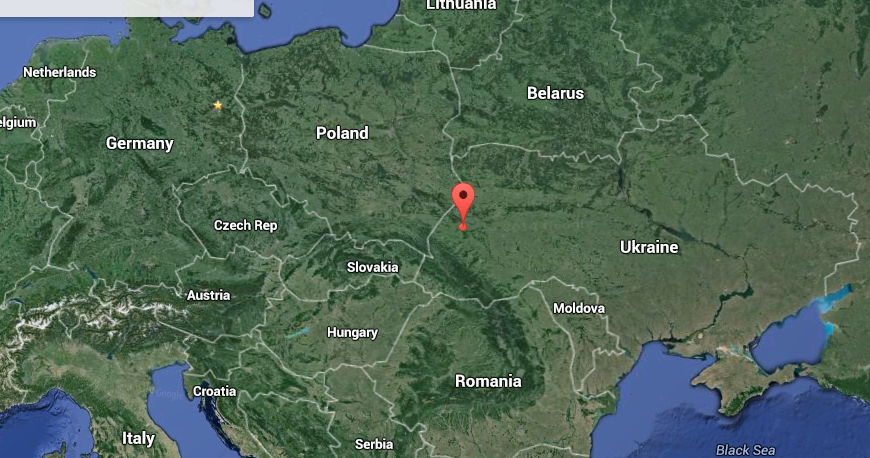
Michael is a resident of Lviv, Ukraine, which is one of the few remaining "bucket list" cities in Europe for me. 


Wikipedia quoted verbatim strikes me as the best way to introduce the city of Lviv.

Lviv (UkrainianЛьвів L’vivIPA: [lʲvʲiu̯] ( )RussianЛьвов L’vovIPA: [lʲvof]Polish:LwówIPA: [lvuf] ( ),[2] GermanLembergLatinLeopolisthe city of the lion) is a city in western Ukraine that was once a major population centre of the Halych-Volyn Principality, the Crown of the Kingdom of Poland, the Habsburg Kingdom of Galicia and Lodomeria, and later the capital of Lwów Voivodeship during the Second Polish Republic.
Formerly capital of the historical region of Galicia, Lviv is now regarded as one of the main cultural centres of today's Ukraine. The historical heart of Lviv with its old buildings and cobblestone streets has survived Soviet and Nazi occupation during World War IIlargely unscathed. The city has many industries and institutions of higher education such as Lviv University and Lviv Polytechnic. Lviv is also a home to many world-class cultural institutions, including a philharmonic orchestra and the famous Lviv Theatre of Opera and Ballet. The historic city centre is on the UNESCO World Heritage List. Lviv celebrated its 750th anniversary with a son et lumière in the city centre in September 2006.

To know me is to grasp the centrality of the Habsburg dynasty and the Austrian (later Austro-Hungarian) empire as situated within an overall love of European history. As the map shows, Lviv lies at the center of Eastern/Central Europe.


Some day ...

To date, Michael's request for swag is the most light-hearted and colorful. It deserves to be quoted in its entirety.

My name is Michael Khomik, I am a passionate fan of beer. I collect beer Labels, Caps and beer mats. I love beer for the fact that with every breath of the world is getting better. I have a beer with no borders, except for age. eer - it's one of the few things that can unite people of different views and speak different languages. Even for that it is love. It is the oldest drink - drink of the Gods. It works wonders, and only having drunk it before the end bottles, can become an angel or a demon. Beer for connoisseurs Men and real Women. I decorate my kitchen with beer labels, beer mats, caps, and various attributes of the beer. This is my mini-museum. If this does not contradict the rules of your company, please send me promotional material of your company ( you have a very nice label, and beer coasters are beautiful.) What would I and my guests, who will be coming to visit me, admired them, praising your company and your City. What would everyone know about your wonderful beer brewery, and your, as well as about the wonderful people that make a beer from the heart and with Love! Please send me, Labels, Beer mats, Caps, and other attribute in my collection. Front, rear and top label produced today, and made in the past or are no longer available. Please make an exception and send for Free!!! , I'm on my mini - Museum. I hope that your company is not difficult.

Happy New Year to you and all your friendly staff

P.S "advertisement motor trade and collector distributor of advertising."

With respect and hope for Michael.

Not unexpectedly for a city of 730,000, Michael lives fairly far outside the historic town center. Look behind the smaller vertically arranged buildings, to the apartment block running horizontally behind them.


Here.


I think Michael will be getting a package soon.

Wednesday, December 17, 2014

These requests from abroad, Vol. 10: "My favourite interest is collecting beer items, especially openers."

If you own or work for a brewery, you've probably fielded numerous e-mail inquiries from overseas asking for beer labels, crown caps and the like, as destined to become the cherished keepsakes of private collectors from just about anywhere -- although it seems that most of them live somewhere around eastern and central Europe.

To me, there is something compelling and yet haunting about these foreign requests, places of longtime personal interest to me both historically and geographically. I've been in or near many of them. They speak vividly to my inner melancholic. Lately, I've been pasting their addresses into Google Map and seeing what their places of residence look like.

After all, they can look at my business, and it seems only fair for me to see where they live, so very far away.

Tracking Krystyna from Poland proved a bit of a challenge. Addresses can be confusing when place names for streets, towns and districts overlap. 

I have a lot of it from my country, but I would like to broaden my collection for openers from abroad. I also collect other beer items like: coasters, labels, caps, glasses, beer mugs etc. I will be very grateful for any help with widen my collection. I found your e-mail address in web and I decided to write this request. I hope you understand my passion. I take any item with great gratitude. I wish Merry Christmas and Happy New Year.

She lives between the Polish capital of Warsaw and the Baltic, amid vast, flat farmland.


The actual town of Koneck is here.


It's a tidy place lining both sides of the main drag. To the left below are the commercial buildings, including a restaurant/pub (bet there's beer there) and a grocery.


However, the address provided is a few kilometers south of Koneck, within the township. Brzeźno is the name of a town nearby, and presumably, doubles as the street identifier connecting Brzeźno with Koneck. At any rate, it's the house on the right, set mysteriously in the trees, and surrounded by farmland.


This may be the most thought-provoking request to date.

Thursday, December 11, 2014

These requests from abroad, Vol. 9: "I am a big collector of beermats, coasters and other promotional items of beer brands."


If you own or work for a brewery, you've probably fielded numerous e-mail inquiries from overseas asking for beer labels, crown caps and the like, as destined to become the cherished keepsakes of private collectors from the foothills of the Alps to the South Sea islands.

To me, there is something compelling and yet haunting about these foreign requests, which tend most often to come from Central/Eastern European locales, places of longtime personal interest to me historically and geographically. They speak vividly to my inner melancholic. Lately, I've been pasting their addresses into Google Map and seeing what their places of residence look like.

After all, they can look at my business, and it seems only fair for me to see where they live, so very far away.

Now, for something completely different, we have Frans. His request is the first we've received from the Netherlands in a very long time. He's from Zwolle (population 125,000), the capital of Overijssel province. 


First, see where the water used to be ... and still is.


According to Wikipedia, "In World War II, Zwolle was single-handedly liberated from the Germans by Canadian soldier Léo Major. He was made an honorary citizen of Zwolle in 2005 and a street is named for him."

This is it: Leo Majorlaan. Look at those tidy bike paths on both sides. Sighhh ...


In addition, note that "Citizens of Zwolle are colloquially known as Blauwvingers (Bluefingers)."


Frans says:

I live in the Netherlands and I am a big collector of beer mats, coasters and other promotional items of beer brands.

I hear you, buddy. Let's forget the small potatoes.

Would you like to trade homes?

Wednesday, December 10, 2014

These requests from abroad, Vol. 8: "I am sure that they will take a worthy place in a collection."

If you own a brewery or work for one, you've probably fielded numerous e-mail inquiries from overseas asking for beer labels, crown caps and the like, as destined to become the cherished keepsakes of private collectors from Catalonia to Ruritania, who've somehow heard about your brewing expertise.

To me, there is something compelling and yet haunting about these foreign requests, which tend most often to come from Central/Eastern European locales, places of longtime personal interest to me historically and geographically. They speak vividly to my inner melancholic.

Lately, I've been pasting their addresses into Google Map and seeing what their places of residence look like. After all, they can look at my business, and it seems only fair for me to see where they live, so very far away.

Александр lives in Bryansk in eastern Russia, a city of 415,000 inhabitants near the border with Belarus. Its original 11th-century name referred to "dense woodlands," which no longer exist. 


To get an impression of the huge distances as one moves eastward from "western" Europe into Russia, it is 1,268 miles driving distance from Bryansk to Bamberg (Germany), though only 238 miles from Bryansk to Moscow, the Russian capital. Here is Bryansk in winter.


Александр (okay, let's transliterate from the Cyrillic: Alexander) resides in what I'd imagine is a fairly typical neighborhood. His is the building in the middle, showing us its less attractive side.


He has a specific request.

The main emphasis is placed on crowncups. I am engaged in it since 2001. we have a very difficult to find your products. It would be very desirable to fill up the collection with your copies. I am sure that they will take a worthy place in a collection.

Unfortunately, NABC's crown caps are entirely generic, and would be of little use. As always, I wish Alexander the very best in his foraging, in spite of my inability to be of assistance.

Tuesday, December 09, 2014

These requests from abroad, Vol. 7: "I wish you happiness and good luck!"

If you own a brewery or work for one, you've probably fielded numerous e-mail inquiries from overseas asking for beer labels, crown caps and the like, as destined to become the cherished keepsakes of private collectors who've somehow heard about your brewing expertise, even in far-off Plovdiv or Lhasa.

To me, there is something compelling and yet haunting about these foreign requests, which tend most often to come from Central/Eastern European locales, places of longtime personal interest to me historically and geographically. They speak vividly to my inner melancholic.

Lately, I've been pasting their addresses into Google Map and seeing what their places of residence look like. After all, they can look at my business, and it seems only fair for me to see where they live, so very far away.

Vladimir lives on Zadniprovska Ulitsa (street) in Zaporizhia, Ukraine. Glancing at a map, the city appears to be safely removed from the current fighting to the east between Ukraine and Russia.


Google has yet to add a street view of his place of residence, but it's fairly easy to visualize the old-school apartment block from the closest aerial view. I'd guesstimate the immediate post-war era of construction.


Zaporizhia originated as an 18th-century Russian garrison settlement during the reign of Catherine the Great. The city is situated on the steppe (a grassland ecoregion) and straddles the Dnieper River, which is the key to its historical growth.

Following the Civil War and advent of the Soviet Union, Zaporizhia was targeted for industrialization. A "hero" hydroelectric project dammed the Dnieper, a steel mill and aluminum plant were built, "surplus" labor from the countryside was brought (willingly or otherwise) to work, and a new city was built. These days, the population is 770,000.

To his credit, Vladimir has done his homework.

I am labels collector and I would be most grateful if in 2015 year you will send me for my collection some your labels like Naughty Girl Blonde India Pale Ale, Solidarity Baltic Porter, 15B.

Maybe I will.

Sunday, December 07, 2014

These requests from abroad, Vol. 6: "I wish you prosperity and development!"


If you own a brewery or work for one, you've probably fielded numerous e-mail inquiries from overseas asking for beer labels, crown caps and the like, as destined to become the cherished keepsakes of private collectors who've somehow heard of your portfolio, even in far-off Montenegro or Macao.

To me, there is something compelling and yet haunting about these foreign requests, which tend most often to come from Central/Eastern European locales, places of longtime personal interest to me historically and geographically. They speak to my inner melancholic.

Lately, I've been pasting their addresses into Google Map and seeing what their places of residence look like. After all, they can look at my business, and it seems only fair for me to see where they live, so very far away. In this spirit of introductions, meet Pavel from St. Petersburg, Russia

"Good day! Ladies and gentlemen, may I ask you a favor? I am interested in beer coasters/beer mats from around the world."

The last time I visited St. Petersburg, it was called Leningrad, and that was in 1987. Two years before, in 1985, my introduction to the Russian capital of old ... a real-life figment of Peter the Great's imagination ... came aboard a bus from Helsinki with a group of youthful tourists just like me, and it seems so much like a dream now. It was still the USSR, fully Communist, and Mikhail Gorbachev had been the head cheese for only a few scant months.

Leningrad was a big city even then, and the industrial suburbs coming in seemed endless, but in the historic city center, near the Winter Palace and other historic sites lifted directly from all the damn books I read in college, seemingly in preparation for those three slim days on the ground, it was so quiet you could hear a crown cap drop. Nevski Prospekt, the main shopping street, seemed perpetually deserted apart from the street cars, which cost the equivalent of about five cents to ride.

Forlorn vending machines dispensed still or fizzy water into communal glasses -- not paper, not plastic, but glass; two or three might be lined up atop the contraption, with a "sanitizer" function that occasionally worked. I celebrated my 25th birthday at a Central Asian joint, in the company of an entertaining Aussie named Mark, who regaled me with tales of the Smiths.

Leningrad was punished severely at the hands of the invading Germans during World War II (the Great Patriotic War, in regional usage). There was a 900-day-long siege, and the city bent but didn't break. A half-million people died, most of them civilians, and among the sites my tour group visited was the Piskariovskoye Memorial Cemetery. At the time, it was a favored pilgrimage spot for newlyweds. Sure enough, upon arrival, we saw a bride and groom posing for photos with the cemetery as backdrop. Somewhere I have a slide to prove it.

My point in recounting all this is that in all likelihood, Pavel hadn't yet been born when I was there. His apartment block on Turistskaya, which appears quite new, looks to be roughly 8-10 miles away from where I spent most of my time 29 years ago, which is labeled "Tsentralny" on the map above.


At least he has a nice shopping mall right across the street.


I wonder if there is beer for sale there?

Saturday, November 08, 2014

These requests from abroad, volume five: "I collect souvenirs from various beer companies and brands."

If you own a brewery or work for one, you've probably fielded e-mail inquiries from overseas asking for beer labels, crown caps and the like, as destined to become cherished keepsakes of private collectors who've heard of your beer, even in far-off Albania or Singapore.

To me, there is something compelling and yet haunting about these foreign requests, which tend to come from Central/Eastern European locales, places of longtime personal interest to me historically and geographically. They speak to my inner melancholic. Lately, I've been pasting their addresses into Google Map and seeing what their places of residence look like.

We begin today in Italy, a booming "craft" beer producer in its own right.


Granted, the northern Italian city of Bologna is not so well known for beer. Rather, it is famed for its mortadella.

Confused? Don't be. It's all a bunch of bologna.

MORTADELLA DI BOLOGNA: DON'T CALL IT BALONEY!

You may have seen it at the supermarket, packed in individual slices next to the other pre-packaged baloney products. Sadly this is what most Americans think of when they hear the word mortadella. However real Italian mortadella, the pride of the city of Bologna is more than just fatty baloney. Either served in a sandwich, as an appetizer or part of the main course Mortadella di Bologna is yet another delicacy coming from the bountiful region of Emilia-Romagna.

Mortadella hails from the food rich town of Bologna, aptly nicknamed "la grassa," meaning fat.

Bologna also is the home of Germano, who lives in the house I want, and gets it.

I would like to enlarge my collection. Would it be possible for you to send me by post some labels and mats or caps of your beers? If you agree I can send you a self addressed envelope with prepaid postage. Please inform me by return E-Mail.

This I will do, and look forward to filling his order.

From sunny Italy, we shift far to the north, from Romance to Slavic. Yekaterinburg is a thousand miles to the east of Moscow, and is the fourth-largest city in Russia, now boasting 1.3 million inhabitants and a skyscraper-filled city center. You may remember Yekaterinburg as the place where the Romanov dynasty came to a barbaric close.


Oleg lives in one of the classic "rabbit hutch" blocks of flats constructed during Soviet times.

I collect souvenirs from various beer companies and brands. I'd love to get some items from you, if it is possible. I am interested in labels, stickers, crown caps, beer mats, openers, lanyards and other branded items.

Ironically, given that I only recently name-dropped Klement Gottwald (the first Czechoslovak Communist kingpin), Oleg lives on Gotvalda Street.

Is there a Tsar Nicholas II Street in Yekaterinburg?

Wednesday, October 22, 2014

These requests from abroad, volume four: "May I ask you to send me one set of your beer labels?"

If you own a brewery or work for one, you've probably fielded e-mail inquiries from overseas asking for beer labels, crown caps and the like, as destined to become cherished keepsakes of private collectors who've heard of your beer, even in far-off Moldova or the Ivory Coast.

To me, there is something compelling and yet haunting about these foreign requests, which tend to come from Central/Eastern European locales, which are places of longtime personal interest to me historically and geographically. They speak to my inner melancholic. Lately, I've been pasting their addresses into Google Map and seeing what their places of residence look like.

The most recent request comes from Peter, in the Czech Republic.


He lives in Teplice, a spa town located in northwestern Bohemia near the border with Germany. His apartment building is very indicative of those constructed during the Communist era. During my time in Czechoslovakia teaching English, the building opposite my dorm residence looked much like this one, and it reminds me of sitting on my balcony, smoking little Vatra cigars, and drinking coffee, bottled beer, or both.

Let's hope no privacy protocols are being violated by my depicting their buildings, seeing as there's a drone hovering outside my front door even as I type these words. It's just that I can't help wondering: What's the rest of the story?

Saturday, August 16, 2014

These requests from abroad, volume three: "I am writing to ask if you could help me to increase my collection."

(Other instances of voyeurism are here and here)

If you own a brewery or work for one, you may have fielded e-mail inquiries from overseas asking for beer labels, crown caps and the like, as destined to become cherished keepsakes of private collectors who've heard of your beer, even in far-off Belarus or the Kalahari.

To me, there is something haunting about the foreign requests, which tend to come from Central/Eastern European locales, these being places of longtime personal interest to me historically and geographically. They stoke my inner melancholic, and for the life of me, I don't know why.

Lately, I've been pasting their addresses into Google Map and seeing what their places of residence look like. Here are the most recent ones.

Krzysztof lives in Wrocław, the fourth-largest city in Poland. It appears to be a pleasant, newer housing development outside the city center.


It took some thought and head-scratching to find Roman's and Igor's house in Lviv, Ukraine, which is a place I almost visited once in the mid-1990s until the length of the train ride from Slovakia deterred me. Instead, we went to Hungary and got juiced in Eger.

In their request, the brothers' chosen English transliteration of the Cyrillic came out as Ogienka Street, which would not register as a search. Fortunately, I have a bare-bones familiarity with the Cyrillic alphabet (actual language proficiency is another matter), and eventually got the right letters in a process that can be quite variable: Not Ogienka, but Ohijenka Street.


Is it one of them coming out the door in this 2011 street view?

Let's hope no privacy protocols are being violated by my depicting their buildings, seeing as there's a drone hovering outside my front door even as I type.

It's just that I can't help wondering: What's the rest of the story?

Sunday, August 03, 2014

More requests from abroad: "I would like to ask you to send me some beer items."

(The first instance of my overt voyeurism is here)

If you own a brewery or work for one, you probably know the drill.

E-mails constantly arrive from overseas (oddly, with the exception of Nigeria), asking you to send beer labels, crown caps and the like to become the cherished keepsakes of private collectors who've heard of your beer, even in far-off Warsaw or the Amazon Basin.

No SASE, no service; still, there's something that haunts me about the foreign requests, which tend to come from Central/Eastern European locales, these being places of longtime personal interest to me historically and geographically. Lately, I've been pasting their addresses into Google Map and seeing what their places of residence look like. For some reason, I find it a melancholy exercise, and I'm unsure why. My best guess is transferral. Here are the most recent ones.

First, Vlad from Russia. He lives in Novocherkassk, near Rostov-on-Don, near the Sea of Azov. The city is only a few years older than New Albany.


Pavel also lives in Russia. His home in the Moskovsky district of St. Petersburg is well removed from the city center, but the subway runs relatively nearby. It's a typical apartment house, but at least it appears leafy.


I hope no protocols are being violated by my depicting their buildings, seeing as there's a drone hovering outside my front door even as I type. I just can't help wondering: What's the rest of the story?

Wednesday, July 09, 2014

"I would like to ask you to send me some beer items."

If you own a brewery or work for one, you probably know the drill. E-mails constantly arrive from overseas (oddly, with the exception of Nigeria), asking you to send beer labels, crown caps and the like to become the cherished keepsakes of private collectors who've heard of your beer, even in far-off Vladivostok or the Amazon Basin.

The return mailing's on your dime, of course. The cynical way to view these requests is to imagine that they're just a way for traders to build up swap stocks. I suppose many are. Apart from cynicism, and absent the money for postage, no one's getting a snail mail freebie; sorry. The images can be freely cribbed on-line, anyway.

Fewer Americans seeking labels go fishing on e-mail. They generally will send a stamped, self-addressed envelope via the US Mail. At NABC, we try to oblige them, irrespective of what they plan on doing with whatever items they're given.

But there's something that nags me about the foreign requests, which tend to come from Central/Eastern European locales, these being of longtime interest to me historically and geographically. Lately, I've been pasting the addresses into Google Map and seeing what their houses look like. For some reason, I find it a melancholy exercise, and I'm unsure why.

Transferral, perhaps?


The home of Tomas from Czech Republic is above. Katarzyna lives in Poland (below). Actually, Tomas's request was to publicize a beer app he'd created. 


These look like nice places to live, and I hope no protocols are being violated by my depicting their homes, seeing as there's a drone outside my front door as I type.

I just can't help wondering: What's the rest of the story?