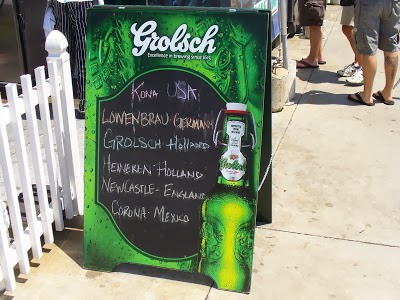
(backdate to Wed., Sept. 29)To me, it all goes back to seeing the half-liter bottle of Holsten Pils on the shelf in Budapest, and wondering how it came to be that a capitalist German beer was being exported to communist Hungary and sold to consumers at a price only slightly higher than local Hungarian beers, which were dirt cheap at the time, in 1989.
Doing my best to comprehend the mysterious language on the label, I soon concluded that the West German brewer had entered into some sort of licensing agreement with counterpart in Hungary to use the Holsten name but actually brew the beer in Budapest.
In truth, the only German aspect of that particular beer was the name on the label. All the rest of the ingredients came from Hungary or elsewhere in the East Bloc, and the production costs naturally were at the Eastern European rock-bottom point.
There was the brand’s logoed identity for marketing purposes, but not the brand’s intrinsic value as added to it by virtue of being brewed in Hamburg. Any significant component of terroir was absent. The rationale behind the licensing agreement was that brand imagery alone could be substituted for the actual beer given the expense of importation, and so yes, it was Holsten by legal agreement … and yet, it was not Holsten as an appellation of origin.
Some years later, back home and taking a greater interest in better beer beyond the admittedly joyful act of drinking it, I became aware of the phenomenon known as Samuel Adams. At first, I accepted the conventional wisdom that the Sam Adams line was from Boston, and originally, it may have been. In those pre-internet times, at least for me, it took a while to glean that the Boston brew house was the least of the line’s sources, and that contract brewing was what made Jim Koch’s early fortune possible.
For those just tuning to Craft Beer 101, contract brewing is the act of paying another brewery somewhere else – 10 miles or a thousand; Nevada or Wisconsin – to brew your beer for you. In terms of money, it can be a very savvy deal. A brewer with excess capacity can fill empty fermenters for cash flow, and an entrepreneur with little more than a fully charged laptop can market a schwag-laden product without the expense of bricks and mortar.
Some mid-sized brewers specialize in making beer for others, and at an even higher level of the game, revitalized entities like Pabst have kept costs low and marketing budgets high by eschewing the physical brew cycle for a contract with a megabrewer (in this case, Miller). Aesthetically, the result is all hat, no cattle, with lamentable though undeniable profits for the wizard behind the curtain, peddling imagery sans substance. In this addled age, we venerate such fiscal acuity without asking, “At what aesthetic cost?”
My milieu is the metropolitan Louisville area, and so if you will, I’ll narrow the range of inquiry to these environs.
Assuming that all local brewers doing business in metro Louisville, and brewing their beer right here, are producing a quality product absent technical flaws, there are a number of ways to determine the value of beers brewed at these local breweries. Obviously, the single most important determination of local value comes from whether the beer actually is brewed here, locally, in metro Louisville.
We accept it as axiomatic that the “local” tomatoes at the farmers market come from truly local sources. That’s because when we make the conscious decision to buy local, the decision often stems from considerations of quality, personal belief and philosophy that extend beyond lowest price. If price were the only concern, nasty waxen tomatoes grown in vast factory greenhouses would preclude all others, and there would be no farmers market at which to shop.
Granted, apart from limited amounts of locally grown hops, brewers in metropolitan Louisville must “import” raw materials from elsewhere. In this sense, none of us can be in precisely the same position as the local tomato vendor at the farmers market. However, the value of locally brewed beer as a product is added by people working locally, at the local brewery itself.
Raw materials for making beer do not magically transform themselves into a finished item that commands a higher price than the ingredients. Human expertise is required. The value of human expertise is added here. The very value of “here” derives from here, in this place, in metro Louisville. Beer brewed elsewhere that seeks to derive its value from identity with metro Louisville is at best a contradiction in terms, and at worst, fundamentally dishonest. It is a marketing concept that sucks “value-added” from the efforts of local “value-adders,” and muddies conceptual waters at a time when clarity is necessary.
This isn’t to imply that contract brewing is wrong, or should be illegal, or isn’t of a certain quality. America remains a free market of sorts, except that I personally reserve the right to delineate definitions and appellations to assist in clearer understanding, because the muddier the waters, the worse it is for the craft beer market. If we’re no honest, we’re nothing.
While I have no opinion as to where any brewer, local or contract, sells its beer, whether here, there, or everywhere, it is my position that contract brewing simply be viewed for what it is, and not what it isn’t. I was born in New Albany, not Vladivostok; facts are facts; and that’s why I say: When you see a bottle or a mug of “local” beer purporting to be from metro Louisville beer, shouldn’t it actually have been brewed in metro Louisville? Here is a list of the breweries currently operating in metro Louisville:
BBC (brewpub systems): St. Matthews & 3rd Street
BBC (production): Main & Clay
Browning’s: In Louisville Slugger Field; also brews Jobless Burring ales as a “line extension”
Cumberland: Brewpub on Bardstown Road, production on Poplar Level Road
NABC: Grant Line Road and Bank Street, both in New Albany
Did I leave anyone out? There are other breweries slightly beyond the statistical metropolitan definition; to me, these comprise a second tier of “local” breweries, which includes Alltech’s Kentucky Ale in Lexington KY and Power House in Columbus IN. I’m entirely open to augmenting and discussing these categories, and I’m perfectly aware that there are arguments on more than one side, as well as precedents I’ve probably ignored, intentionally or otherwise.
In the end, it is my goal that local be local, and the differences clearly understood. That’s all … but sometimes, it’s a lot to ask.